


 Powered by Comercia.io
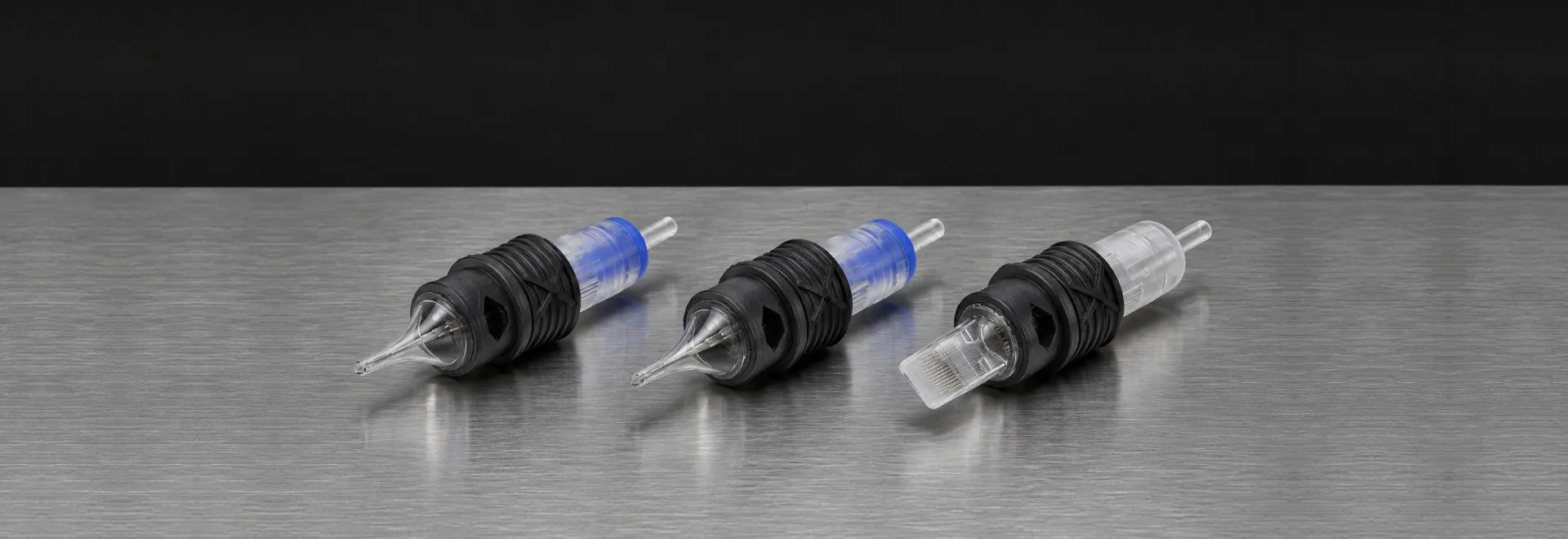
Tattoo line weight depends on three needle choices: pin count, individual pin diameter and taper, plus the artist's machine and technique. Fewer pins generally produce a finer footprint, while larger round-liner groupings cover more ground; at the same pin count, #8 (0.25 mm) and #10 (0.30 mm) needles tend to be finer than #12 (0.35 mm) needles. This practical fine-line vs bold-outline needle guide compares the Bishop, Kwadron and Nexus liners we carry and explains why a needle code is not a finished-line width.
Explore Bishop Liners Compare Kwadron Liners
QUICK ANSWER
Which tattoo needle makes a thin line, and which makes a bold outline?
Start with a smaller round-liner grouping and narrower pins for fine details; compare larger groupings and standard-diameter pins for bolder outlines. Peak and FK Irons explain why grouping, diameter and taper must be considered together. A 3RL, 5RL or 9RL describes pin count, not a guaranteed finished width.
PIN COUNT
3RL has fewer pins than 5RL or 9RL; generally less contact area and finer coverage.
PIN DIAMETER
#8 = 0.25 mm; #10 = 0.30 mm; #12 = 0.35 mm. These describe one pin, not line width.
TAPER + TECHNIQUE
Needle geometry, stretch, machine behavior and consistent movement refine the result.
THE RESULT, NOT JUST THE CODE
What determines tattoo line weight besides the needle size?
Line weight is the visual presence of the finished line. A needle label describes its construction, but the mark also reflects how the artist works. Peak identifies pin count, diameter, taper, grouping tightness, setup and technique as interacting factors. FK Irons additionally discusses resistance, stretch, working angle, hand movement and machine response.
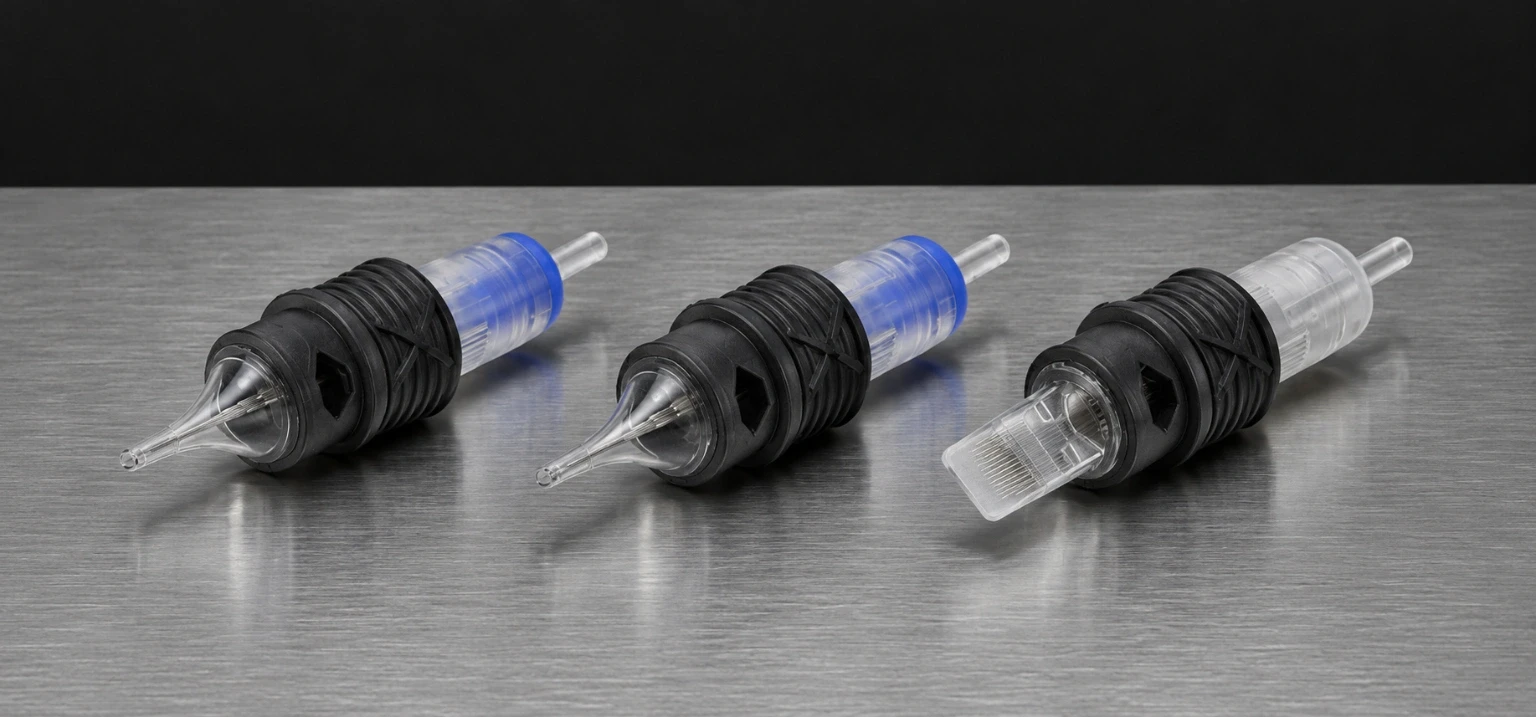
Round liners group pins tightly for outlines, script and detail.
Choose for desired contrast and controllable execution, not code alone.
What the numbers really tell you
The pin diameter printed on a needle package is a physical pin measurement. It is not the measured width of a healed tattoo line. For reading RL, RS and other codes in detail, use Tattoo Needle Guide.
LEVER 1 / PIN COUNT
Does a 3RL make a thinner line than a 5RL or a 9RL?
Generally, fewer round-liner pins give a smaller contact area and finer line potential. Peak explains that larger groupings cover more span. FK Irons contrasts a 3RL's smaller contact area with a 9RL that brings more pins into each pass and places greater demand on the machine.
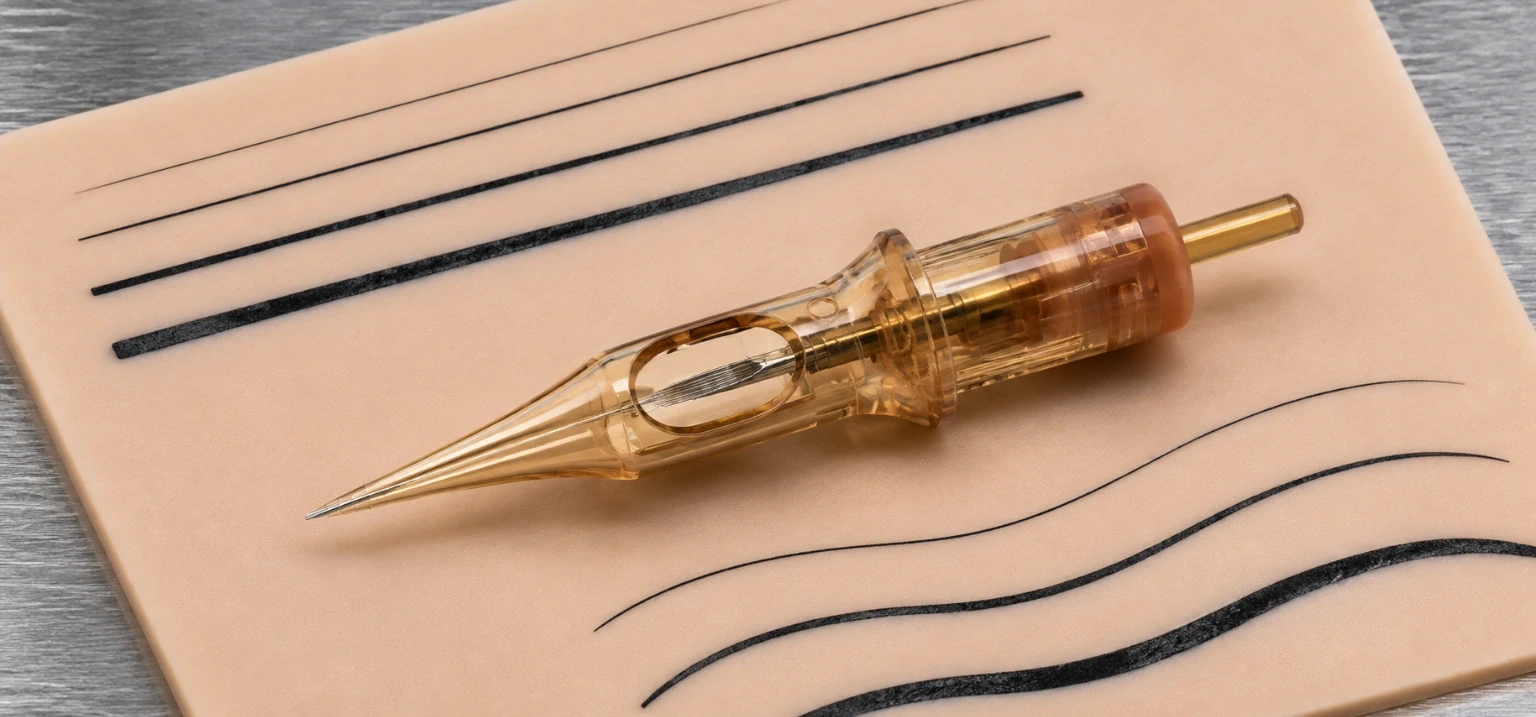
A 5RL sits between those counts, but its diameter and taper also shape the comparison.
FK Irons says fine groupings reveal shaky movement and inconsistent angles, while larger groups change resistance.
LEVER 2 / PIN DIAMETER
How do #8, #10 and #12 tattoo needle diameters change line weight?
Peak identifies #8 as 0.25 mm, #10 as 0.30 mm and #12 as 0.35 mm per pin. It describes #8 and #10 as bugpin diameters and #12 as a standard diameter. At the same pin count, smaller bugpins generally create a tighter footprint than #12 pins.
A 1007RL and a 1207RL both contain seven pins in different diameters, and Peak says bugpins will not put down exactly the same line weight as standard needles.
| Diameter label | Pin diameter | Peak's category | Practical line-weight question |
|---|---|---|---|
| #8 / 08 / 25 | 0.25 mm | Bugpin | Does a smaller footprint help keep a fine detail controlled? |
| #10 / 10 / 30 | 0.30 mm | Bugpin | Does a middle diameter give the desired balance at this count? |
| #12 / 12 / 35 | 0.35 mm | Standard | Does a larger pin diameter provide the outline weight needed? |
Kwadron's 25/30/35 labels identify diameter families. Verify the actual box code.
LINE WEIGHT COMPARISON TABLE
What RL grouping and diameter should you compare for fine lines, lettering and bold outlines?
Use a comparison chart to choose which needles to test, not to predict a finished line width. The examples combine Peak's grouping and diameter principles with configurations in our Bishop, Kwadron and Nexus liner ranges.
| Example RL | Pin diameter | Line-weight direction to test | Artist workflow fit |
|---|---|---|---|
| 1RL / #10 or #12 | 0.30 or 0.35 mm | Very small grouping; technique-sensitive | Isolated detail and controlled precision tests |
| 3RL / #8 | 0.25 mm | Smaller bugpin footprint | Delicate detail and very fine line studies |
| 3RL / #10 | 0.30 mm | Small grouping, wider pin than #8 | Fine outlines and script comparison |
| 3RL / #12 | 0.35 mm | Same count with a larger pin | Compare against 3RL bugpin at the same grouping |
| 5RL / #10 | 0.30 mm | More pins than 3RL | Script and small-to-medium outline trials |
| 5RL or 7RL / #12 | 0.35 mm | Larger standard-diameter footprint | Stronger outline and contour comparisons |
| 9RL / #10 or #12 | 0.30 or 0.35 mm | More coverage; compare two diameters | Bold-outline testing and machine-load comparison |
| 11RL or 14RL / #12 | 0.35 mm | Broader round-liner grouping | Heavier outline studies, based on design and control |
| 18RL / #10 or #12 | 0.30 or 0.35 mm | Large grouping within our Kwadron options | Compare broad outlines without assuming a fixed width |
These are test directions, not a guarantee that one example will outperform another. Use Best Tattoo Cartridges for Lining, Shading and Fine Line to compare the job-specific cartridge choices.
FINE OUTLINE VS BOLD OUTLINE
What is the practical difference between choosing tattoo needles for fine lines and bold lines?
Fine work seeks a smaller footprint; bold work seeks more visual span. Peak favors bugpins for detail and standard diameters for bold outlines; FK Irons notes that larger groupings also change resistance.
Fine detail and small script
Compare smaller round-liner counts with #8 or #10 pins. Peak warns that hand wobble becomes more visible as lines get thinner.
Intermediate contours
Compare 5RL or 7RL options in different diameters. Use the design's hierarchy rather than making every outline the same weight.
Bold traditional-style outlines
Compare larger standard-diameter round liners and assess the machine response. There is no one required pin count for traditional work.
Mixed line-weight designs
Keep fine accents and primary outlines distinct. Test combinations rather than switching needle size solely to compensate for unstable technique.
For a focused fine-line workflow, see Fine-Line Tattoo Needles and Settings. For bold-style context, see American Traditional Tattoo Needles and Ink and Lettering and Script Tattoo Needles.
LEVER 3 / TAPER
Does long taper or shorter taper make a tattoo line thicker?
Taper is the geometry of the needle tip, not another name for gauge or grouping. Peak documents varied taper lengths; FK Irons compares how different 9RL builds feel.
Compare count, diameter, taper and tightness together. A long-taper bugpin 9RL differs from a thicker, shorter-taper 9RL.
Read the actual product code. Bishop and Kwadron catalog descriptions include RLLT configurations; some smaller Nexus liner variants are marked XL. Do not treat XL and LT as equivalent specifications without checking the corresponding variant.
For a deeper treatment of tip geometry, see Long Taper vs Short Taper Tattoo Needles.
ALTERNATIVE LINER CONFIGURATION
What are hollow liner needles, and where do they fit in bold-line comparisons?
Hollow liners are another liner configuration to compare when planning heavier outlines. Peak identifies hollow liners among its specialist configurations; our Bishop and Nexus hollow-liner families give working artists additional options beyond standard round liners.
We carry Bishop Da Vinci V2 Hollow Liners in 1207, 1208 and 1210 HRLLT, and Nexus Hollow Liners in 1207, 1209 and 1211 HRLLT. These codes are product configurations, not claims about finished width, saturation or the amount of work needed.
Compare a hollow liner against a familiar standard RL without assuming it is automatically wider or darker.
COMPARE OUR PROFESSIONAL LINER RANGES
How do Bishop, Kwadron and Nexus liner choices differ for fine and bold work?
Each brand offers a different range of counts, diameter labels and configurations. Use the product variant, not the brand name alone, to match a planned line weight.
| SVT Shop liner family | Catalog range | Why compare it? | Detail to verify |
|---|---|---|---|
| Bishop Da Vinci V2 Liners | #4 to #12, selections from 0403 to 1214 RLLT | Compare small and large groupings across diameter families | Exact two-part code and included pin count |
| Kwadron Cartridges Liners | 25 / 30 / 35 diameter families; 1 to 18 pins across variants | Compare pin count or diameter while holding the other variable | 25/3, 30/7, 35/9 and other printed variants |
| Nexus Cartridges Liners | #4 to #12, variants from 0403 to 1214 | Compare fine through broader groupings | 0403–0807 listed as XL; verify actual taper per SKU |
| Bishop and Nexus Hollow Liners | Bishop 1207/1208/1210; Nexus 1207/1209/1211 | Alternative configurations in an outline comparison | Hollow-liner code instead of ordinary RL |
| Kwadron Liner Bar Needles | 35/3 through 35/11 RLLT | For workflows built around traditional bar needles | Bar needle, not a cartridge |
For more brand detail, see Kwadron vs Bishop vs Nexus Cartridges; for cartridge-selection basics, see How to Choose Tattoo Cartridges.
MACHINE AND HAND CONTROL
Why can two needles with the same count produce different line weights or shaky lines?
Even two 9RL cartridges can feel different under load. FK Irons identifies needle diameter, taper, grouping tightness and membrane tension as factors; the artist's stretch, depth, angle and hand speed also affect consistency.
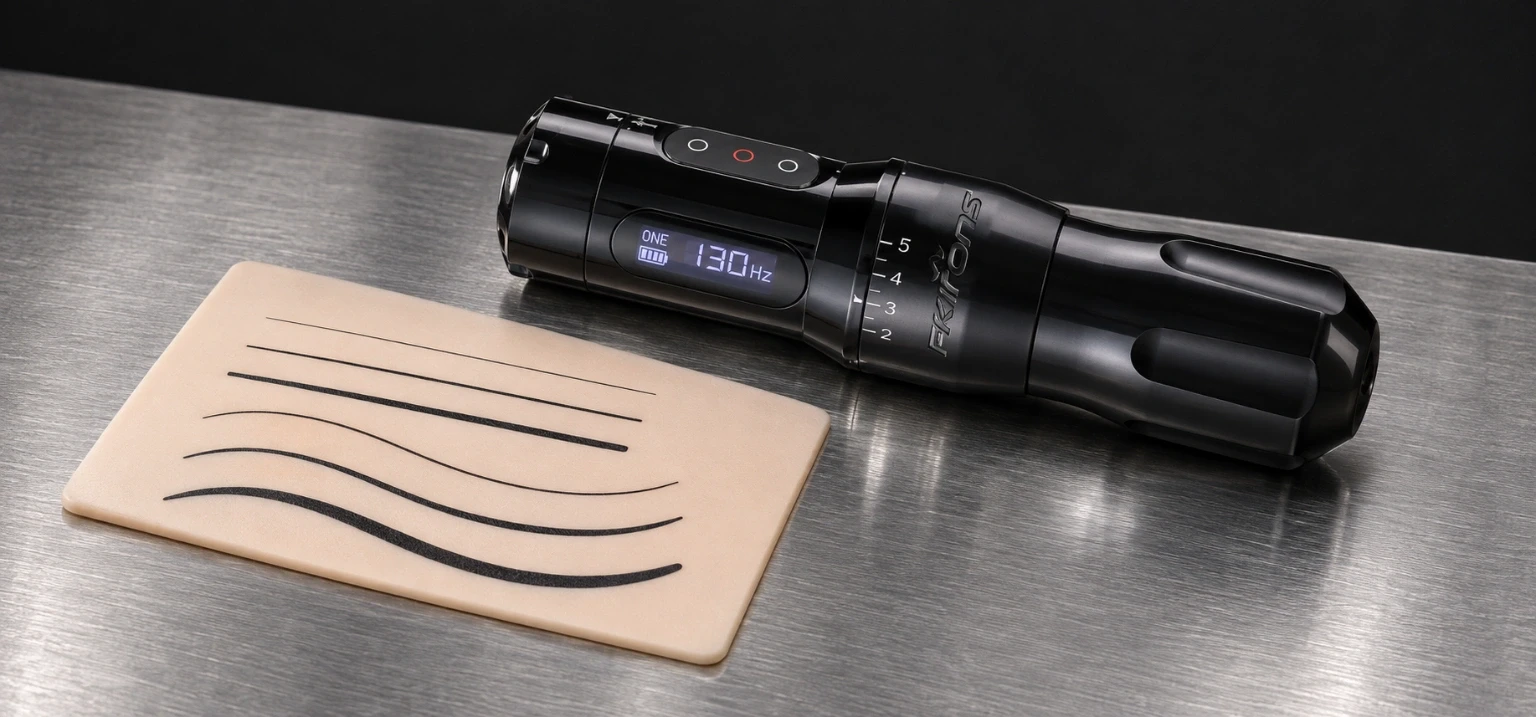
Peak says finer bugpin work exposes tremors; a larger grouping is not an automatic solution.
Confirm the grouping
Read the pin count, diameter and taper rather than relying only on the RL name.
Compare the machine response
FK Irons explains that larger groups increase resistance and change how a setup feels under load.
Review consistent technique
Compare stretch, working angle, depth and hand movement without chasing an arbitrary setting.
Change one variable at a time
Use controlled tests to identify whether grouping, diameter or technique is responsible for the difference.
For machine setup, see Tattoo Machine Stroke, Needle Depth and Voltage.
PRACTICE-SKIN COMPARISON
How can an apprentice compare line weights before choosing a tattoo liner?
Practice skin makes side-by-side comparisons easier to organize. Draw the same simple line and curve with known liner sizes, then change one characteristic at a time. The purpose is to understand your hand and tool combination, not to generate a universal millimeter conversion.
Start with one familiar setup
Keep the machine and movement approach consistent for the first comparison.
Compare grouping at fixed diameter
Test 3RL, 5RL and 9RL in one diameter family to see how the contact area changes.
Compare diameter at fixed count
Test #10 and #12 variants of the same grouping, and #8 where offered.
Compare taper or hollow configurations separately
Mark the product code so any difference is linked to the right needle.
Choose based on the design
Evaluate fine details, outline presence, smoothness and control rather than copying someone else's code.
See Tattoo Practice Supplies for practice-material selection.
DESIGN LEGIBILITY
Do fine tattoo lines change as they age, and how should line weight be planned?
Peak advises leaving enough room around small details for continued clarity as a tattoo ages. A very fine liner is not automatically the best choice for every element of a design.
For more on fine-line legibility, see Fine-Line Tattoo Needles and Settings.
COMMON LINE-WEIGHT ERRORS
What mistakes make tattoo lines too thin, too bold or inconsistent?
Common errors begin with the count alone or a mismatched setup.
Treating 3RL as a fixed-width line
The code describes three pins, not a finished line measurement.
Ignoring #8 vs #12 diameter
Equal counts with different pin thicknesses can produce different footprints.
Calling bugpin a separate grouping
Bugpin describes individual pin diameter, not the RL arrangement.
Using a larger RL to hide shaky movement
Peak says standard diameters can forgive tremors better, but technique still matters.
Assuming every 9RL runs alike
FK Irons points to taper, diameter and grouping tightness.
Turning a liner code into millimeters of line width
Pin diameter is not the tattoo's final line width.
Confusing XL and LT on a Nexus box
Confirm taper for the exact variant instead of guessing.
Assuming hollow automatically means wider or darker
Compare the actual hollow configuration and its result.
Ordering Kwadron bar needles as cartridges
Bar needles and cartridges are different product formats.
LINERS WE CARRY
Which Bishop, Kwadron and Nexus tattoo liners can you buy at SVT Shop?
We carry round-liner cartridges, hollow liners and Kwadron bar needles across multiple pin counts and diameters. Use the exact size code when ordering for a planned fine, medium or bold outline.
 CARTRIDGE / WIDE LINER RANGE
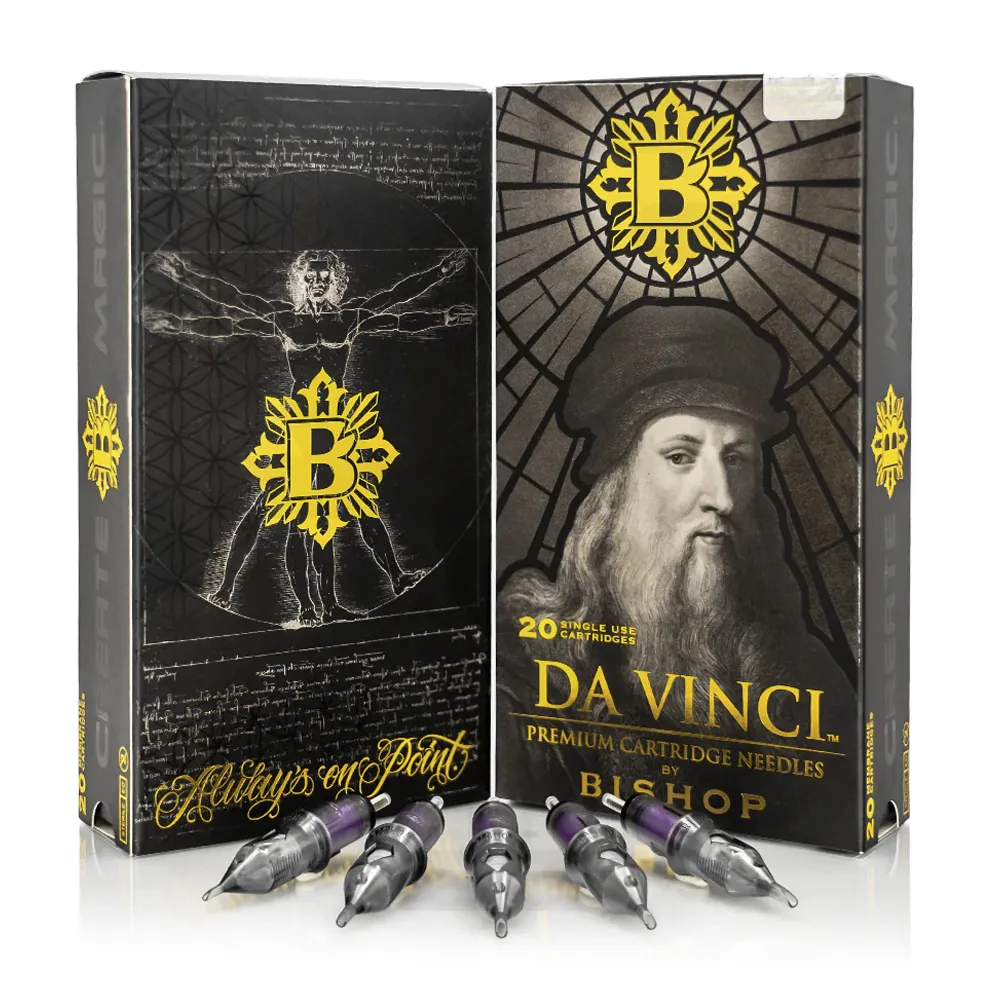
Bishop - Da Vinci V2 Liners
RLLT options spanning #4 through #12 diameter labels, with variants from 0403 to 1214. Compare pin count and diameter for different line-weight goals.
 CARTRIDGE / 25-30-35 DIAMETER FAMILIES
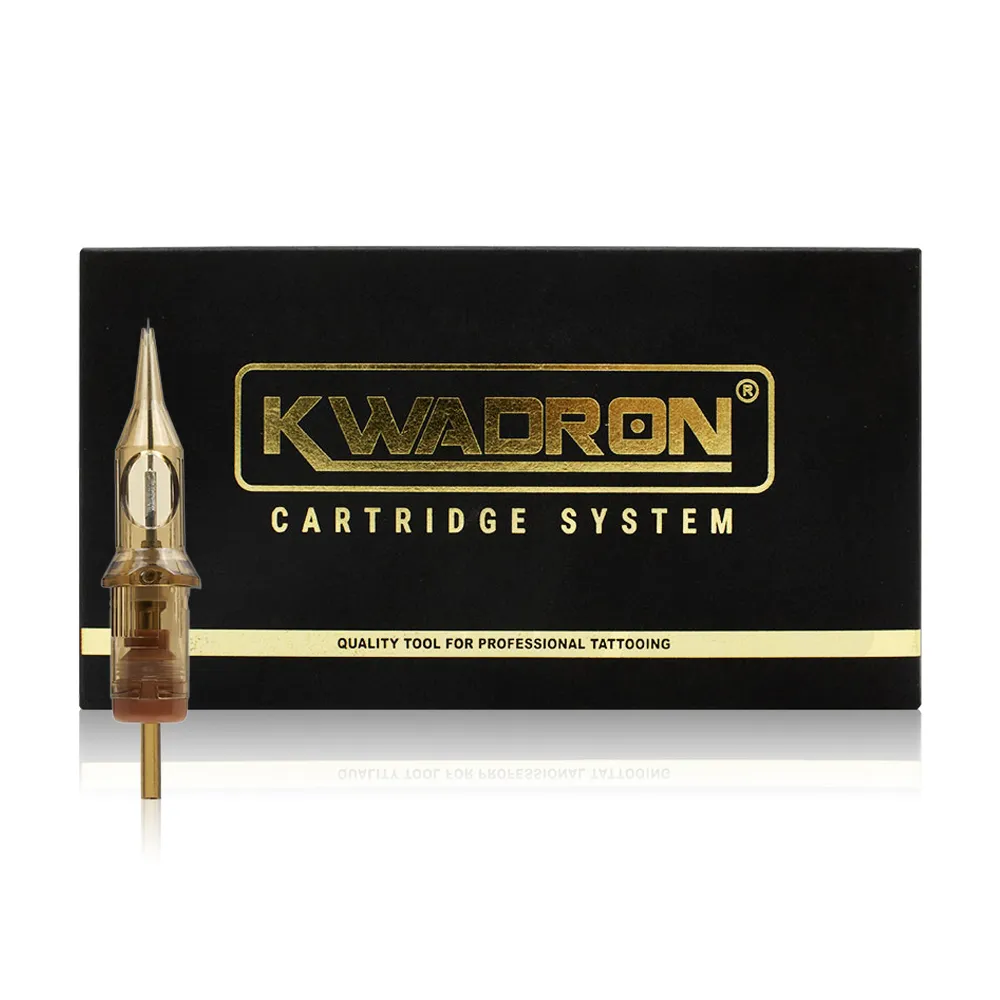
Kwadron - Cartridges Liners
25, 30 and 35 diameter labels with counts from 1 to 18 across variants. Useful for comparing groupings while tracking diameter separately.
 CARTRIDGE / FINE TO LARGE GROUPINGS
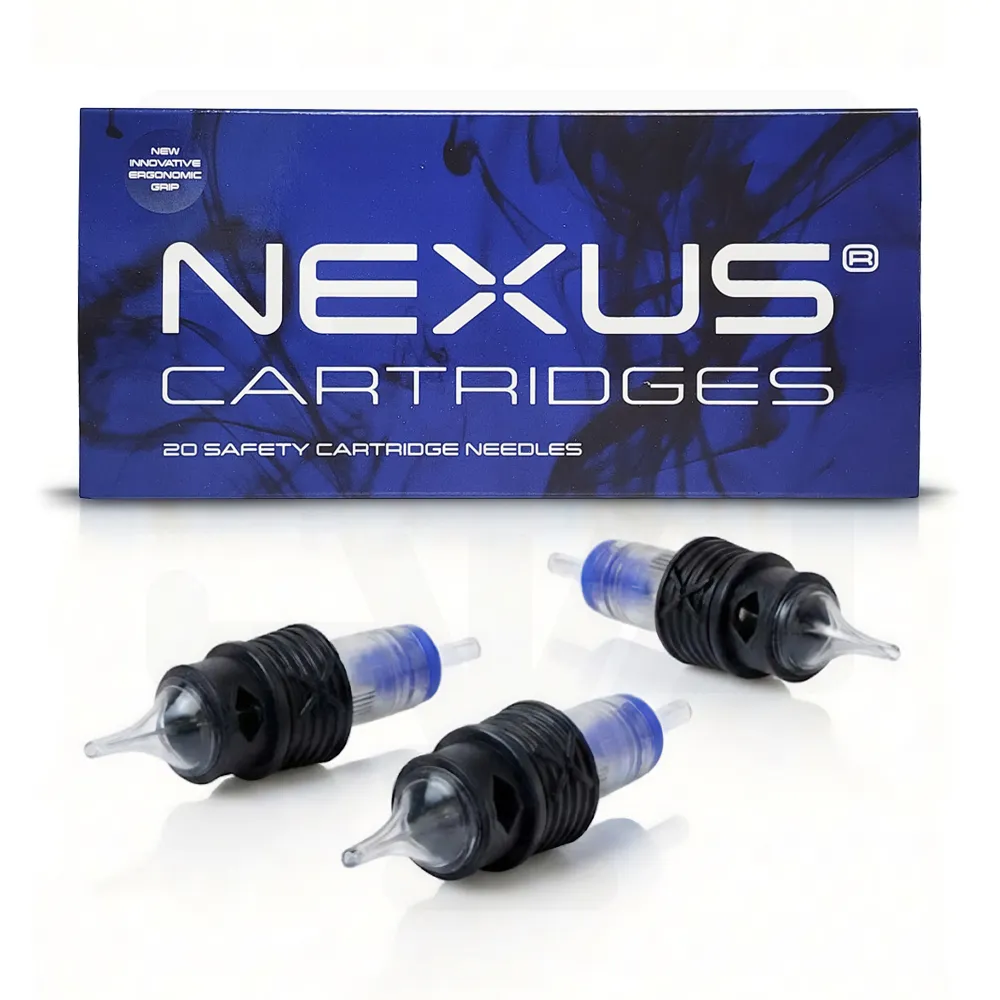
Nexus Cartridges - Liners
Catalog sizes from 0403 to 1214. Small-diameter 0403–0807 variants are labeled XL; confirm the exact taper before purchasing.
 CARTRIDGE / HOLLOW LINER
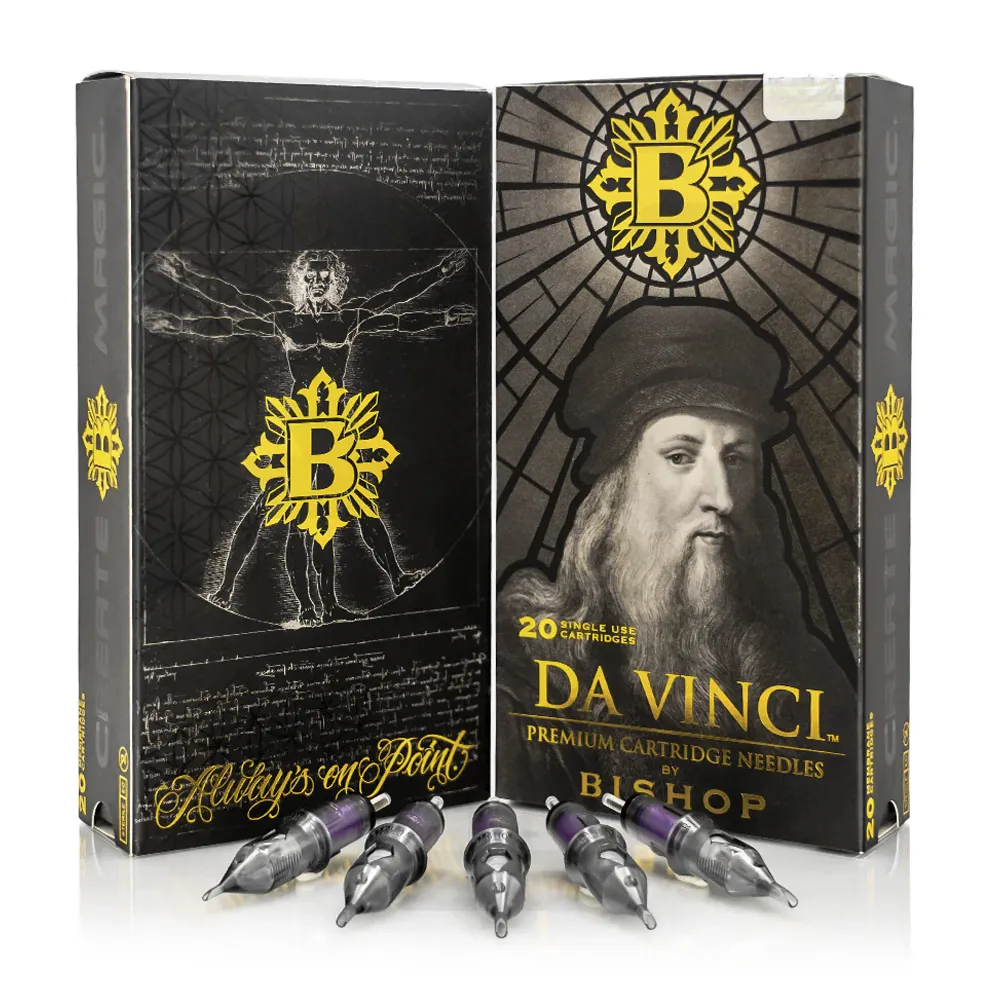
Bishop - Da Vinci V2 Hollow Liners
1207, 1208 and 1210 HRLLT hollow configurations to compare with standard RLs for larger outline work.
 CARTRIDGE / HOLLOW LINER
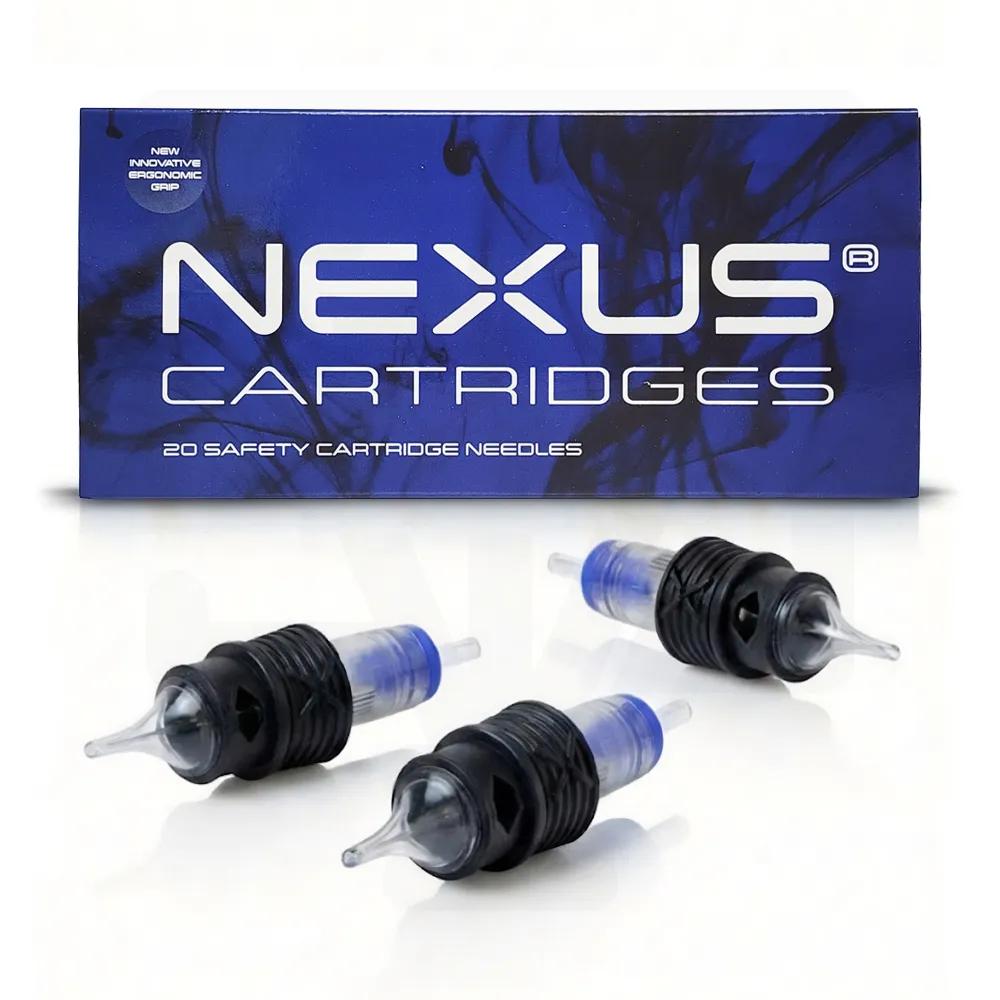
Nexus Cartridges - Hollow Liners
1207, 1209 and 1211 HRLLT options for artists testing hollow versus standard liner configurations.
 CARTRIDGE / LINER ASSORTMENT
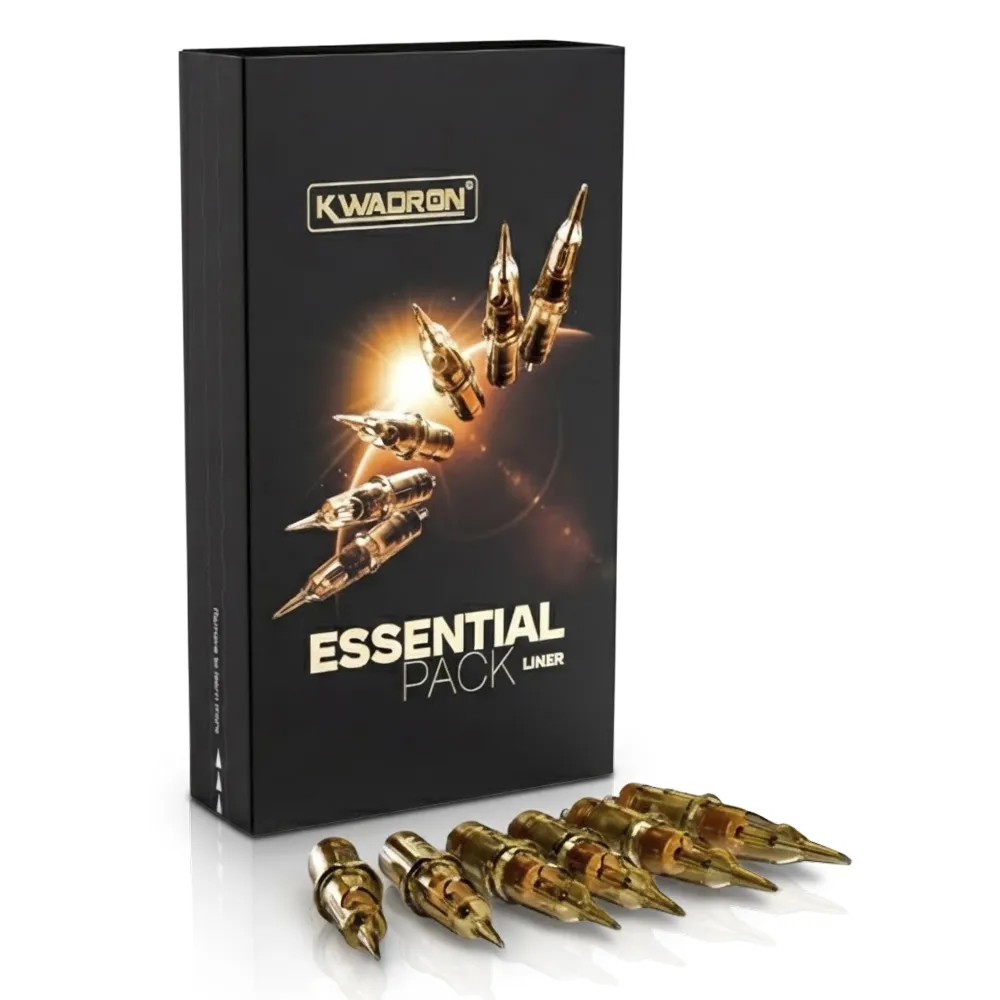
Kwadron - Cartridges Essential Pack Liner
A liner assortment for comparing options in a professional cartridge workflow; check the individual size labels before each test.
 BAR NEEDLES / NOT CARTRIDGES
Kwadron - Bar Needles Liners
35/3, 35/5, 35/7, 35/9 and 35/11 RLLT bar needles for setups using conventional needle bars.
Explore Bishop V2 Liners Explore Kwadron Liners Explore Nexus Liners
STUDIO LINER BUYING CHECKLIST
What should an artist verify before ordering a fine-line or bold-outline liner?
Choose the visual weight, then verify count, diameter, taper and format.
- Design goal: Delicate detail, readable script, intermediate contour or bold outline?
- Grouping: 1RL, 3RL, 5RL, 7RL, 9RL or a larger count?
- Diameter: #8 / 0.25 mm, #10 / 0.30 mm or #12 / 0.35 mm?
- Taper: Does the exact SKU say LT, XL or another construction?
- Configuration: Standard round liner or a hollow liner comparison?
- Product format: Cartridge or traditional bar needle?
- Machine response: Is the grouping working consistently with the selected setup and technique?
- Practice result: Have you compared the line on practice skin with known variants?
- Clarity: Does the design leave enough space around fine details?
- Reorder: Full brand and needle code checked on the box?
FAQ
Frequently asked questions about tattoo line weight, needle count and diameter
The label is a starting point, not a finished-line measurement.
What determines tattoo line weight?
Pin count, pin diameter, taper and grouping tightness combine with stretch, machine behavior and technique, according to Peak and FK Irons.
Does a 3RL make a thinner line than a 5RL or 9RL?
Generally, fewer pins make a smaller footprint. Hold diameter and technique constant when comparing; an RL count does not fix the final width.
What is the difference between #8, #10 and #12 tattoo liners?
Peak lists #8 at 0.25 mm, #10 at 0.30 mm and #12 at 0.35 mm per pin. A thinner pin typically makes a tighter footprint at the same count.
What tattoo needle should I compare for thick, bold lines?
Compare larger RL groupings and #12 standard-diameter options. Match the result to your technique instead of treating one count as mandatory.
What tattoo needle should I compare for thin lines?
Compare smaller round liners with #8 or #10 bugpin diameters, then evaluate control and spacing. See our dedicated fine-line guide.
Does a long taper or a medium taper make thicker lines?
Taper changes tip geometry and how a grouping feels. FK Irons says different tapers and diameters make even two 9RLs behave differently; no universal width follows.
What is a bugpin liner, and does it make thinner lines?
Bugpin describes smaller pin diameter, typically #8 or #10 in Peak's explanation, rather than a different grouping. It generally produces a tighter footprint at equal count.
Is there an official tattoo line weight chart in millimeters?
We found none: maker guides give pin diameters and grouping comparisons, not a finished-line width for each RL code.
Why do my tattoo lines look uneven or shaky?
Peak says thin lines expose wobble; FK Irons points to stretch, angle and technique as well as grouping and machine response. Review one variable at a time.
Do tattoo lines change in appearance over time?
Peak recommends giving small details enough room to remain readable as tattoos age. See our fine-line guide for the wider discussion.
What are hollow liner needles used for?
They are an alternative liner grouping to compare for outline work. We carry Bishop and Nexus hollow variants; judge their results against regular RLs.
How many pins should a bold traditional tattoo outline use?
There is no single manufacturer-required count. Compare larger grouping and standard-diameter choices based on the design and the artist's setup.
MANUFACTURER EDUCATION
Sources Consulted
Peak Needles and FK Irons explain grouping, pin diameter, taper and machine response. Product size ranges and names come from the SVT Shop catalog.