Powered by Comercia.io
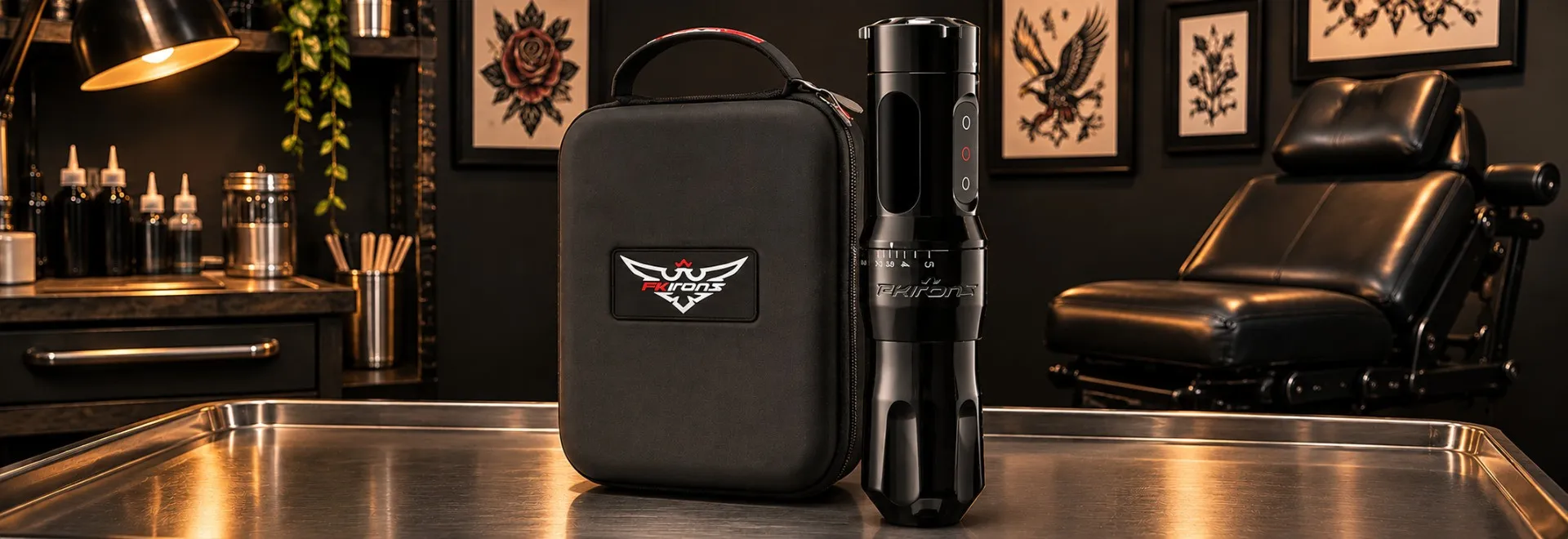
Tattoo machine stroke vs needle depth vs voltage is a comparison of three different controls: how far the needle travels in a cycle, how far the tip protrudes from the cartridge, and how fast the motor runs. Confusing stroke length, needle hang, and voltage can cause skipped lines, weak saturation, or unnecessary skin trauma. Here is how FK Irons and Kwadron explain each setting, how they interact, and how to test them on practice skin before working with a client.
Shop Tattoo Machines Shop Practice Supplies
QUICK ANSWER
What is the difference between tattoo machine stroke, needle depth, and voltage?
Stroke length is the machine's needle travel per cycle; needle hang (protrusion) is how far the needle extends beyond the cartridge or tube tip; and voltage affects motor speed and how frequently the needle cycles. Actual depth in the skin depends on the setup and the artist's technique.
STROKE
Distance traveled in one cycle. Determined by the cam or machine's stroke mechanism. Longer usually hits harder; shorter generally feels lighter.
NEEDLE HANG
Visible needle protrusion beyond the cartridge tip. Usually adjusted at the grip or collar; check that the needle retracts enough to reload.
VOLTAGE
Electrical input that changes motor speed. Match its resulting cycle rate to your hand speed and the machine's approved range.
THE CORE DISTINCTION
3 settings, 3 jobs: what changes when you turn each control?
Before discussing lining voltage or shading stroke, separate the machine's motion from the exposed needle and from the actual puncture into skin. FK Irons distinguishes stroke from needle extension, and Kwadron lists stroke, protrusion, and voltage as separate machine specifications.
| Setting | What it is | What adjusts it | What it changes | What it does NOT change |
|---|---|---|---|---|
| Stroke / throw | Mechanical travel of the needle during one cycle, measured in mm. | Cam, stroke wheel, armature arrangement, or adjustable-stroke mechanism. | Available travel, retraction, momentum, and the feel of the hit. | Does not set visible cartridge protrusion or directly select the speed displayed in volts. |
| Needle hang / protrusion | How far the tip comes past the end of a tube or cartridge. | Grip, collar, depth dial, or tube position depending on the machine. | Exposure, tip visibility, and the relationship between extension and retraction. | Does not alter the stroke mechanism or establish the exact depth reached in skin. |
| Voltage | Electrical input to the motor, shown in V. | Power supply, wireless battery interface, or machine control. | Motor behavior and generally needle cycling speed, influencing the felt hit. | Does not directly control needle depth in skin, visible hang, or mechanical stroke length. |
The simple memory rule: Stroke determines the travel available, hang positions the exposed tip, and voltage changes the pace. Hand speed and technique influence how those settings perform together.
MECHANICAL TRAVEL
What does tattoo machine stroke length mean?
FK Irons defines stroke length, sometimes called throw, as the distance the needle travels between its upper and lower positions during one complete cycle. On rotary and pen machines, the cam mechanism creates that motion; on coil machines, the armature arrangement determines travel.
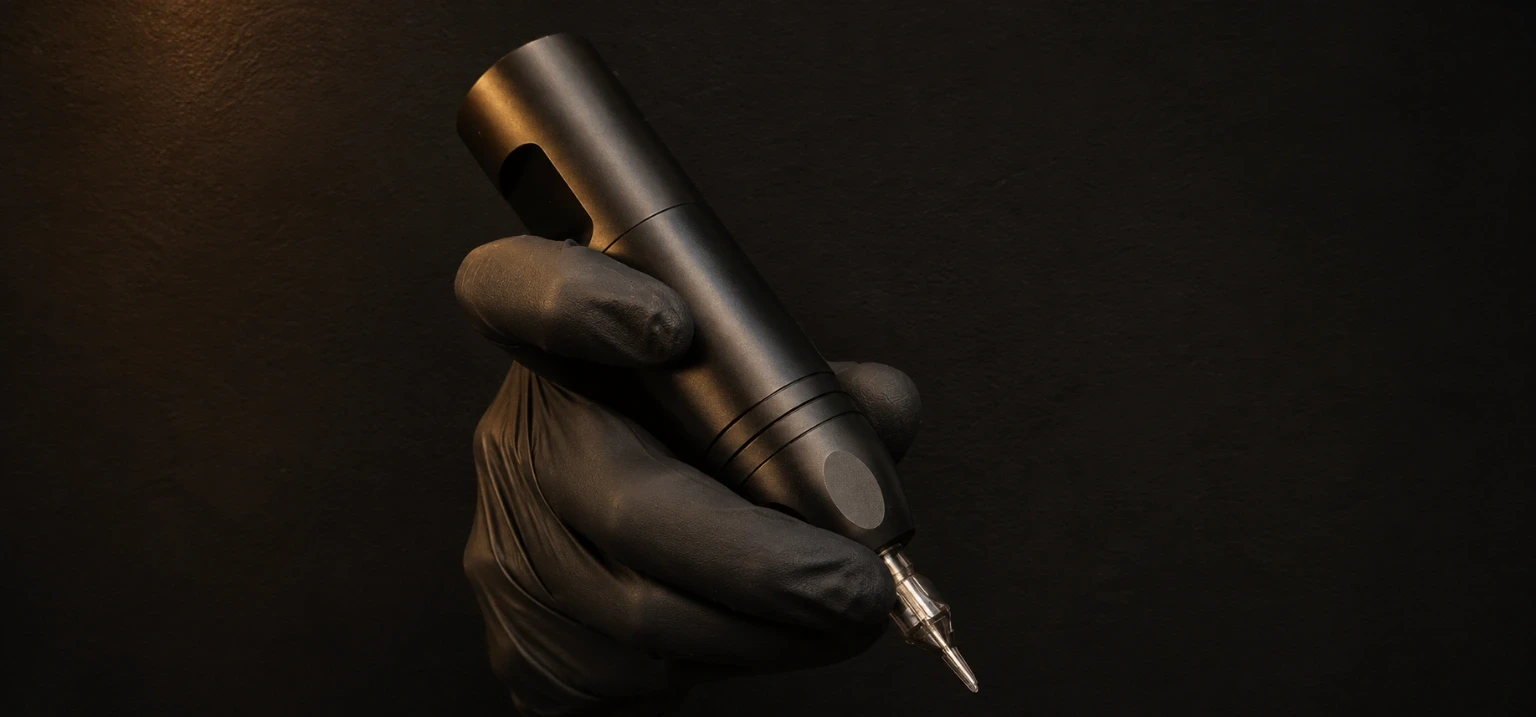
Short stroke: soft and controlled
FK's stroke-length guide calls 2.0–2.5 mm short, while its machine-settings article calls 2.5–3.0 mm short. Both associate shorter travel with lighter hits, soft shading, and fine detail.
Medium stroke: versatile
FK describes 3.0–3.5 mm as medium in its stroke-length guide and emphasizes 3.5 mm as the all-round choice in its settings guide.
Long stroke: momentum and harder hit
FK uses 4.0 mm and above for long stroke. The longer swing produces greater momentum and a harder hit, making it useful for bold single-pass lines and solid color packing.
The slightly different short and medium boundaries come from two separate FK Irons educational articles, not two incompatible mechanical definitions.
MACHINE DESIGN
Fixed stroke vs adjustable stroke: do you need another machine?
A fixed-stroke pen retains the same mechanical travel until its cam or applicable component is changed. FK Irons explains that adjustable-stroke machines can change travel without tools or disassembly.
FK Irons One Adjust
FK lists adjustable stroke from 2.0 to 5.0 mm in 0.5 mm increments. The manufacturer says it can be adjusted without shutting the machine down.
Kwadron Equaliser Pentagram
Kwadron lists 2.0–4.2 mm stroke, a separate 0–5 mm needle protrusion adjustment, and a 4.0–12.0 V operating range. Stroke can be changed without powering down.
Fixed-stroke or task-focused machine
A fixed option can suit an artist who already knows the desired hit or prefers a consistent tool for one technique. FK describes cam swaps as one way to change stroke on compatible fixed machines.
An adjustable-stroke pen is especially useful when one artist frequently moves between fine details, whip shading, strong lines, and packing. Beginners can use that flexibility to compare strokes while keeping other variables consistent.
See pen machines vs coil machines and our wireless tattoo pen comparison for help evaluating machine formats.
CARTRIDGE POSITION
How far should the needle stick out of a tattoo cartridge?
Needle hang (protrusion) means the exposed tip beyond the cartridge. FK's Xion manual also calls that grip adjustment needle depth; Kwadron calls it needle protrusion. Here, depth in the skin means actual tissue penetration, not the grip setting.
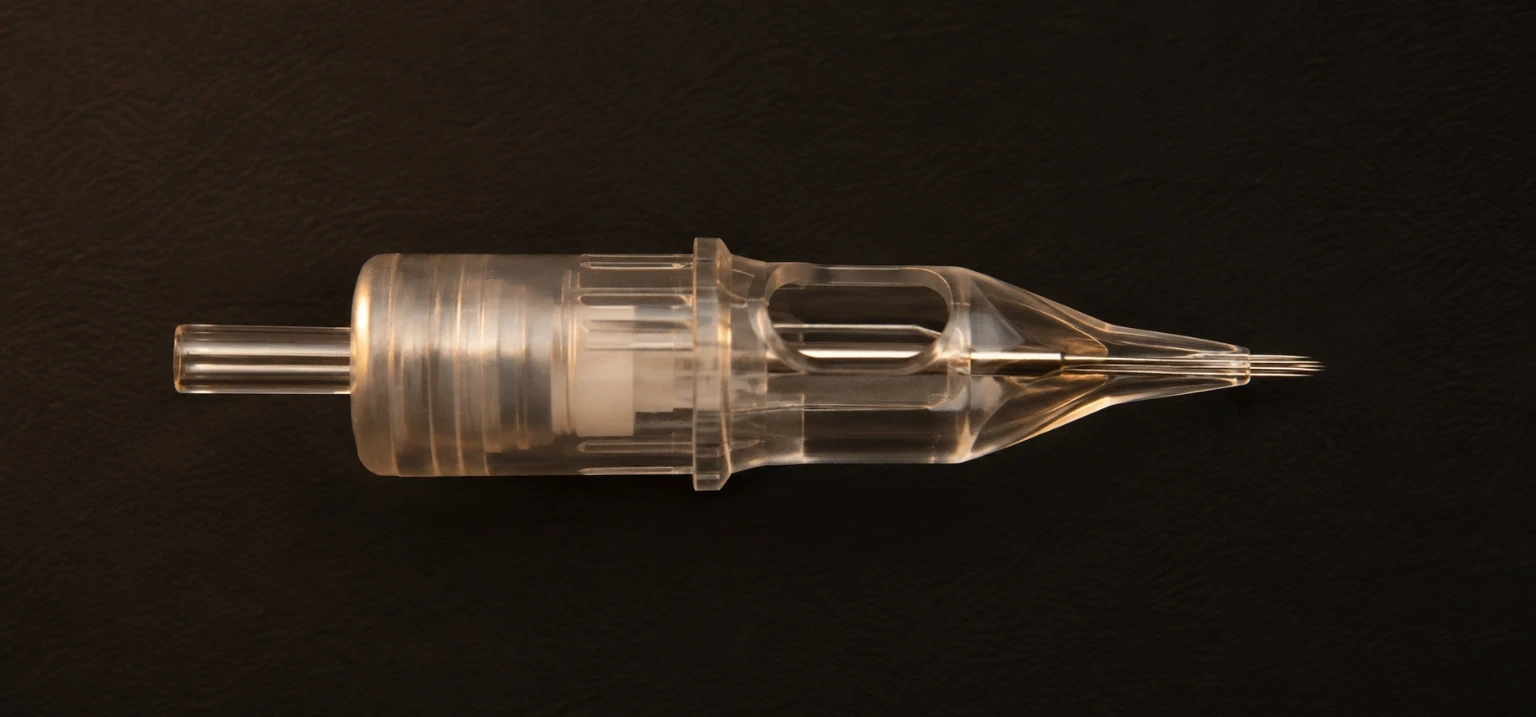
Install the appropriate cartridge
Check your machine and cartridge's instructions, including grouping compatibility.
Locate the grip or depth collar
FK says most rotary and pen machines adjust protrusion with a dial or collar near the grip.
Follow your model's directions
The FK Spektra Xion manual says turning its grip clockwise increases hang and counterclockwise decreases it; each click changes needle position by 0.2 mm.
Begin with modest exposure
FK's needle-depth article advises starting with less extension than expected and testing on practice skin. Keep a clear view of the needle tip.
Check retraction and ink pickup
FK warns that too much hang on a short stroke prevents adequate retraction into the cartridge for ink pickup.
There is no single cartridge protrusion that belongs to every liner, magnum, machine, and placement. FK says harder-hitting machines may call for less exposed needle, while softer setups may call for a little more.
Stroke must accommodate hang
FK's stroke-length guide explains that a short travel paired with excessive hang may fail to pull the needles back far enough to reload ink. This can cause weak or patchy results.
THE SKIN IS NOT A DIAL
How deep should a tattoo needle go into the skin?
FK Irons says pigment should reach the dermis, with many tattoos deposited approximately 1–2 mm into skin. That describes tissue placement, not the cartridge hang or a fixed target for every anatomy.
| FK general technique starting point | What FK discusses | How to interpret it |
|---|---|---|
| Lining: about 1.5 mm | A controlled, shallower technique-related depth setup. | Use it as FK's general starting point, not an exact hang measurement or a fixed penetration target. |
| Shading: about 2 mm | A setup that supports smooth pigment distribution. | Evaluate stroke, hang, machine feel, and technique together. |
| Color packing: about 2–2.5 mm | A setup directed at consistent saturation. | Do not substitute this figure for measuring visible needle protrusion or actual penetration. |
FK recommends shallower handling on thinner or bony areas such as ribs, hands, and feet. Excessive depth can cause heavy bleeding, scarring, and blowouts.
A longer hang is not a deeper tattooing target
Needle hang is an equipment adjustment; actual tissue penetration is an artistic and anatomical outcome. Develop depth control on synthetic skin and through qualified supervision.
MOTOR SPEED AND CONTROL
What voltage should I use for lining, shading, or color packing?
Voltage changes motor speed, not mechanical stroke or preset tissue depth. FK reports broad rotary ranges of 8–10.5 V for lining, 6–8.5 V for shading, and 7–9.5 V for packing. Always follow the exact machine's operating limit.
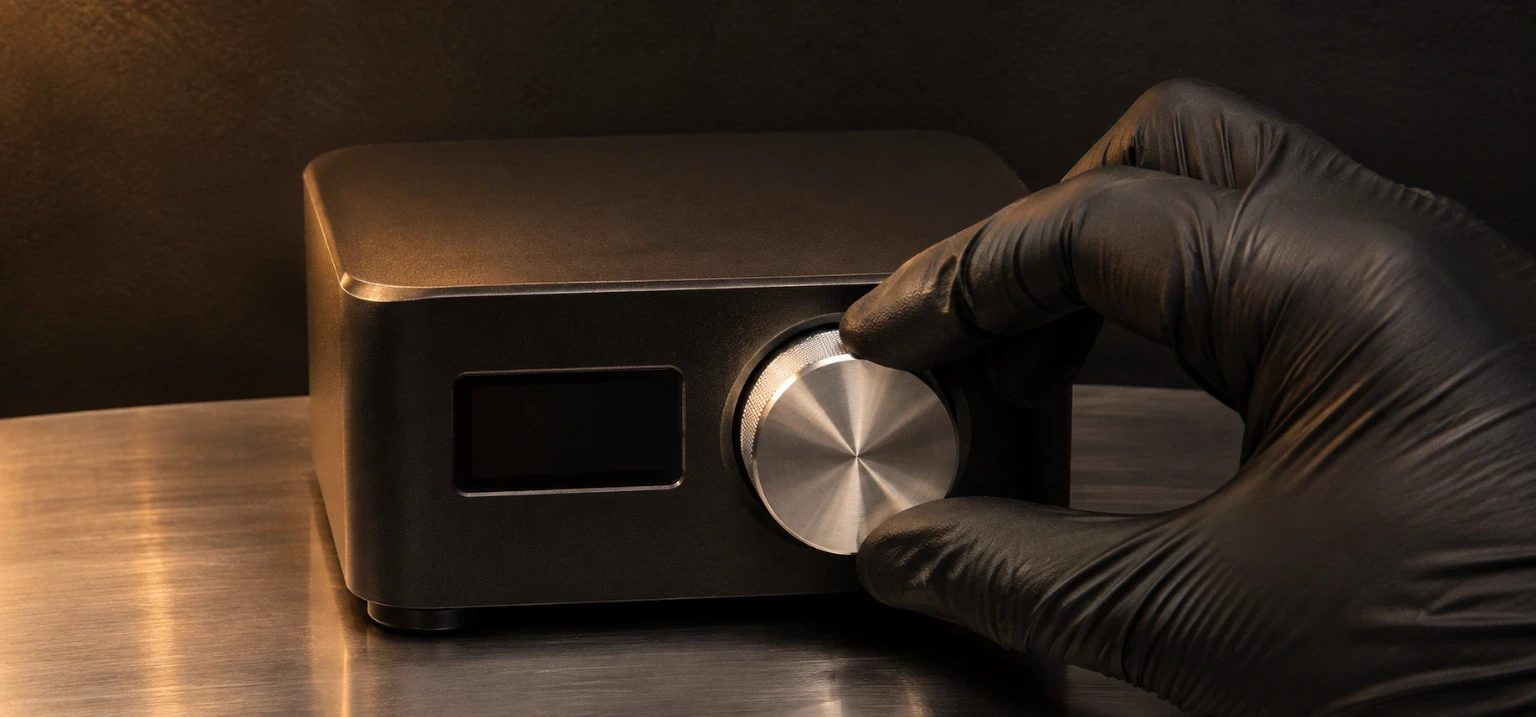
| FK voltage baseline | Suggested exploration range | What to pay attention to |
|---|---|---|
| Fine line and detail | 7–8.5 V | Maintain control and an even path rather than chasing the highest speed. |
| Black-and-gray shading | 6.5–8 V | Balance smooth layering with hand speed and needle grouping. |
| Color packing | 7.5–9.5 V | Check whether coverage is efficient without unnecessary repeated passes. |
| Bold lining and large groupings | 8–10.5 V | Compare solid lines against hand speed and machine-specific operating limits. |
FK recommends making voltage adjustments in 0.2–0.5 V steps. Low voltage combined with fast hand movement may produce dashed lines; high voltage with a slow hand can overwork the skin.
Voltage is not a saturation repair button. FK advises reviewing needle grouping, hand pressure, skin stretch, and pass strategy when ink is not packing evenly.
Check the exact machine's operating range
The FK Spektra Xion manual reports operation tested from approximately 4 to 9.5 V and advises against exceeding 9.5 V. Kwadron lists the Equaliser Pentagram at 4.0–12.0 V. General technique ranges do not override the machine manual.
For power controls, read SVT Shop's tattoo power supply guide.
READING THE DISPLAY
Hertz vs volts: is voltage the same as needle speed?
FK Irons distinguishes volts (V), the motor's electrical input, from hertz (Hz), the number of full needle cycles completed each second.
Two pens at the same 8 V may cycle at different Hz because FK says motor design, stroke, and give affect the resulting speed. Voltage is input; Hz is cycles per second.
THE FOURTH VARIABLE
What is give in a tattoo machine?
FK Irons defines give as the machine's response when the needle meets resistance. It is a cushioning effect that can soften the feel of an otherwise rigid rotary setup.
Low or off for linework
FK associates lower give with a firmer hit for controlled, confident single-pass lines.
Medium for packing
FK's give guide suggests a balance of momentum and cushioning for color packing. If give is excessive, the needle may lack the momentum to deposit ink consistently.
High for soft shading
FK associates higher give with a gentler, more forgiving impact for gradual layering. It also warns that rigid zero-give contact on thin skin raises blowout risk.
Give does not replace a thoughtful stroke choice. It changes how the machine responds to resistance, so evaluate it alongside stroke, hang, voltage, and hand pressure.
TECHNIQUE REFERENCE
Best stroke, give, and voltage starting points by tattoo technique
These figures combine FK Irons' machine-settings, voltage, and give guides. They are starting points for practice, not universal settings for every tattoo pen.
| Technique | FK stroke suggestion | Give approach | FK voltage reference | What to test |
|---|---|---|---|---|
| Lining | 3.5–4.2 mm | Low or off for a firmer hit. | 8–10.5 V broad lining range. | One continuous line, stable depth, and hand speed that matches the cycling rate. |
| Whip shading | 3.5–4.0 mm | Fine-tune response for the intended peppered texture. | 6–8.5 V broad shading range. | Consistent whip marks and movement without repeatedly working the area. |
| Soft shading | 2.5–3.0 mm | Higher give for a softer hit. | 6.5–8 V black-and-gray baseline. | Even, gradual tonal changes with controlled passes. |
| Color packing | 4.0 mm+ | Medium give to balance hit and cushion. | 7.5–9.5 V packing baseline. | Even coverage, grouping fit, and efficient saturation without excess passes. |
FK's broader voltage table also describes shading at 6–8.5 V and packing at 7–9.5 V. Its separate baselines narrow these ranges for common styles.
For grouping choices that affect these settings, see how to choose tattoo cartridges and our tattoo needle guide.
PUTTING THE CONTROLS TOGETHER
How do stroke, needle hang, voltage, and hand speed work together?
A productive adjustment starts by identifying which variable is responsible for the result. FK explains that stroke affects travel and hit, hang affects tip exposure, and voltage affects cycling speed.
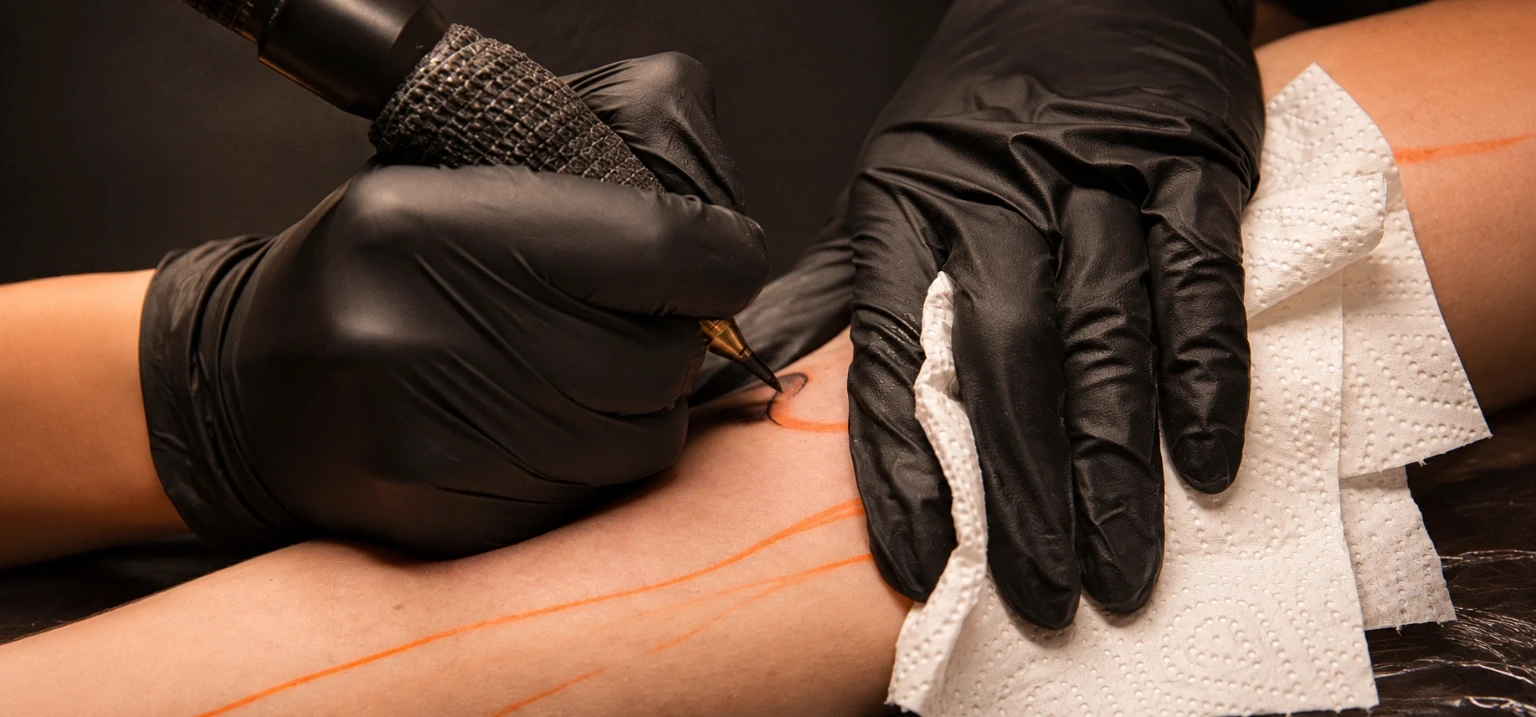
Choose stroke and match hang
Select stroke for the task, then position the tip so it stays visible and retracts enough to reload ink.
Match voltage to hand speed
Begin within the machine's approved voltage range and compare needle cycles with how quickly you move your hand.
Read the practice-skin result
Dashed marks suggest a speed mismatch; patchy ink pickup can point to too much hang for the stroke; excessive repeated contact suggests reconsidering speed, pressure, and passes.
Example: A 3.5 mm stroke with excessive hang can produce weak ink pickup even when you raise voltage. A suitable hang and stroke can still produce dashed lines when your hand moves too quickly for the cycling rate.
PRACTICE BEFORE CLIENT WORK
How to test stroke and voltage on tattoo practice skin
FK Irons recommends testing throw and hit on synthetic skin. Its machine-settings guide describes comparing five lines at 7 V with five lines at 9 V while keeping hand speed consistent.
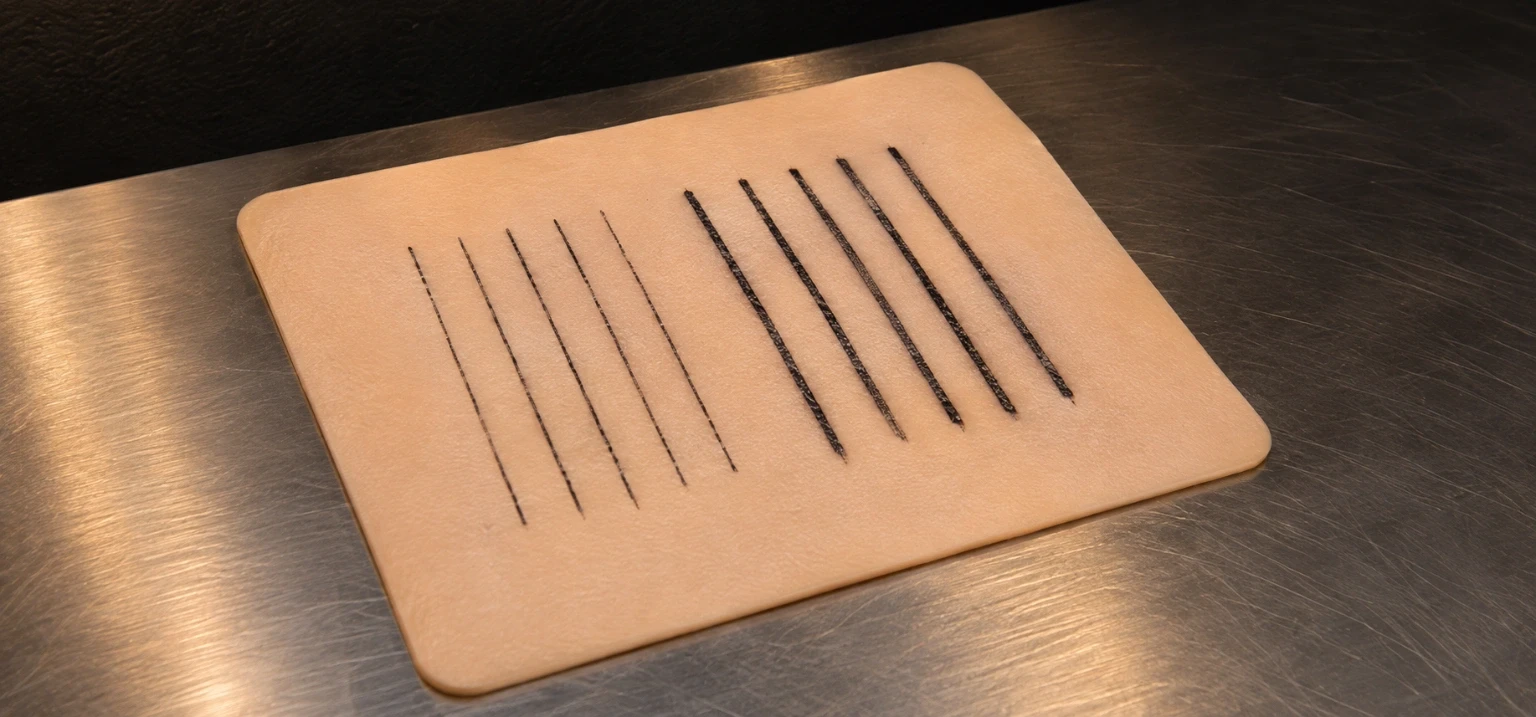
Record your baseline
Write down the machine, stroke, needle grouping, give, visible hang, and voltage.
Check protrusion and retraction
Inspect the needle tip at the cartridge opening. Make sure the selected stroke allows ink pickup.
Pull five controlled lines
Use 7 V if it is within the machine's operating range. Keep the same hand speed and stroke.
Compare five more
Use 9 V if approved for the same machine and maintain the same hand speed.
Fine-tune in small increments
Return to a useful reference and test 0.2–0.5 V adjustments, as FK recommends.
Compare strokes separately
If your pen allows stroke adjustment, repeat a similar test with a different stroke while controlling the other settings.
Repeat with shading and packing groupings
Use liner and curved-mag cartridges to explore different tasks.
Practice skin demonstrates repeatable machine behavior, but it cannot reproduce skin anatomy. See our tattoo practice supplies guide.
READ THE SYMPTOM
Why are my tattoo lines dashed, bouncing, blown out, or overworked?
FK Irons' machine-settings, stroke, depth, voltage, and give guides associate these problems with different mechanical and technique mismatches.
| What you see | FK-based likely factor | Better test or adjustment |
|---|---|---|
| Dashed or dotted lines | Voltage too low for how quickly the hand moves; needle cycles do not keep up. | Slow the hand or increase voltage gradually within the machine's limit, holding other variables steady. |
| Needle seems to bounce | Short stroke lacks momentum for bold linework and may bounce off the surface. | Compare a medium-to-long stroke for linework, then retest consistent hand pressure and hang. |
| Weak ink pickup or patchy passes | Excessive hang on a short stroke leaves inadequate retraction for cartridge reloading. | Reduce protrusion appropriately or use a compatible stroke; confirm the tip pulls back enough to reload. |
| Blowout or overly aggressive hit | FK links blowouts with high voltage, deep needle hang, heavy pressure, and thin skin; rigid zero give adds risk. | Reassess hang, pressure, machine speed, give, and the anatomical area before proceeding. |
| Overworked surface | High voltage with a slow hand repeatedly strikes one area; too many passes can add trauma. | Reduce the speed mismatch and review passes, pressure, and grouping instead of forcing saturation. |
| Solid line in one area, faint in another | FK points to inconsistent needle depth and difficulty seeing the tip. | Recheck visible hang, maintain a clear tip view, and practice steady angle and hand positioning. |
Stop when skin response says stop
FK warns that excessive depth and repeated high-speed contact can cause heavy bleeding, scarring, and blowouts.
BUILD YOUR WORKFLOW
Tattoo machines, cartridges, and practice skin to compare
The useful purchase is the one that serves the adjustment you want to learn. Consider adjustable machines for stroke comparisons, cartridges for technique-specific testing, and synthetic skin for repeatable practice.
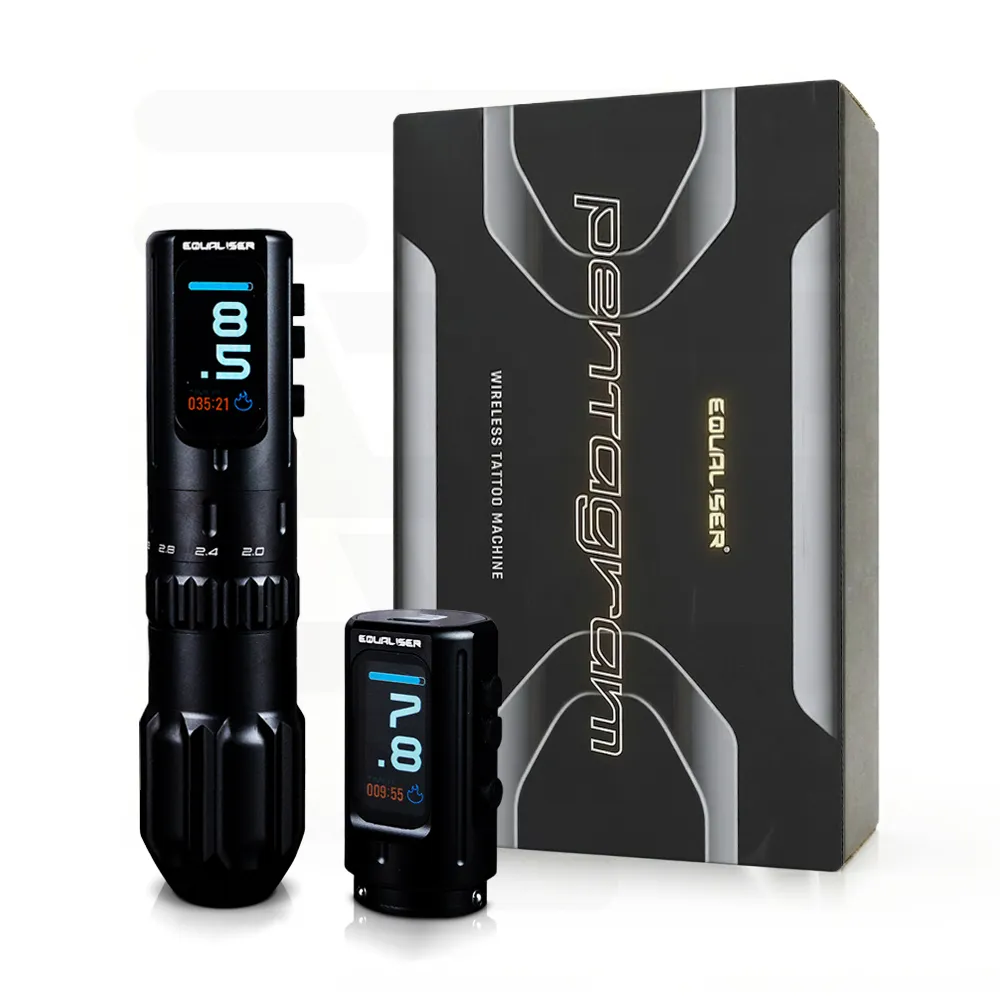 Stroke, protrusion, and voltage controls
Kwadron Equaliser Pentagram
Kwadron specifies 2.0–4.2 mm adjustable stroke, separate 0–5 mm needle protrusion, and a 4.0–12.0 V operating range. A clear example of three different settings on one machine.
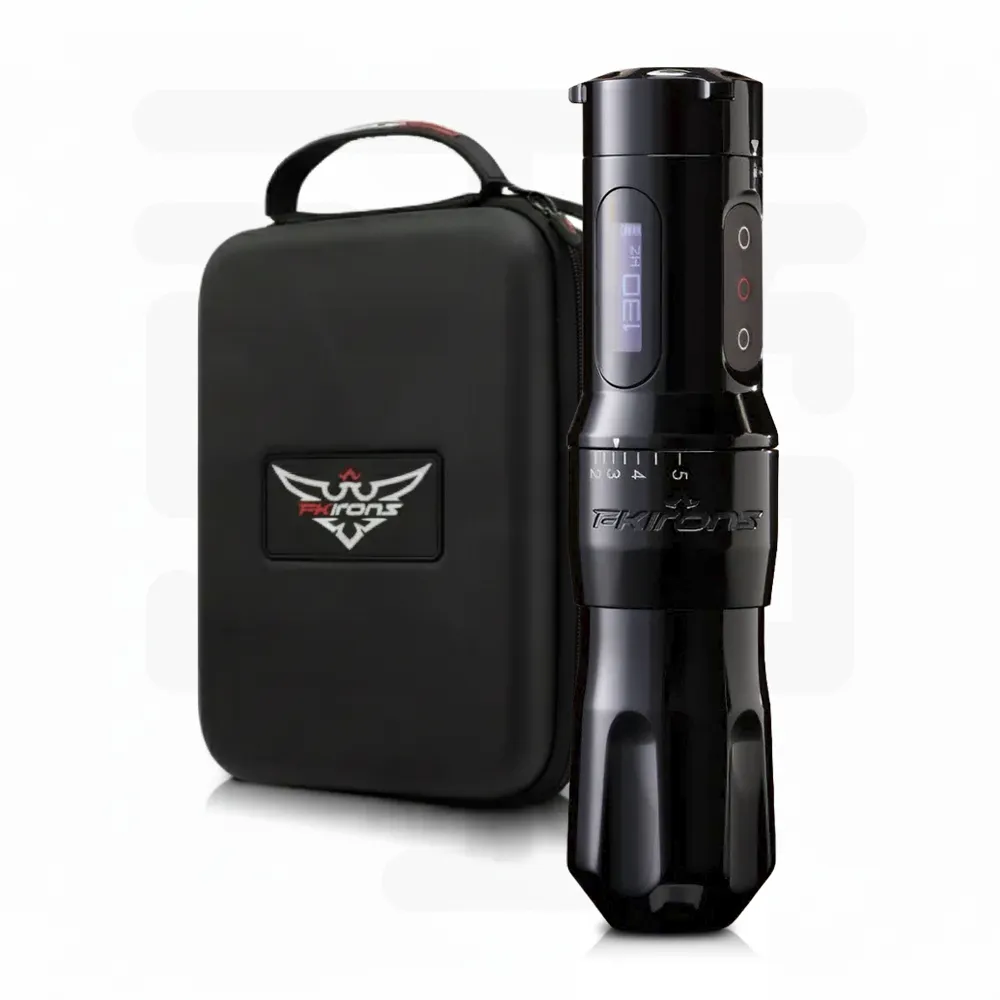 Wide adjustable stroke
FK Irons One Adjust
FK Irons describes a 2.0–5.0 mm stroke range in 0.5 mm increments, adjustable without powering down. Useful for comparing short, medium, and long travel.
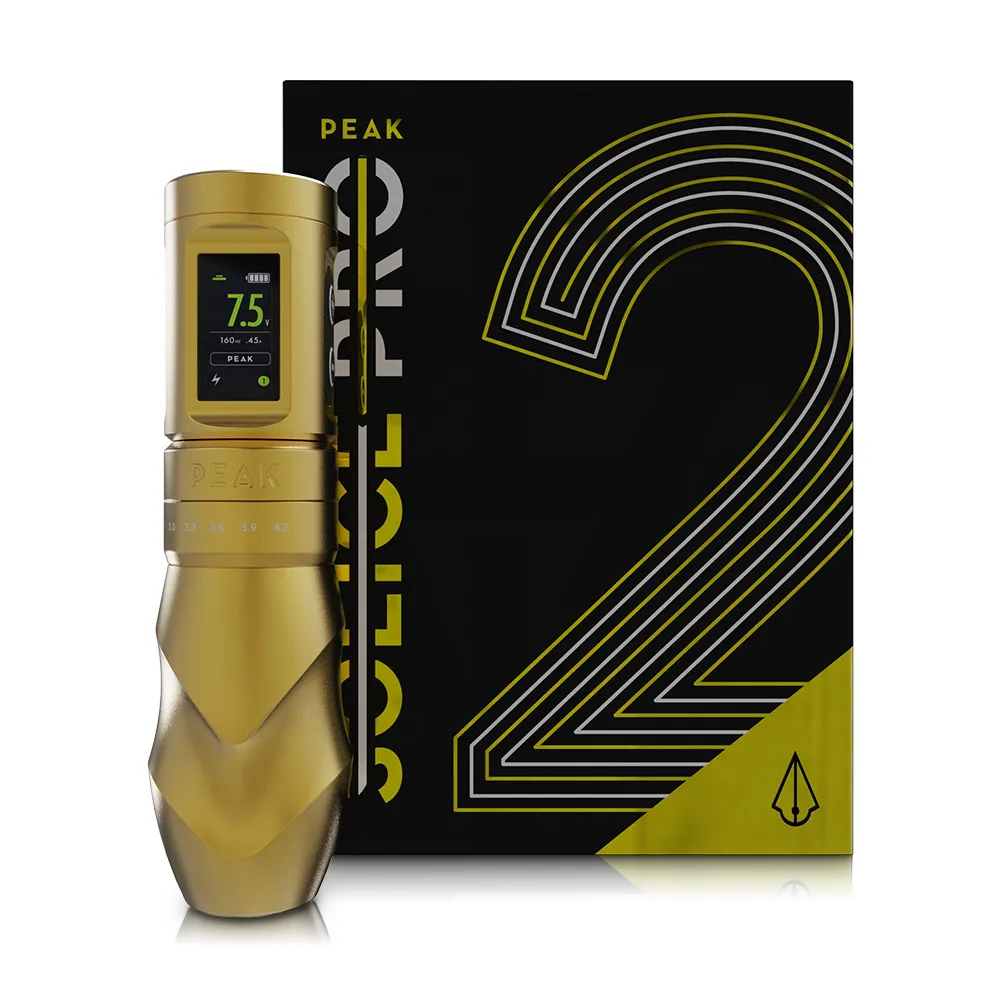 Alternative adjustable-stroke pen
Peak Solice Pro 2 Matte Gold
An adjustable-stroke pen option for artists comparing workflow and machine feel. Review the specific controls and operating instructions before testing.
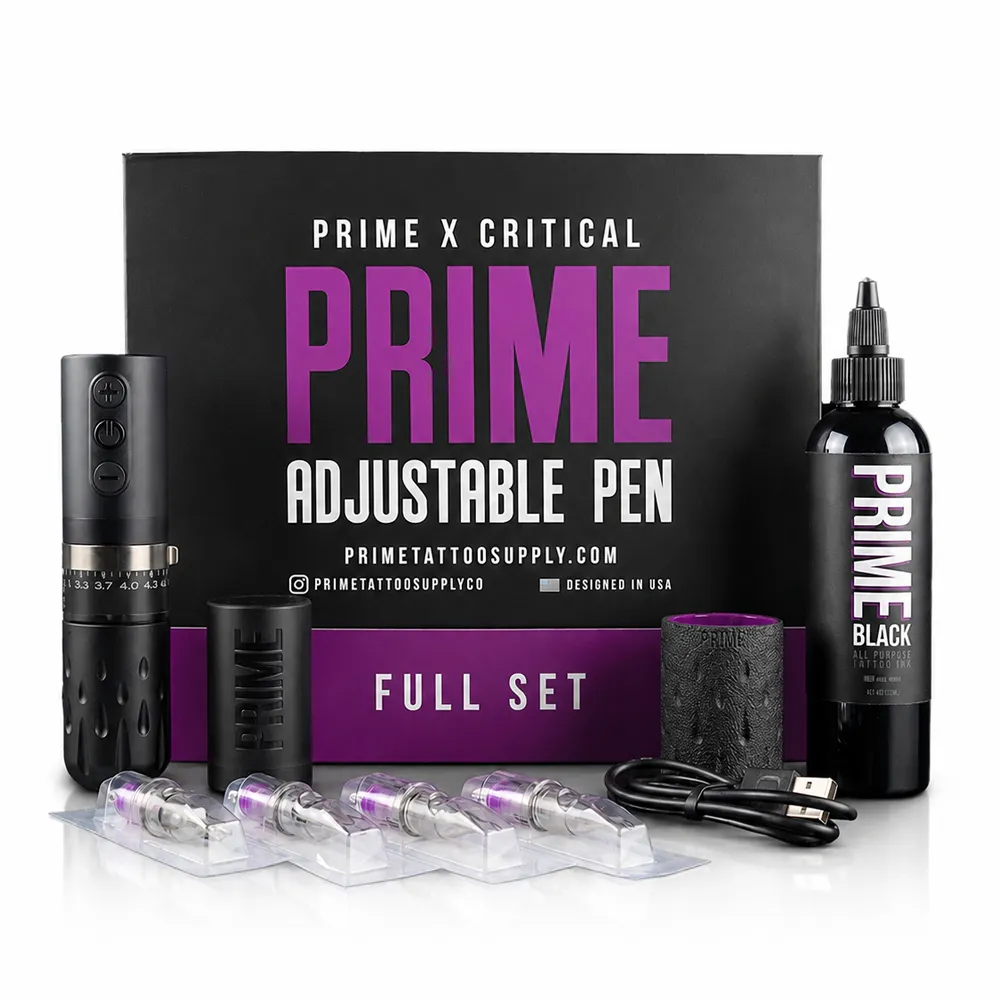 Adjustable-pen setup
PRIME X Critical Adjustable Pen Full Set
A full-set adjustable-pen option to evaluate alongside your preferred cartridge groupings and machine-control workflow.
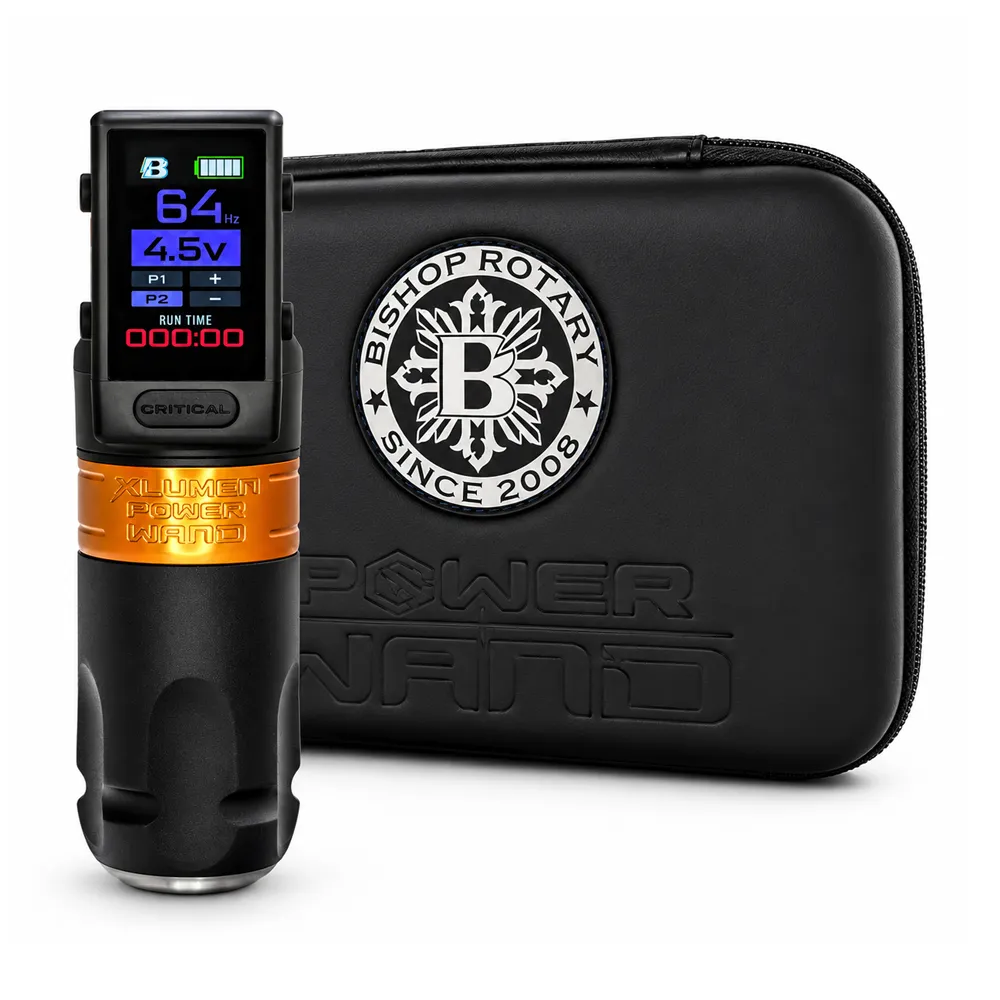 Task-focused machine example
Bishop Power Wand XLUMEN Packer Full Set
An example of selecting a machine around a particular job, such as packing, rather than expecting one setting to produce every kind of hit.
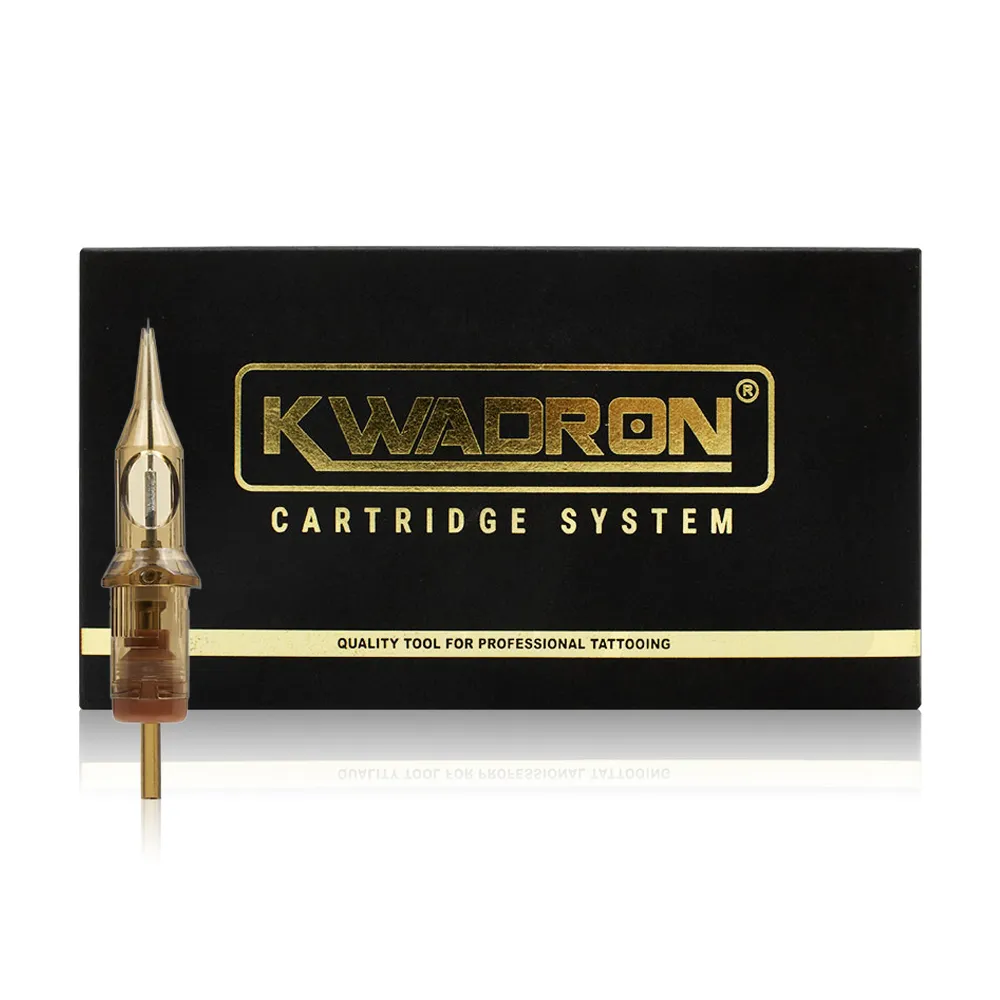 Linework testing
Kwadron Cartridges Liners
A liner cartridge option for practicing continuous lines, hand-speed control, tip visibility, and the interaction of hang and stroke.
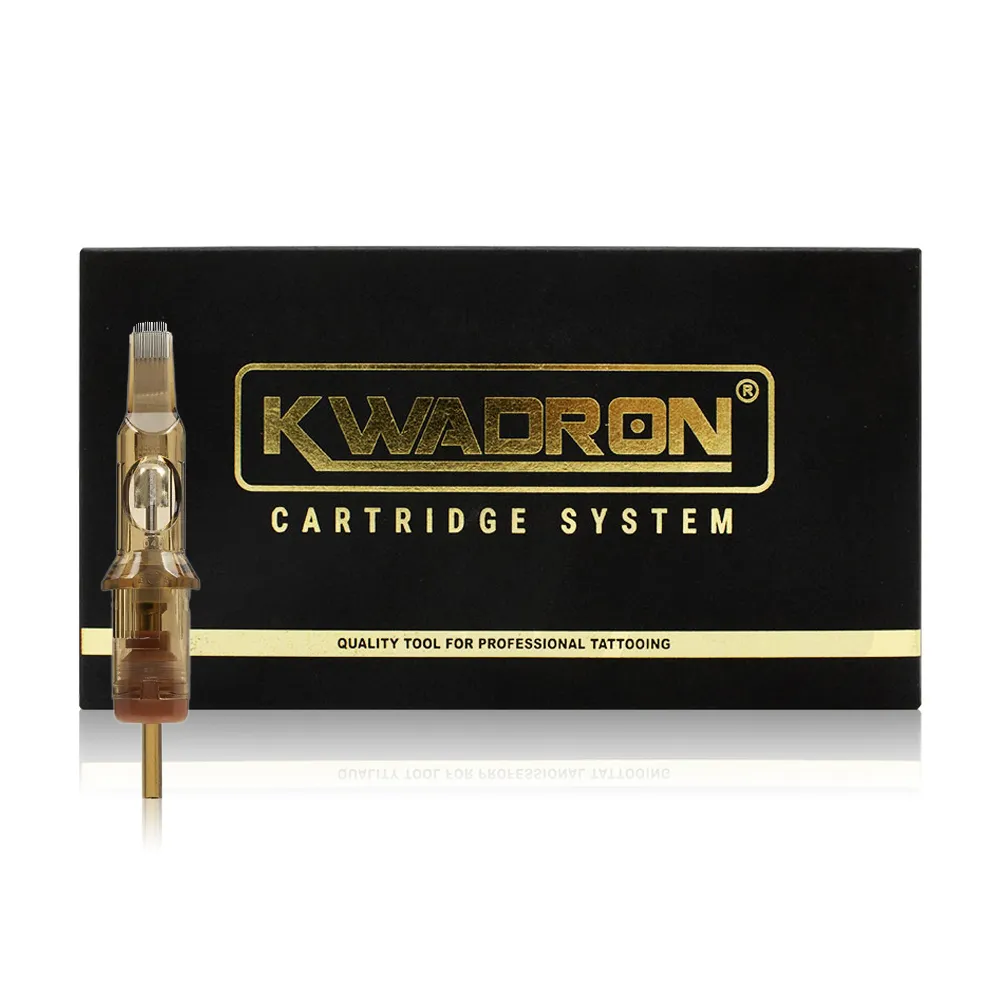 Shading and packing practice
Kwadron Cartridges Curved Mags
A curved-mag grouping for testing shading and packing technique, motor response, and efficient pass strategy.
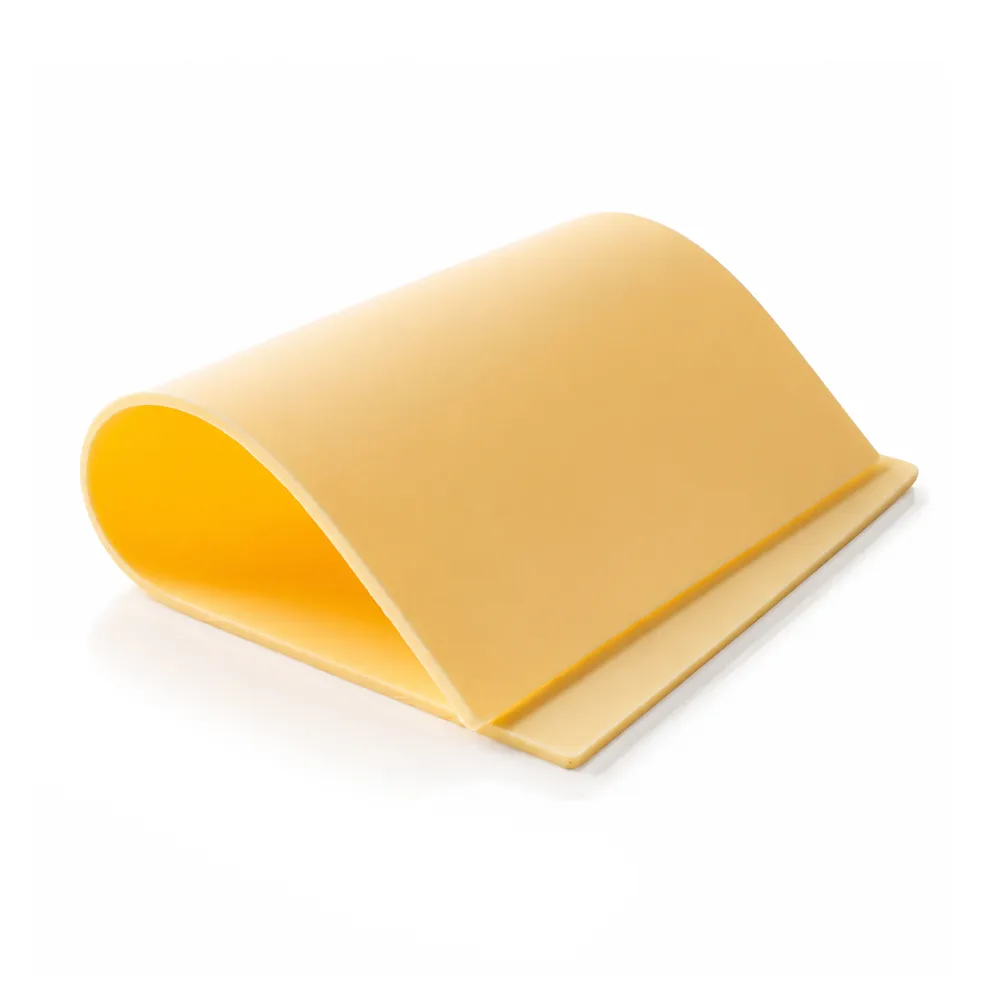 Controlled comparisons
Tattoo Practice Skin 3mm A4
A 3 mm-thick A4 practice surface for repeatable side-by-side line, shading, and machine-setting experiments before client work.
Shop Tattoo Machines Explore Wireless Machines Shop Power Supplies Shop Practice Skin
BEFORE YOU BUY OR ADJUST
Quick checklist for choosing and testing a tattoo machine setup
Prioritize a setup you can describe, repeat, and understand. Focus on the adjustments that actually fit your technique.
- Know your stroke: Fixed travel, changeable cam, or adjustable-stroke control.
- Find the hang adjustment: Grip, collar, dial, or tube; check visibility and retraction.
- Read the manufacturer limit: Never treat a general FK voltage range as your exact model's operating specification.
- Check give and hand speed: The felt hit comes from more than one setting.
- Test and document: Start on practice skin, change one variable, and keep a written baseline.
SVT Shop helps artists and apprentices compare professional tattoo machines, cartridges, and practice supplies in El Paso, TX. Next Day Delivery is available in El Paso.
FREQUENTLY ASKED QUESTIONS
12 common tattoo stroke, needle hang, and voltage questions
These answers draw on FK Irons' machine-setting education, the Xion manual, and Kwadron's Pentagram specifications.
1. What is the difference between tattoo machine stroke and needle depth?
Stroke is mechanical travel during each cycle, set by the cam or armature. Needle hang is exposure beyond the cartridge, adjusted at the grip. Depth in the skin is the actual penetration reached by the artist, not either machine measurement.
2. Does voltage change tattoo needle depth?
No. FK Irons says voltage primarily changes motor speed and does not directly set needle depth.
3. What does stroke length mean on a tattoo pen machine?
It is the millimeter distance traveled by the needle between its highest and lowest positions in one cycle. Longer stroke generally provides a harder hit.
4. How far should the tattoo needle stick out of the cartridge?
Set needle hang so the tip remains clearly visible and the stroke still permits adequate retraction and ink pickup. FK recommends beginning with less extension and testing on synthetic skin.
5. What stroke is best for lining, shading, and packing?
FK's machine-settings article suggests 3.5–4.2 mm for linework, 3.5–4.0 mm for whip shading, 2.5–3.0 mm for soft shading, and 4.0 mm or more for color packing.
6. What voltage should I use for lining, shading, and color packing?
FK's broad rotary-machine ranges are 8–10.5 V for lining, 6–8.5 V for shading, and 7–9.5 V for packing. Its more focused baselines include 7–8.5 V for fine detail and 6.5–8 V for black-and-gray shading.
7. Is a short stroke with high voltage the same as a long stroke with low voltage?
No. FK says voltage affects cycling speed, while stroke determines travel and impact momentum. A short stroke running fast can still lack the swing needed for bold lines. Compare both settings on practice skin with sensible hang.
8. What is give, and how does it affect the tattoo machine?
Give is the machine's cushioning response to resistance, according to FK. Low or off give creates a firmer linework feel, medium give is a packing reference, and higher give softens the hit for gradual shading.
9. How deep does a tattoo needle actually go into skin?
FK describes pigment placement in the dermis, with many tattoos deposited about 1–2 mm deep. Anatomy, hand pressure, angle, and technique change the result. This is not the same measurement as needle hang.
10. Is an adjustable-stroke tattoo machine worth it for a beginner?
It can be useful if you want to learn differences between short, medium, and long travel on one machine. FK identifies 3.5 mm as versatile and explains that adjustable machines avoid cam swaps when changing stroke.
11. Why are my tattoo lines dashed even with the right voltage?
FK links dashed lines to a mismatch between the needle's cycling pace and hand speed. Your stroke may also lack momentum for the line style, or excessive hang on a short stroke may interfere with ink pickup.
12. How do I test tattoo machine settings before working on a client?
FK recommends synthetic-skin tests. On a machine approved for both levels, pull five lines at 7 V and five at 9 V with unchanged hand speed, grouping, stroke, and hang.
RESEARCH
Sources Consulted
Manufacturer explanations and product specifications below support the mechanical definitions, technique ranges, machine operating limits, and practice recommendations in this guide.
- FK Irons: Tattoo Machine Stroke Length Explained
- FK Irons: How Machine Settings Affect Linework, Shading, and Color
- FK Irons: A Comprehensive Guide on Tattoo Machine Stroke
- FK Irons: Everything You Need to Know About FK One Adjust
- FK Irons: Tattoo Needle Depth: How to Set It Correctly
- FK Irons: How to Master Your Tattoo Machine Voltage
- FK Irons: Tattoo Machine Hertz vs Voltage
- FK Irons: What Is Give in a Tattoo Machine?
- FK Irons: Spektra Xion User Manual
- Kwadron: Equaliser Pentagram Specifications