


 Powered by Comercia.io
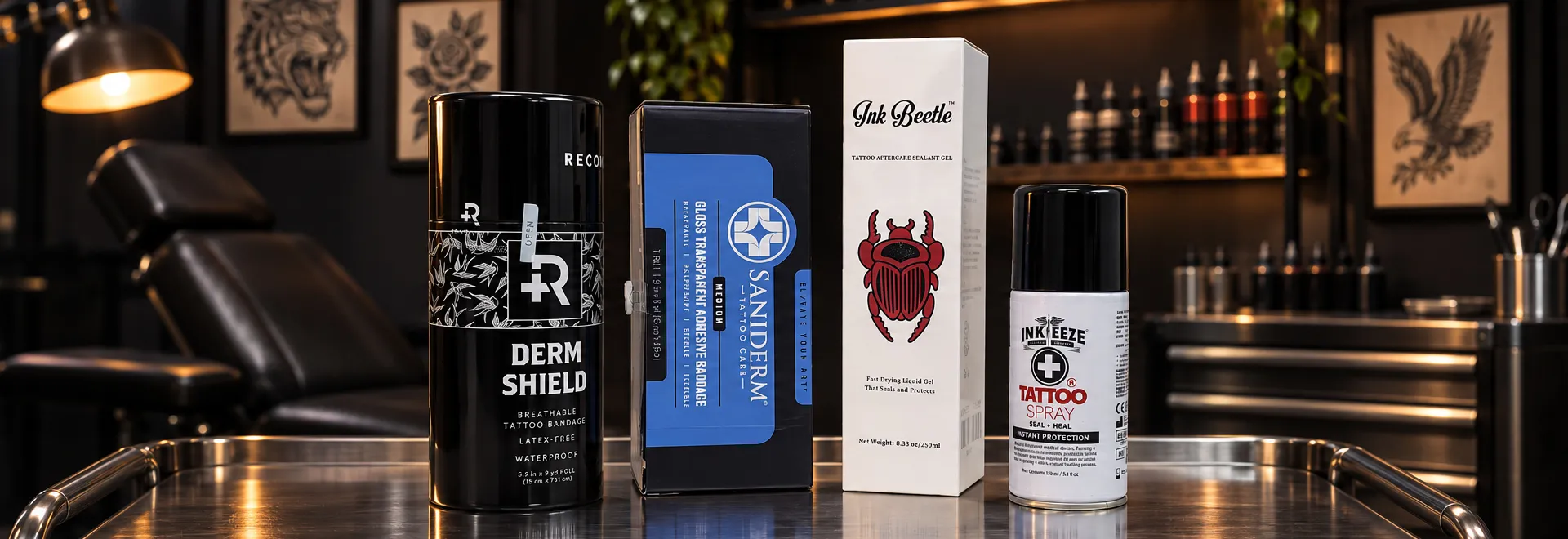
Compare adhesive tattoo films from Recovery, Saniderm and OZER with the drying barrier gel from Ink Beetle and the spray-on protective layer from INKEEZE. Understand how each works, how it is applied and removed, and which format fits your tattoo's size, location and aftercare routine.
EXPLORE PROTECTIVE FILMS COMPARE ALL 3 FORMATS
THE SHORT ANSWER
Quick Answer: Which Type of Tattoo Second Skin Should You Choose?
Choose adhesive film when you want a flexible, waterproof dressing with a continuous seal; choose Ink Beetle Derm Gel when you prefer a hand-applied barrier that dries without adhesive; and consider INKEEZE Tattoo Spray for a fast, contact-free coating that is washed off and renewed daily. Film, gel and spray have different application, wear and removal instructions, so the correct choice depends on tattoo size, body location, fluid release and skin tolerance. Have your tattoo artist approve the format and follow the exact manufacturer's directions rather than treating all three as interchangeable.
ONE TERM, DIFFERENT PRODUCTS
What Does "Second Skin" Mean in Tattoo Aftercare?
"Second skin" is a commonly used term for a protective layer placed over freshly tattooed skin. The most familiar format is transparent adhesive film, but the same description is now used commercially for drying gels and spray-on coatings. These products do not have the same construction, wear schedule or removal process, even when manufacturers describe them as breathable protective barriers.
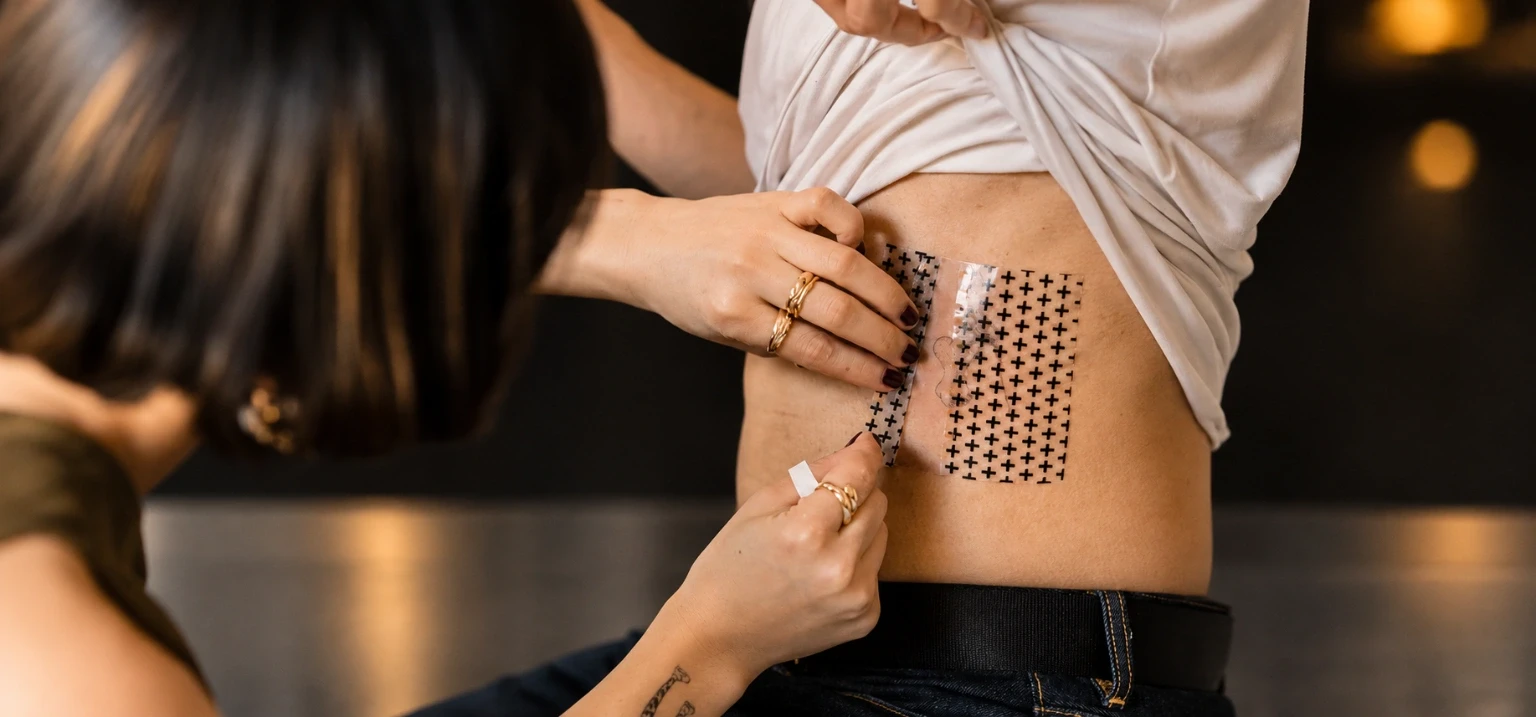
The shared goal is to reduce routine exposure to external dirt and rubbing while the tattoo is in its early aftercare stage. Recovery and Saniderm use premanufactured adhesive sheets; OZER offers a similar sheet format. Ink Beetle supplies a gel that dries on the surface, and the new INKEEZE Tattoo Spray uses a fine aerosol application to form a thin coating directly on the skin.
This guide treats physical barrier format as the main buying decision. It does not assume that an adhesive film, a dried gel or a sprayed coating creates the same level of water resistance, survives the same activity or remains suitable for the same number of days. Manufacturer instructions and the condition of the skin are more important than the general label "second skin."
Do you need a precut or cut-to-size dressing that stays adhered, a manually spread gel that dries into a removable layer, or a contact-free spray coating that can be washed away and reapplied? Start with that distinction before comparing individual brands.
THREE DIFFERENT MECHANISMS
How Film, Gel and Spray Form a Protective Layer
A manufactured sheet
The artist positions a flexible film over the tattoo. Its adhesive attaches to the surrounding skin, creating a defined perimeter. The sheet itself is the protective material; it does not need to dry into a film.
Removal: peel back slowly over itself.A wet-to-dry layer
Ink Beetle Derm Gel is spread over clean, appropriately dry tattooed skin. It sets into a flexible protective layer without the pressure-sensitive adhesive used on a bandage sheet.
Removal: wash with warm water; peeling is possible.A sprayed-on coating
INKEEZE Tattoo Spray distributes a fine coating without needing to touch the tattoo during application. Its volatile components evaporate, leaving a thin protective film formed on the surface.
Removal: gently wash off before renewing.All three formats involve a protective layer, but adhesive and film-forming are not synonyms. Ink Beetle contains film-forming ingredients yet is marketed as adhesive-free. INKEEZE's partnered Tattoo Spray product forms a coating from a spray rather than arriving as a ready-made sheet. A customer who wants to avoid adhesive film should still review the gel or spray's own ingredient list and potential sensitivities.
The first difference you will notice in a studio is handling. Film requires measuring, cutting and sealing edges. Gel requires spreading and allowing it to set. Spray requires correct distance, light coats and a fully dry surface. These different preparations influence which format is convenient for a compact flash tattoo, a curved area or a much larger composition.
AT-A-GLANCE COMPARISON
Tattoo Second Skin: Adhesive Film vs. Gel vs. Spray
The comparison below separates the product format from individual manufacturer instructions. Gel and spray are renewed on a different schedule from longer-wear adhesive film, and their contact methods are not identical.
| FEATURE | ADHESIVE FILM | DRYING GEL | SPRAY-ON BARRIER |
|---|---|---|---|
| Brands discussed | Recovery Derm Shield, Saniderm, OZER | Ink Beetle Derm Gel | INKEEZE Tattoo Spray |
| How it forms | Preformed adhesive dressing placed on skin | Gel dries into a thin protective layer | Sprayed liquid dries into a thin surface coating |
| Application | Cut or select sheet; adhere over tattoo plus border | Spread evenly after tattoo settles and skin is dry | Spray light coats onto clean, dry tattoo |
| Contact while applying | Film is smoothed onto skin | Gel is spread over the area | Contact-free aerosol application |
| Wear schedule | Brand-specific first and later applications | 2–24 hours per layer; typically renewed for 3–4 days | Up to 24 hours per layer; daily renewal for up to 5 days |
| Removal | Peel gently back over itself | Warm-water washing preferred by manufacturer | Wash off with water and gentle cleansing |
| Water exposure | Recovery and Saniderm describe waterproof film when sealed | No comparable waterproof performance established in reviewed instructions | Manufacturer explicitly says not waterproof |
| Main practical limit | Requires a secure adhesive border and suitable skin | Heavy fluid can prevent the gel from drying correctly | Requires dry skin and renewal after washing or heavy wetting |
Timings for Ink Beetle and INKEEZE come from their manufacturer instructions. OZER's reviewed product description does not establish a specific wear schedule; use its actual package directions and the artist's guidance.
Choose based on adhesion, moisture exposure, application method, coverage area and the artist's aftercare plan.
FORMAT 01 / ADHESIVE FILM
Adhesive Tattoo Film: A Defined, Waterproof Covering
Adhesive tattoo film is supplied as a ready-made flexible membrane, usually on a roll or in precut sheets. The artist chooses a piece that covers the entire tattoo while leaving enough surrounding untattooed skin for the adhesive border. When the perimeter is properly attached, Recovery Derm Shield and Saniderm describe their films as waterproof and breathable.
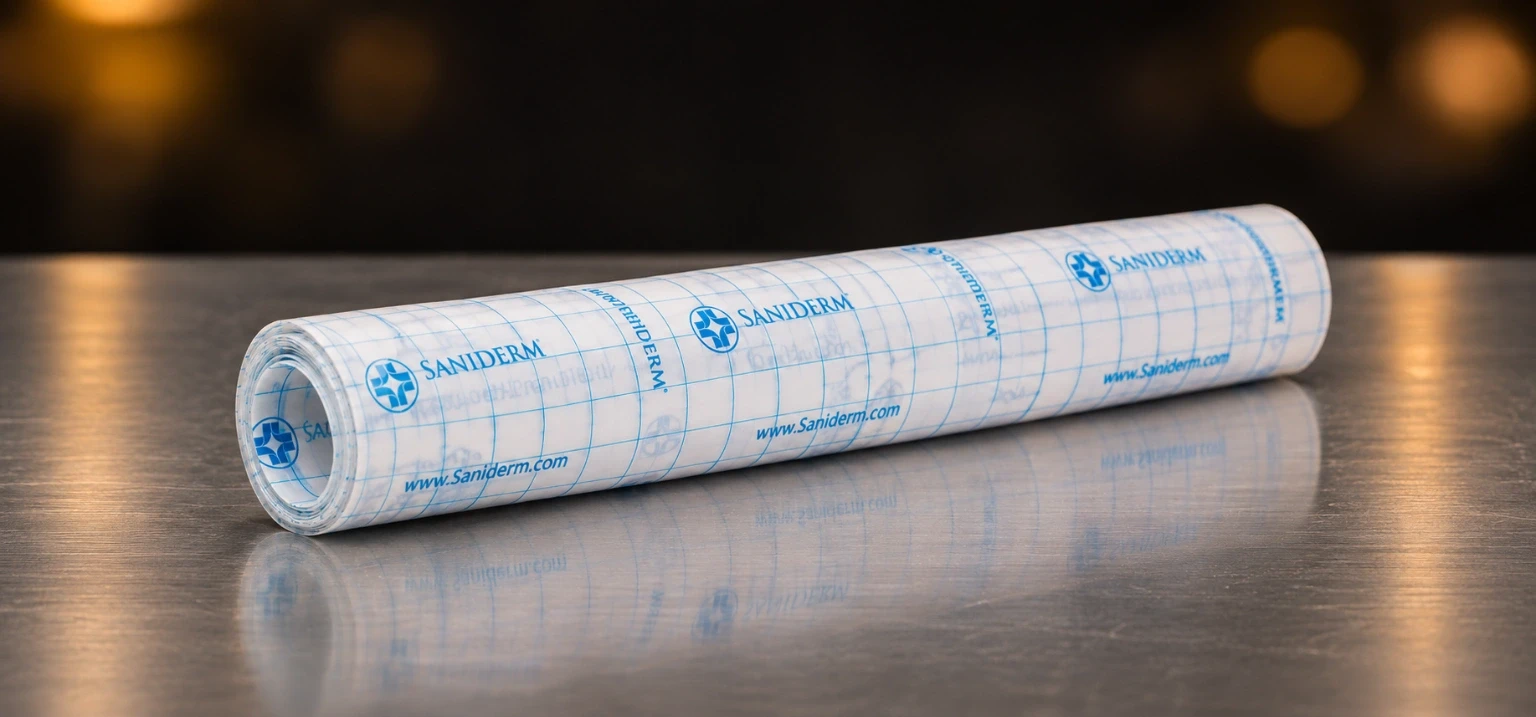
The physical advantages are straightforward: the sheet is transparent, can reduce incidental friction and creates a continuous covering between the tattoo and normal external contact. A roll can be cut to different lengths; a sheet offers a ready-sized rectangle. The artist does not have to wait for the protective material to form after applying it.
Its main limit is also physical: the film depends on its seal. Clothing, folds, sweat, unexpected stretching and poorly cleaned surrounding skin can affect adhesion. A border lifting away from the tattoo is different from harmless wrinkling on an area that remains sealed. Recovery also cautions against application when an adhesive sensitivity is known or develops.
Proper removal involves peeling the dressing slowly back along itself instead of pulling directly upward. Recovery and Saniderm provide specific guidance for the first dressing, later applications, cleaning between changes and removing the adhesive. Those protocols are different and should not be combined into a single universal schedule.
For the detailed timing, first-change decisions and full application and removal instructions, read SVT Shop's dedicated guide: Tattoo Second Skin Film: Recovery Derm Shield vs. Saniderm. This article focuses instead on how the film format compares with gel and spray.
FILM BRANDS AND SIZES
Recovery Derm Shield, Saniderm and OZER Protection Film
All three brands provide a preformed adhesive film, but the formats linked at SVT Shop are not identical. Roll width, roll length and the availability of precut sheets determine how easily an artist can prepare the covering for a particular design.
Recovery Derm Shield Tattoo Adhesive Film
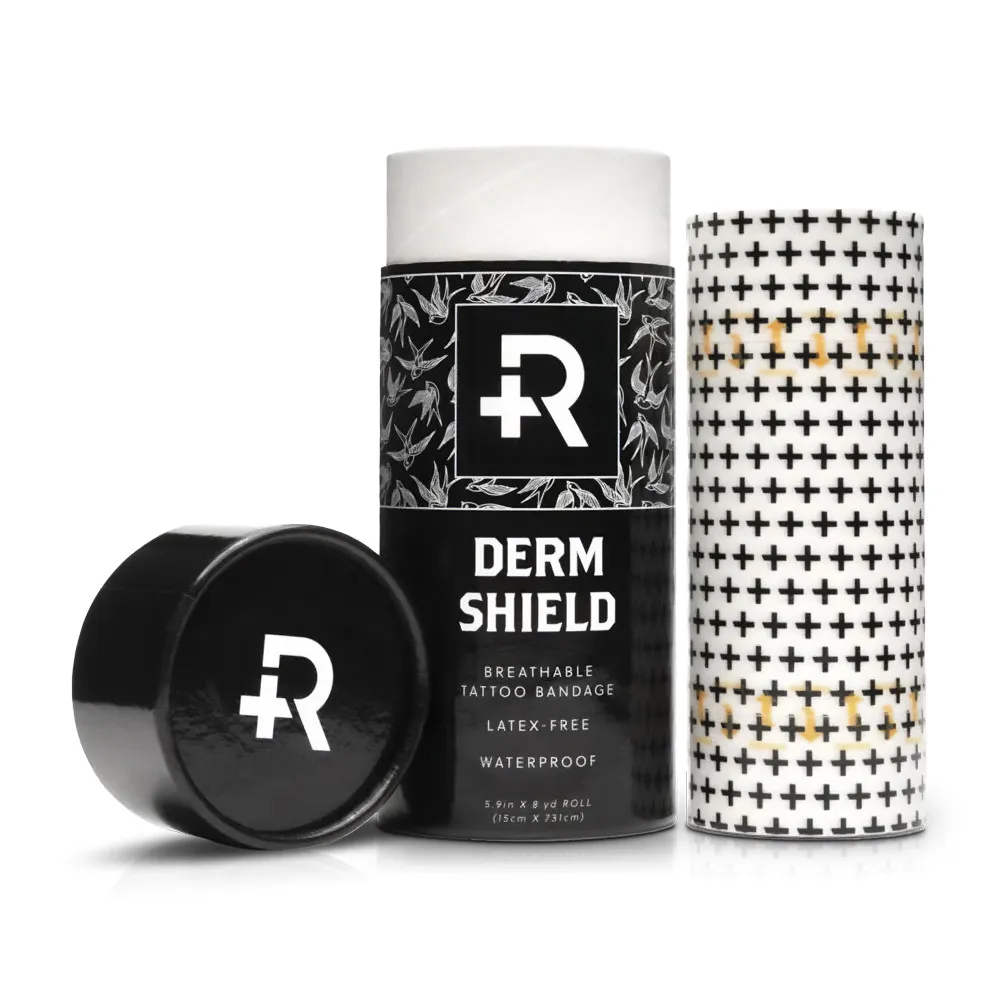
Recovery describes Derm Shield as a transparent, matte, breathable protective film with a waterproof barrier and adhesive backing. Its professional roll sizes include 5.9, 7.9 and 10 inches wide, each by 8 yards long. The range lets studios match film width to the usual size of their work without assuming that wider is always necessary.
Recovery's instructions call for a 1–2 inch clean-skin margin and caution against stretching the film during application. That is relevant for larger or curved tattoos where trying to force a narrow strip around the design could create edge tension.
VIEW RECOVERY DERM SHIELD ROLLSRecovery Derm Shield 5.9 x 7.9-Inch Sheet Pack
The linked Recovery sheet format contains 5.9 x 7.9-inch precut rectangles. Recovery identifies the manufacturer pack as 10 sheets. These are convenient when an artist often finishes tattoos that fit within a repeated rectangular coverage area.
The sheet dimensions describe the whole dressing, not the usable tattoo size. The required border consumes part of the sheet, so a tattoo that almost fills the rectangle may need a larger piece cut from a roll.
VIEW RECOVERY DERM SHIELD SHEETSSaniderm Tattoo Adhesive Film 10.2 in x 2 yd
Saniderm describes its bandage as a polyurethane medical bandage with an acrylic adhesive that is breathable and waterproof. The selected SVT Shop roll is 10.2 inches wide and 2 yards long, giving artists a wider piece of film without requiring an eight-yard roll.
The wider format can be practical for medium or broad artwork when the full tattoo and adhesion border fit within the roll width. Saniderm's own wear and removal instructions apply; do not use Recovery's directions as a substitute.
VIEW SANIDERM 10.2-INCH ROLLOZER Protection Film 20 x 20 cm
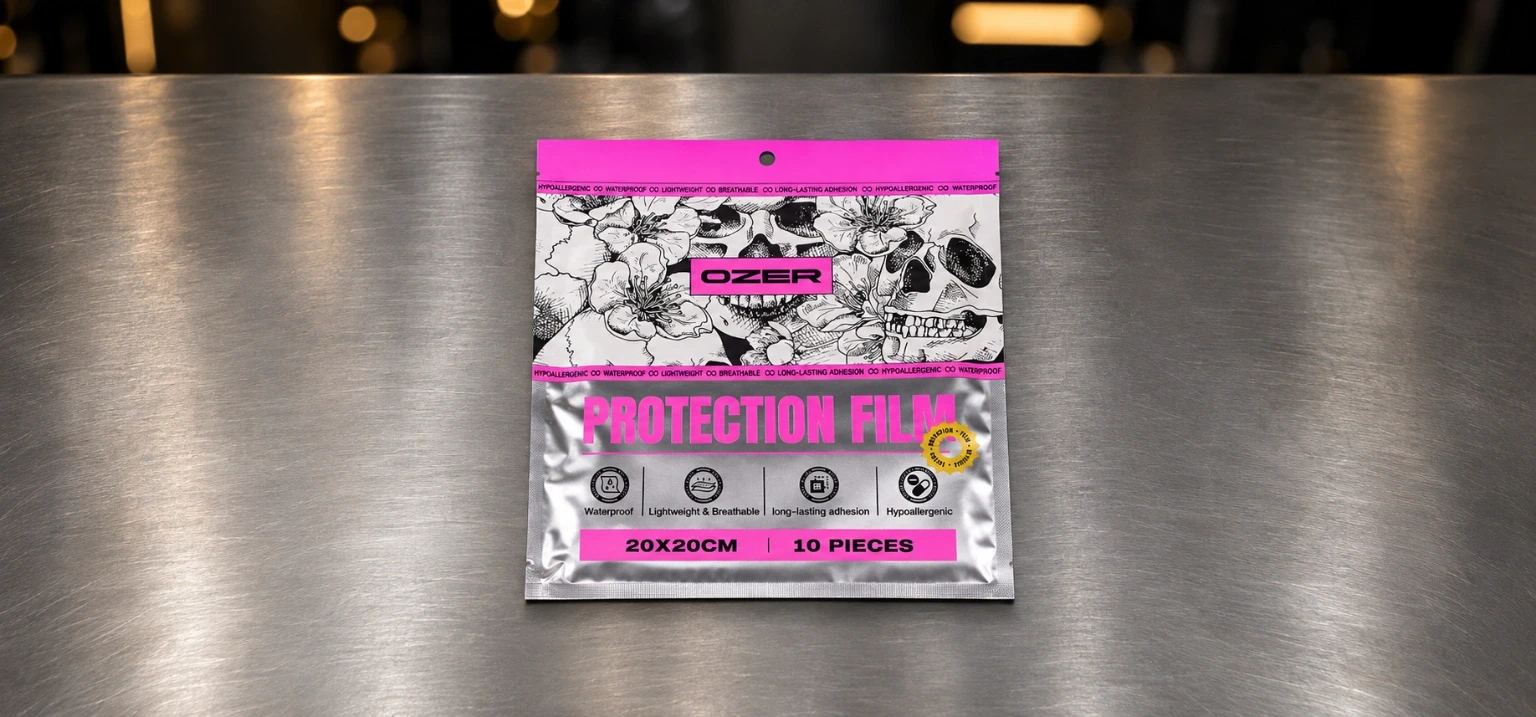
OZER describes its Protection Film as soft, lightweight, breathable and transparent enough to observe a covered tattoo. The manufacturer lists 20 x 20 cm sheets among its available sizes, with a published film thickness of 0.01 mm and packs of 10.
Square sheets can simplify preparation for tattoos that fit comfortably inside the usable area. The manufacturer's reviewed product information does not give a specific time for first or second wear, so it would be incorrect to copy Recovery's or Saniderm's schedule onto OZER. Check the package directions with your tattoo artist.
VIEW OZER PROTECTION FILMA sheet or roll is useful only when the artist can create a suitable continuous border for the actual placement. For a flat forearm or calf design, a rectangle may be straightforward. Areas that bend, fold or rub against clothing require more judgment regardless of brand.
FORMAT 02 / DRYING GEL
Ink Beetle Derm Gel: A Protective Layer Without Adhesive Film
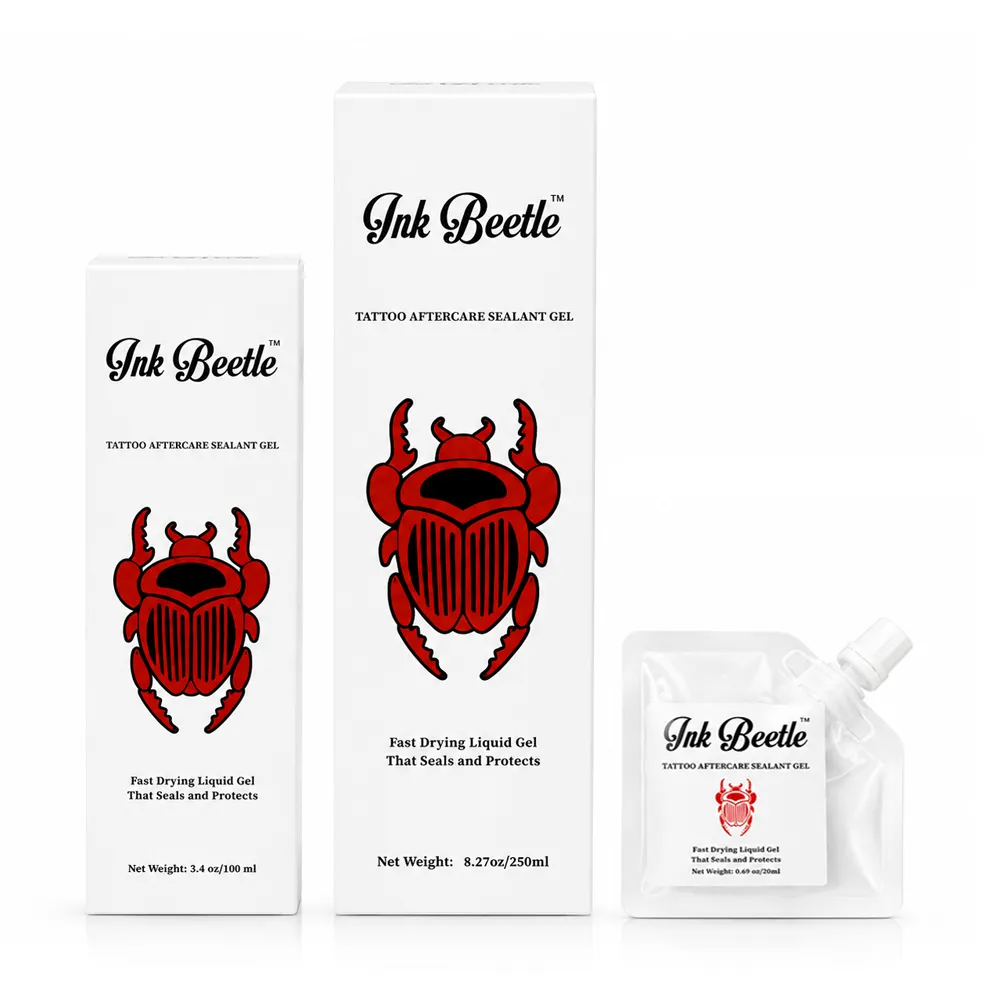
Ink Beetle Derm Gel is a gel applied wet that dries within minutes to form a flexible protective layer directly on the tattooed area. It is not a sheet and does not require adhesive tape or a precut border. Ink Beetle markets the product as adhesive-free and latex-free, with a breathable coating that moves with the covered skin.
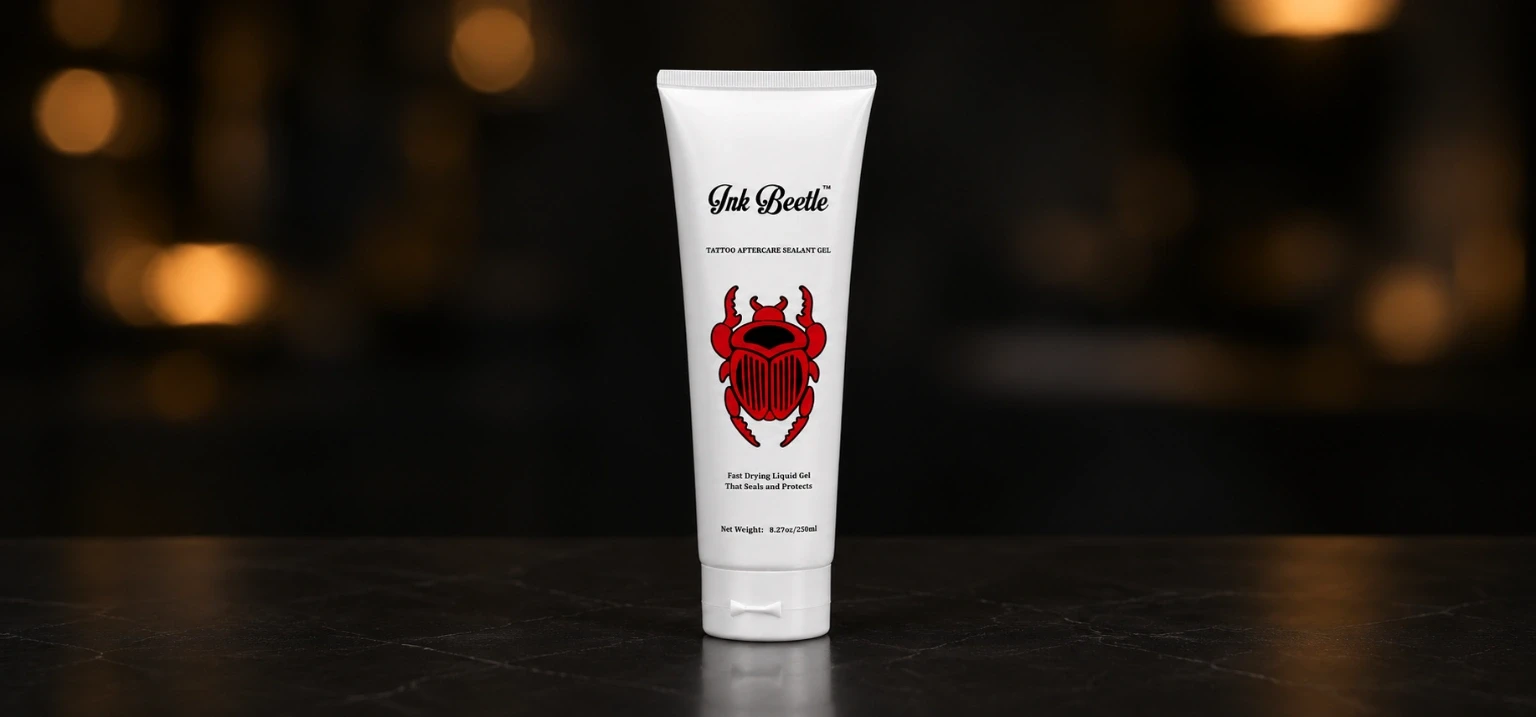
The manufacturer's ingredient information includes shea butter, cacao seed butter, aloe butter and rosemary extract, along with skin-conditioning components such as butylene glycol, allantoin and Portulaca oleracea. Its published ingredients also identify polyvinyl alcohol and an acrylate polymer, which help explain how a gel can form a coherent layer without being a conventional adhesive dressing.
A film-forming ingredient and the pressure-sensitive adhesive on a premanufactured sheet perform different jobs, which is why the gel can be adhesive-free. Anyone with known sensitivities should review the full ingredient list.
An advantage of this format is that the artist does not need to cut material around the tattoo's exact outline. For a large, irregular or curved area, applying an even layer may be easier to organize than making several strips of adhesive film meet without gaps. The trade-off is that the coating must form correctly and be renewed under a shorter schedule.
INK BEETLE / HOW TO USE IT
How to Apply, Wear and Remove Ink Beetle Derm Gel
Ink Beetle's official product FAQ and support page provide a relatively specific procedure. They recommend allowing the newly tattooed area to settle for 5–10 minutes so initial weeping decreases and the skin is suitable for coating. The area should be appropriately clean and dry before the gel is spread.
-
Let the tattoo settle.
Use Ink Beetle's stated 5–10 minute settling interval after professional cleaning, while confirming that active fluid release is not excessive.
-
Apply the gel evenly.
Spread a thin, continuous layer over the intended tattooed area with appropriate clean handling. The manufacturer describes a lightweight wet application.
-
Allow the layer to dry.
Ink Beetle states that the gel dries in minutes. Do not cover it with clothing while the layer is still wet or tacky.
-
Wear for the stated interval.
Ink Beetle recommends 2–24 hours per application, commonly leaving a layer in place overnight.
-
Wash off for renewal.
The brand says the formed layer can be peeled away, but its support instructions strongly recommend washing it off, including with warm water in the shower.
-
Repeat while appropriate.
Ink Beetle's detailed FAQ describes washing and reapplying once daily for approximately 3–4 days, according to the artist's directions.
The brand notes that if the tattoo is releasing excessive blood or plasma, the gel may not dry correctly and may stay tacky. In that situation, the manufacturer's advice is to avoid proceeding with a gel coating until the heavy secretion has settled and an appropriate alternative plan has been agreed with the tattoo artist.
Ink Beetle also explains that if the coating is not washed off, it may begin to fray at the edges or naturally peel as wear continues. That is not a reason to assume the product should be deliberately left for multiple days without normal cleansing. Its recommended routine remains the more relevant guide.
For an artist who wants to avoid adhesive sheet removal, the warm-water wash-off method is a notable convenience. It still requires consistent daily attention, complete drying before each new layer and careful observation of the skin.
VIEW INK BEETLE DERM GEL AT SVT SHOPFORMAT 03 / CONTACT-FREE SPRAY
INKEEZE Tattoo Spray: A Barrier That Forms After Spraying
INKEEZE Tattoo Spray is TATTOO SPRAY®, a spray-on protective product made in the UK by Tattoo Spray Ltd, which lists Inkeeze as its distributor in the USA. The maker calls it a registered and certified medical device for protecting fresh tattoos. It is not a premade adhesive film, and it has its own instructions.
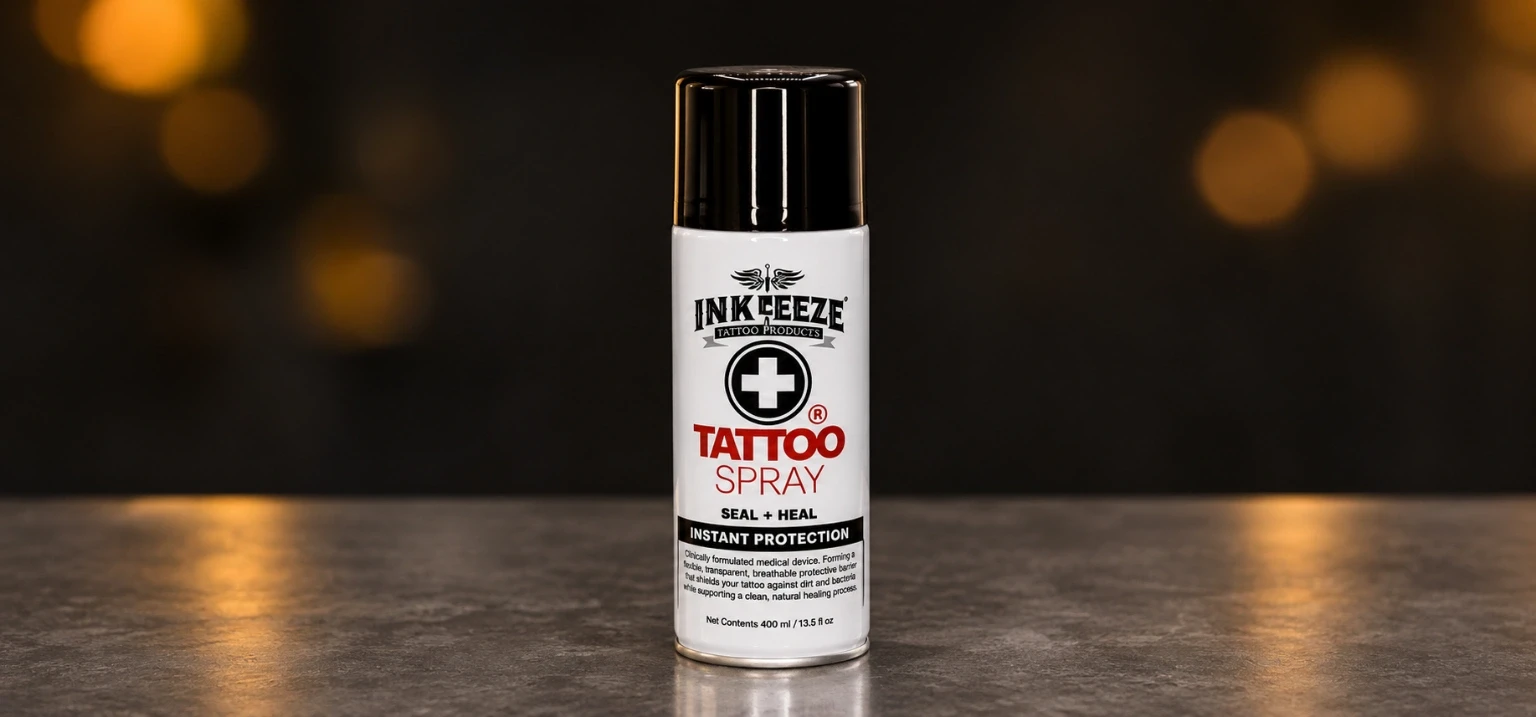
The manufacturer describes a fine, contact-free application that dries into a thin, breathable coating on the tattoo. No rectangular dressing or sticky adhesive border is needed. The film forms as volatile ingredients evaporate from the sprayed layer, rather than being applied as a separate sheet.
Tattoo Spray's published Safety Data Sheet identifies ethanol, isopentane and liquefied petroleum gas among the formulation's hazardous components. The manufacturer also describes a film-forming coating and states that the product is fragrance-free, preservative-free, vegan and cruelty-free. The SDS is not a complete ingredient declaration, so the exact full formula should not be inferred from those listed components.
The manufacturer attributes the rapid drying to solvent evaporation, with the resulting coating intended to reduce external contact and friction. Because the material is sprayed rather than spread, it may suit a clean, accessible area where the artist wants to avoid placing hands on the freshly tattooed surface during the protective application.
The most important practical limitation is easy to overlook: Tattoo Spray's own instructions say the coating is not waterproof. Its daily wash-off routine is fundamentally different from the longer-wear adhesive film system. Heavy sweating or soaking may require the area to be cleaned, dried and recoated.
The formulation can produce a brief sting because it contains ethanol. The manufacturer advises stopping and seeking guidance if discomfort or redness persists and cautions against use on infected, inflamed or ulcerated skin. It is for fresh tattoos only, not piercings or other wounds, and the maker states it is strictly for people 18 and older. The aerosol also requires normal flammable-product precautions during application and storage.
INKEEZE / SPRAY PROCEDURE
How to Apply, Wash Off and Renew INKEEZE Tattoo Spray
The official Tattoo Spray partner instructions use a simple clean, dry, spray, repeat sequence. The tattoo must first be cleaned and sufficiently dry; an active, heavily weeping surface can interfere with formation of a consistent coating.
-
Clean the area after the tattoo.
The manufacturer directs washing with a fragrance-free, pH-balanced antibacterial or antimicrobial soap, avoiding green soap, alcohol wipes, balms, creams or oils, and fully removing any numbing product.
-
Pat dry and allow the surface to settle.
The manufacturer suggests waiting about 10–15 minutes after fine-line work and 20–30 minutes after heavy saturation, color packing or full-day sessions before the first coat.
-
Shake and apply light coats.
Hold the can approximately 20 cm from the tattoo under the current manufacturer instructions, applying a thin, even coating.
-
Allow drying between coats.
The manufacturer specifies approximately 30–60 seconds of drying and describes using two or three light coats with sufficient time between them.
-
Leave the coating for the planned interval.
One application can remain for up to 24 hours, depending on activity and whether the barrier stays intact.
-
Wash off and renew daily.
Gently cleanse, dry and reapply at approximately 24-hour intervals for up to five days, as directed by the manufacturer and the artist.
The product partner explicitly says not to layer the spray with other aftercare coatings or wraps during its intended use. The spray is designed as a stand-alone barrier. Mixing it with another film or coating can alter how the surface forms and should not be presented as an improvement.
After a substantial wash, soaking or heavy sweat exposure, do not assume a sprayed layer is still intact. The manufacturer instructs users to clean, dry and reapply when the coating has been disrupted. This may be less convenient for a person who needs a waterproof dressing for ordinary showering, but it makes daily renewal central to the spray workflow.
The formula is supplied as an extremely flammable aerosol, according to its Safety Data Sheet, so keep it away from heat and flames and do not store it above 50 °C. Use the spray in a ventilated area and let the coating dry before clothing touches it; once dry, the maker says the barrier does not stick to fabric.
VIEW INKEEZE TATTOO SPRAY AT SVT SHOPUNDERSTAND THE WEAR SCHEDULE
Why "How Long It Lasts" Means Different Things for Each Format
Adhesive film has a physical edge that can stay attached for a planned period. Gel and spray form layers on the skin that are commonly removed during daily cleansing and then renewed. Comparing the number of days printed in marketing materials without considering that distinction creates misleading expectations.
Recovery Derm Shield and Saniderm provide brand-specific first- and subsequent-dressing instructions. They do not share one universal timeline. The complete comparison belongs in the separate SVT Shop adhesive-film guide, including the conditions that require early removal.
OZER Protection Film is a manufacturer-described adhesive dressing, but the reviewed official product page does not establish its own wear-time schedule. A buyer should follow the instructions supplied with that specific film instead of borrowing a day count from Recovery, Saniderm, Ink Beetle or INKEEZE.
Ink Beetle Derm Gel describes a 2–24-hour wear interval per layer and a typical 3–4-day routine. A coating that remains visible beyond that period has not necessarily been worn according to the recommended cleaning schedule. The brand's preference is washing it off and reapplying as needed.
INKEEZE Tattoo Spray describes up to 24 hours for a single application, with daily renewal for up to five days. The spray may be interrupted earlier by water or heavy sweat. The five-day figure is the span of the suggested daily routine, not a promise that one spray application forms a five-day barrier.
The important buyer question is whether the client is more comfortable with a longer-wear, sealed dressing or a removable coating that requires daily attention.
MATCH FORMAT TO THE WORK
Which Second Skin Format Fits Different Tattoos and Body Areas?
A placement recommendation should begin with the shape of the artwork and how the skin moves. These examples are practical possibilities based on product construction, not promises that a particular format will remain attached or comfortable on every body.
Adhesive film offers straightforward coverage
A relatively flat area may make it easier to establish a continuous adhesive perimeter. Recovery precut sheets, OZER squares or a suitable roll cut may work when the full design and required margin fit.
Compare a wide roll with a formed-on-skin layer
Large artwork can require a wider adhesive film or more careful edge planning. Ink Beetle gel may be convenient where a flexible surface layer is easier to spread, provided the tattoo is not excessively weeping.
Flexibility and motion matter
A well-fitted film may accommodate a curve, but seams and tension deserve attention. Gel or spray eliminates the need to shape an adhesive sheet around the curve, though both still require correct drying.
Consider compact film or contact-free spray
A small film sheet can be practical when its border fits comfortably. INKEEZE's manufacturer discusses early application to fine-line tattoos after the skin is cleaned, dry and no longer heavily weeping.
Assess durability carefully
Film can lift where skin folds or clothing catches it. A formed-on-skin coating avoids a separate sheet edge but may still wear or break down with movement, sweat or rubbing. Artist approval is essential.
Do not force gel or spray onto a wet surface
Ink Beetle notes that heavy fluid can stop its gel from setting. The Tattoo Spray manufacturer says to let substantial weeping settle before spraying. Film also needs monitoring when fluid threatens the seal.
Location alone cannot decide the aftercare product. Skin sensitivity, allergies, tattoo size, fluid level, humidity, clothing and the client's ability to follow changing instructions all matter. A heavily moving area may work well with one product in one client and poorly with the same product in another.
THE PROFESSIONAL DECISION
How Tattoo Artists Can Choose an Aftercare Format
Start with the aftercare goal and the requirements of the specific tattoo. A large, flat design might favor the convenience of a wide adhesive film; a small, clean, minimally weeping tattoo might be suitable for a spray applied by the professional; and a client avoiding pressure-sensitive film adhesive may wish to discuss a drying gel.
Then evaluate whether the client can actually follow the instructions. Adhesive film requires understanding when the dressing should be removed or changed. Ink Beetle gel calls for washing and reapplication during its short initial routine. INKEEZE Tattoo Spray also requires daily renewal and additional attention after significant wet exposure.
Check coverage dimensions, placement, movement and fluid release before choosing the format.
Ask about known film-adhesive reactions and sensitivities to gel botanicals, ethanol or aerosol components.
Explain whether the covering remains in place or is washed off and renewed every day.
Give the client the manufacturer's current directions and when to stop using the covering or seek advice.
For professional purchasing, keeping more than one format may be useful when clients have different preferences and placements. It should not encourage combining coatings or putting one barrier over another without manufacturer support. INKEEZE's partnered Tattoo Spray instructions specifically advise against stacking it with other aftercare layers during the prescribed cycle.
AVOID THESE PROBLEMS
Common Mistakes When Choosing Film, Gel or Spray
- Assuming all products called second skin are identical. A manufactured adhesive sheet behaves differently from a drying gel or sprayed coating.
- Using one brand's film timing for another. Recovery, Saniderm and OZER should each be handled according to the applicable instructions.
- Applying adhesive film without enough margin. The covering must include the intended clean-skin border, not only the tattoo's visible outline.
- Ignoring a failing adhesive seal. A dressing that leaks or exposes the tattoo is not performing as an intact protective film.
- Using Ink Beetle while the tattoo is excessively weeping. The manufacturer warns that heavy fluid can keep the gel tacky rather than allowing it to set.
- Leaving Ink Beetle on for days because it has not peeled naturally. The manufacturer's preferred routine is washing off and renewing, typically during the first 3–4 days.
- Peeling a gel layer aggressively. Ink Beetle says washing with warm water is the recommended removal method.
- Treating INKEEZE Tattoo Spray as waterproof. Its manufacturing partner explicitly says the formed coating is not waterproof.
- Confusing drying time with wear time. A spray drying in 30–60 seconds does not mean it is designed to remain unchanged for several days.
- Applying too much spray at once. Tattoo Spray recommends light coats with drying time between them rather than one excessive wet layer.
- Layering spray with gel or adhesive film. The spray manufacturer's instructions prohibit mixing its coating with other aftercare layers during use.
- Assuming adhesive-free means reaction-free. Gel extracts and spray solvents can also be relevant to sensitive skin.
- Skipping the rest of the aftercare plan. A protective layer is one step; clean hands, the artist's instructions and watching how the skin looks still matter.
BEFORE YOU CHOOSE
Tattoo Second Skin Buying Checklist
- I know whether I want a sheet, drying gel or spray coating.
- My tattoo artist approves the format for this tattoo.
- The size and body placement have been evaluated.
- I understand whether adhesive is part of the product.
- I have reviewed the relevant ingredients or SDS information.
- I know whether the product requires daily renewal.
- I understand how to remove it without damaging skin.
- I know how fluid release or sweat affects the barrier.
- I am not assuming gel or spray is waterproof.
- I will not stack incompatible barrier products.
- I know when irritation means stopping use.
- I have the current manufacturer's instructions available.
Pick a format for the actual tattoo and aftercare conditions, and give the client clear written instructions for the product you chose.
EXPLORE THE SIX PRODUCT OPTIONS
Shop Film, Gel and Spray at SVT Shop
SVT Shop helps tattoo artists, apprentices and studios select professional supplies for practical workflows. Based in El Paso, Texas, SVT Shop offers Next Day Delivery in El Paso; confirm delivery eligibility and details when placing an order.
Choose by barrier mechanism and required coverage. A roll or sheet provides preformed adhesive film, Ink Beetle provides a drying gel, and INKEEZE provides a spray-on film that is refreshed through the manufacturer's daily routine.
 ADHESIVE FILM / RECOVERY
Derm Shield Rolls
5.9, 7.9 and 10-inch professional widths, each by 8 yards.
VIEW DERM SHIELD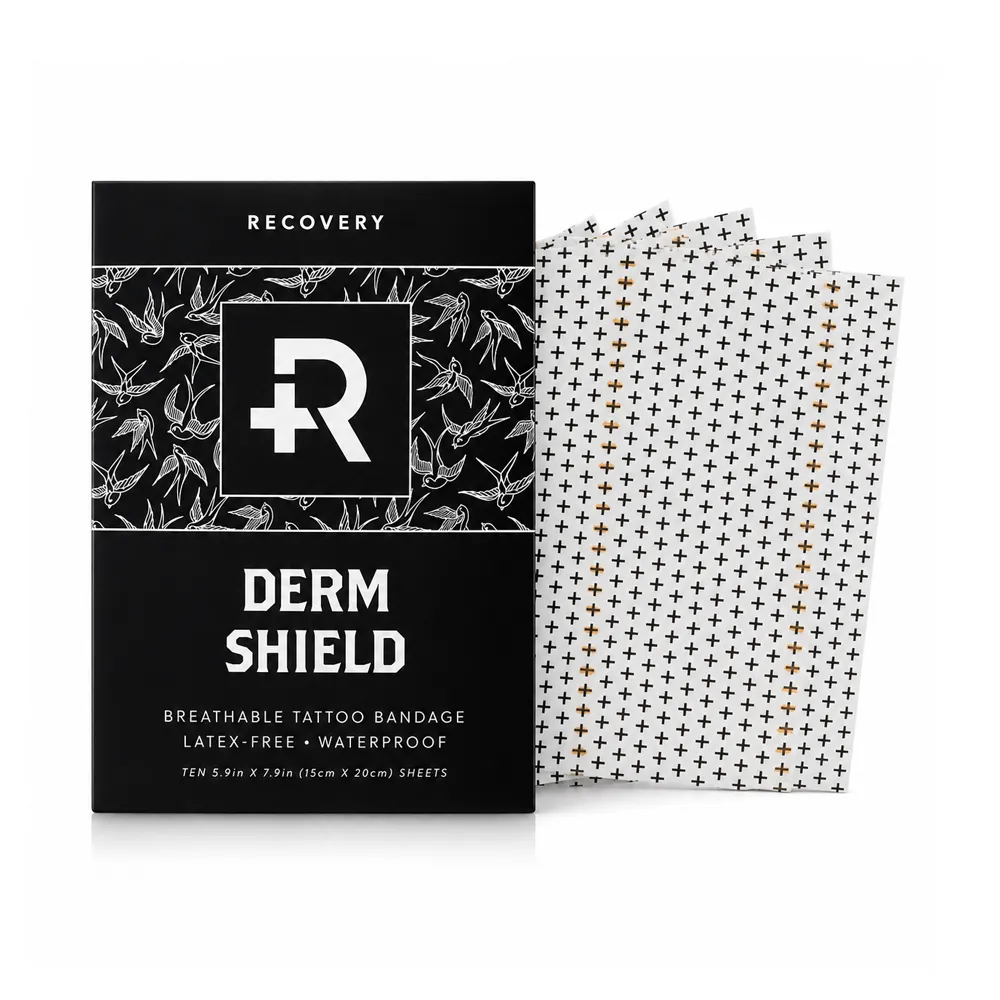 ADHESIVE FILM / RECOVERY
Derm Shield Sheets
5.9 x 7.9-inch precut format for repeated rectangular coverage.
VIEW SHEET PACK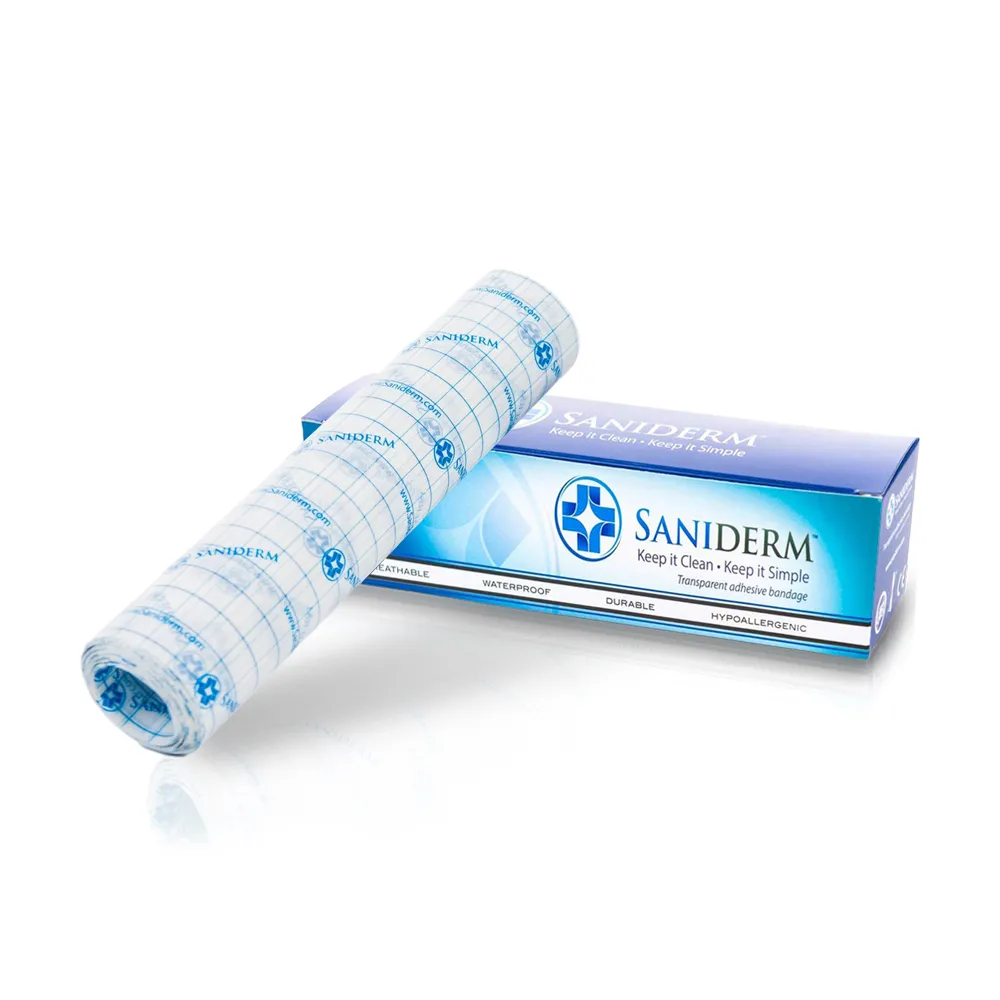 ADHESIVE FILM / SANIDERM
Saniderm Wide Roll
Transparent adhesive film, 10.2 inches wide by 2 yards long.
VIEW SANIDERM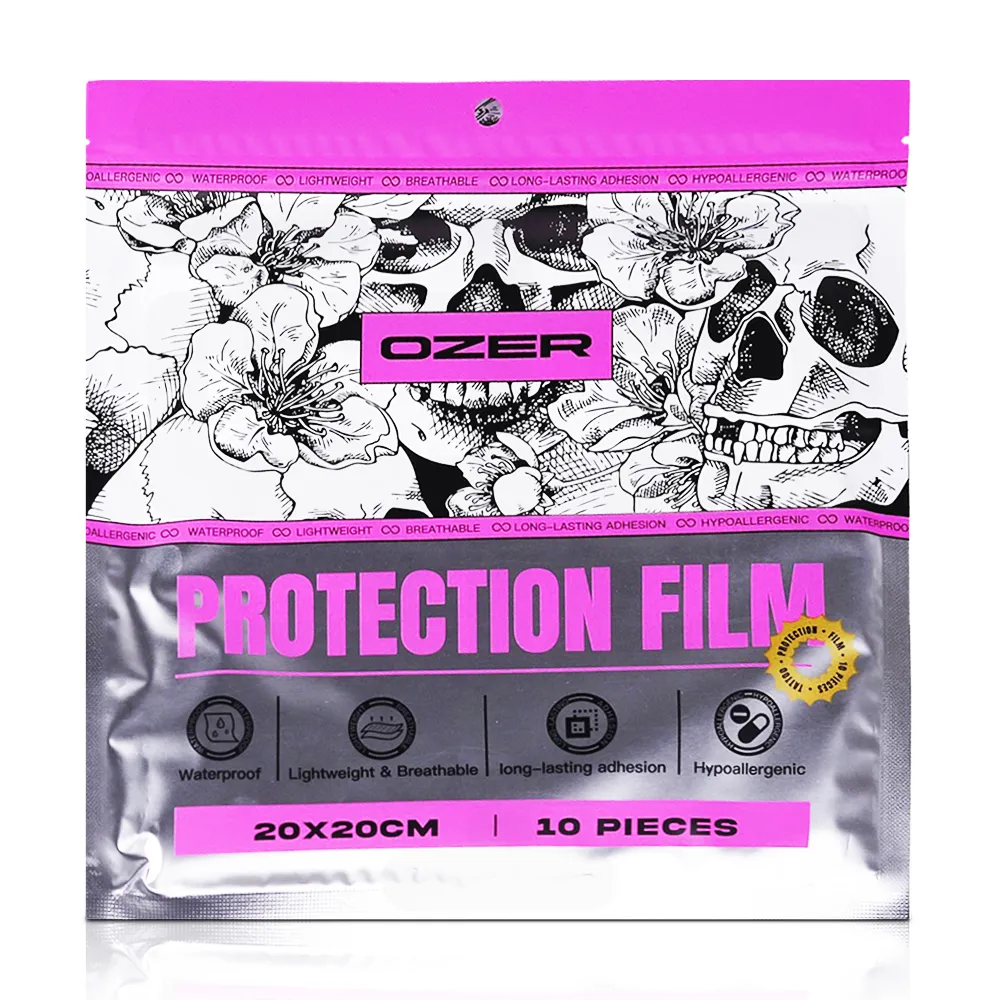
 DRYING GEL / INK BEETLE
Ink Beetle Derm Gel
Adhesive-free gel that dries into a washable protective layer.
VIEW DERM GEL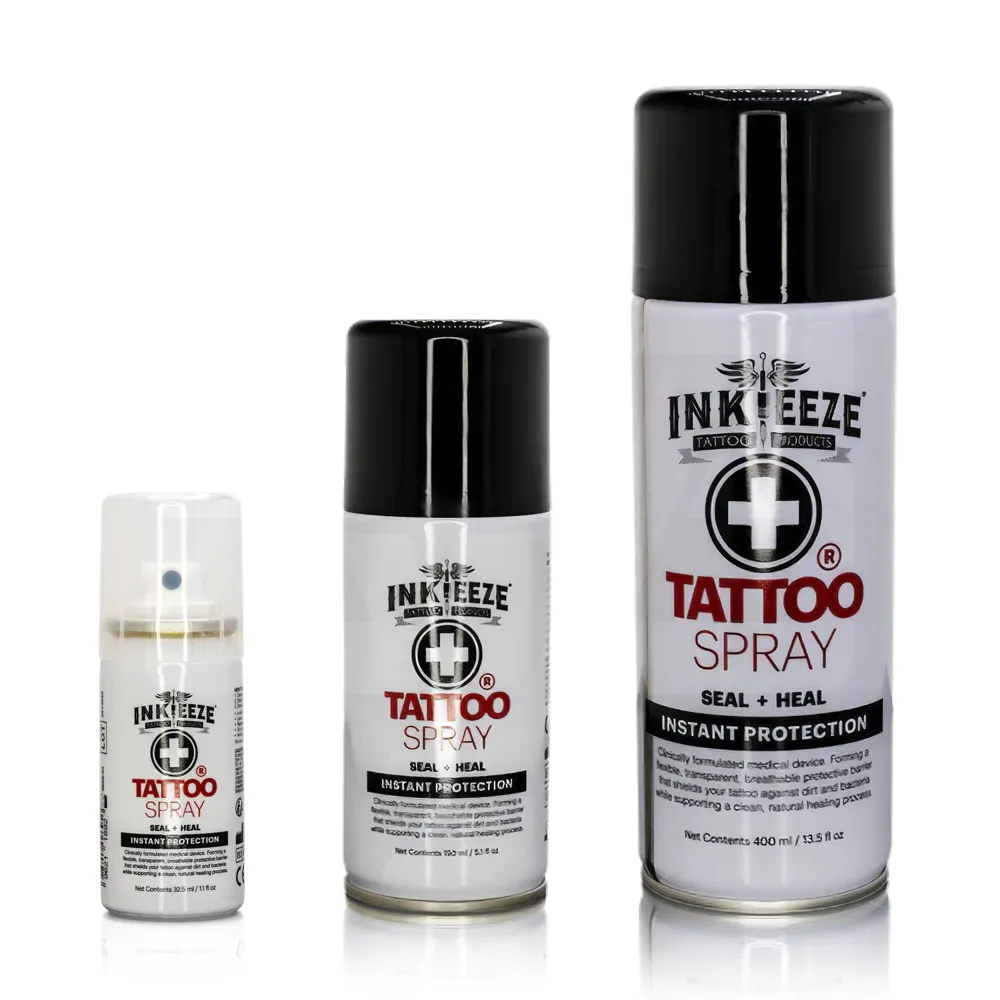 BARRIER SPRAY / INKEEZE
INKEEZE Tattoo Spray
Contact-free protective coating with a daily wash-and-reapply routine.
VIEW TATTOO SPRAYSee the broader selection in Bandages & Protective Films at SVT Shop, or read the detailed adhesive-film instructions.
COMMON BUYER QUESTIONS
Frequently Asked Questions
What are the three main types of tattoo second skin?
The three formats in this guide are premanufactured adhesive film, a gel that dries into a protective surface layer, and a spray that forms a coating after application. Recovery Derm Shield, Saniderm and OZER represent film; Ink Beetle Derm Gel represents drying gel; and INKEEZE Tattoo Spray represents the contact-free spray format.
Is tattoo gel the same as an adhesive second-skin bandage?
No. Ink Beetle Derm Gel is applied wet and forms a removable layer as it dries, without requiring the pressure-sensitive adhesive used by a dressing sheet. Adhesive film arrives as a manufactured layer with a backing that attaches to surrounding skin. Their instructions and wear schedules differ.
Does Ink Beetle Derm Gel have adhesives?
Ink Beetle describes its Derm Gel as adhesive-free and latex-free. The manufacturer lists film-forming ingredients such as polyvinyl alcohol and an acrylate polymer, alongside skin-conditioning components. These are not the same as the adhesive backing of a conventional second-skin sheet.
How long can Ink Beetle Derm Gel stay on?
Ink Beetle's official FAQ recommends 2–24 hours per application. A typical routine is to leave it on overnight, wash it off the following day and repeat daily for approximately 3–4 days, according to the artist's guidance.
Should Ink Beetle Derm Gel be peeled or washed off?
The manufacturer says either is possible but strongly prefers washing it off, including with warm water. Avoid pulling at a film layer that has become difficult to lift; use the gentle wash-off method described by Ink Beetle.
What happens if Ink Beetle will not dry?
Ink Beetle states that excessive blood or plasma can leave the gel tacky and interfere with proper film formation. Its instructions call for allowing heavy secretion to settle rather than repeatedly applying gel to a surface that cannot dry correctly.
Who makes INKEEZE Tattoo Spray?
It is TATTOO SPRAY®, made in the UK by Tattoo Spray Ltd, which lists Inkeeze as its distributor in the USA. It is a spray-on protective coating with its own instructions, rather than a precut adhesive sheet.
What ingredients are listed for INKEEZE Tattoo Spray?
The manufacturer partner's Safety Data Sheet for Tattoo Spray Skin-Cover Sealant identifies ethanol, isopentane and liquefied petroleum gas among its hazardous components. The manufacturer also describes a film-forming coating and a fragrance-free, preservative-free formula. The SDS does not provide a complete cosmetic-style ingredient list, so an exhaustive formula should not be assumed.
How long does one INKEEZE Tattoo Spray application last?
According to the partnered manufacturer's instructions, one coating can remain for up to approximately 24 hours, subject to washing and activity. The recommended routine is to wash, fully dry and reapply every 24 hours for up to five days.
Is INKEEZE Tattoo Spray waterproof?
No. Tattoo Spray's official instructions explicitly state that the coating is not waterproof. After substantial wetting or heavy sweat, the manufacturer directs users to clean and dry the area before applying a fresh coat.
Can INKEEZE Tattoo Spray be layered with Derm Shield or Ink Beetle?
Do not do so as a routine. Tattoo Spray's current instructions state that it is designed to be used without stacking other aftercare products or wraps over or beneath its coating. Follow the artist's selected method rather than combining formats independently.
What is the best format for a tattoo on a curved body area?
There is no automatic winner. Gel or spray can avoid cutting and positioning an adhesive sheet around a curve, while well-sized flexible film may also fit certain placements. Motion, sweating, fluid release, skin tolerance and the artist's assessment determine suitability.
What size is OZER Protection Film?
The linked OZER product is a 20 x 20 cm sheet format. The manufacturer also describes its film as lightweight, breathable and approximately 0.01 mm thick. Its reviewed page does not specify an exact wear-time protocol, so use the package instructions for that product.
Which type can I shower with?
Recovery Derm Shield and Saniderm describe waterproof protection when their adhesive films remain correctly sealed. Ink Beetle does not provide a comparable waterproof-use claim in the reviewed gel instructions, and the manufacturer of INKEEZE's partnered spray says its coating is not waterproof. Do not treat any covering as permission to soak a fresh tattoo.
When should I see a doctor about a covered tattoo?
Follow your artist's instructions and the product label, and stop using any covering that irritates the skin. The American Academy of Dermatology says to see your doctor or a board-certified dermatologist right away if you have signs or symptoms of an infection.
MANUFACTURER AND OFFICIAL REFERENCES
Sources Consulted
Product characteristics and instructions were checked against Ink Beetle, Tattoo Spray (maker of INKEEZE Tattoo Spray), Recovery Aftercare, Saniderm and OZER. Official dermatology guidance was used for reaction warnings.
- Ink Beetle — Derm Gel Official ProductWet-to-dry barrier, manufacturer ingredient examples, 2–24-hour wear and early-aftercare routine.
- Ink Beetle — Support and FAQsHeavy weeping, drying limitations, daily reapplication and the preferred wash-off removal method.
- Ink Beetle — Manufacturer Ingredient InformationPublished conditioning agents and film-forming components, including polyvinyl alcohol and acrylate polymer.
- Tattoo Spray — DistributorsLists Inkeeze as the USA distributor of TATTOO SPRAY®.
- Tattoo Spray — Official How to UseCleaning, drying, light spray coats, 30–60-second film formation, daily renewal and water limitations.
- Tattoo Spray — Manufacturer FAQsUp-to-24-hour wear, up-to-five-day cycle, product restrictions, moisture exposure and formulation characteristics.
- Tattoo Spray — Safety Data SheetIdentified aerosol components, including ethanol, isopentane and liquefied petroleum gas, and relevant handling cautions.
- Recovery Aftercare — Derm Shield RangeProfessional adhesive-film widths, roll lengths and sheet formats.
- Recovery Aftercare — Derm Shield InstructionsAdhesive-film use, border requirements, removal approach and manufacturer cautions.
- Saniderm — Original Tattoo Bandage RollsPreformed film, roll configurations and product format.
- OZER — Protection Film20 x 20 cm sheet size, 0.01 mm film thickness, breathability and manufacturer packaging format.
- American Academy of Dermatology — Tattoo Skin ReactionsRecognizing concerning changes and seeking professional medical evaluation when appropriate.
Editorial note: Last updated November 12, 2026. This guide compares manufacturer-described protective aftercare formats and does not replace the tattoo artist's instructions. Follow the directions for the exact product and current package, monitor for irritation or product failure, and seek medical care for significant or worsening symptoms.