Powered by Comercia.io
Understand breathable adhesive tattoo film, its manufacturer-described benefits, first and second bandage timing, safe application and removal, and the practical differences between Recovery Derm Shield and Saniderm rolls and precut formats.
SHOP PROTECTIVE FILMS COMPARE THE FORMATS
THE SHORT ANSWER
Quick Answer: How Long Should Tattoo Second Skin Stay On?
Recovery Derm Shield instructs users to keep the first piece on for about 24 hours, depending on fluid release, then use a second piece for several days without wearing any individual piece longer than one week. Saniderm recommends 8–24 hours for the first piece and generally 3–5 days for the second (up to six days under its separate guidance), with no more than seven consecutive days total; either film must be removed sooner when its seal fails or significant irritation develops.
THE PRODUCT EXPLAINED
What Is Tattoo Second Skin Adhesive Film?
Tattoo second skin is a thin, flexible adhesive film placed over a freshly completed tattoo. It is designed to cover the tattoo and surrounding skin as one continuous dressing. The film adheres around the tattoo while remaining transparent enough to observe the covered area without removing it simply to look at the work.
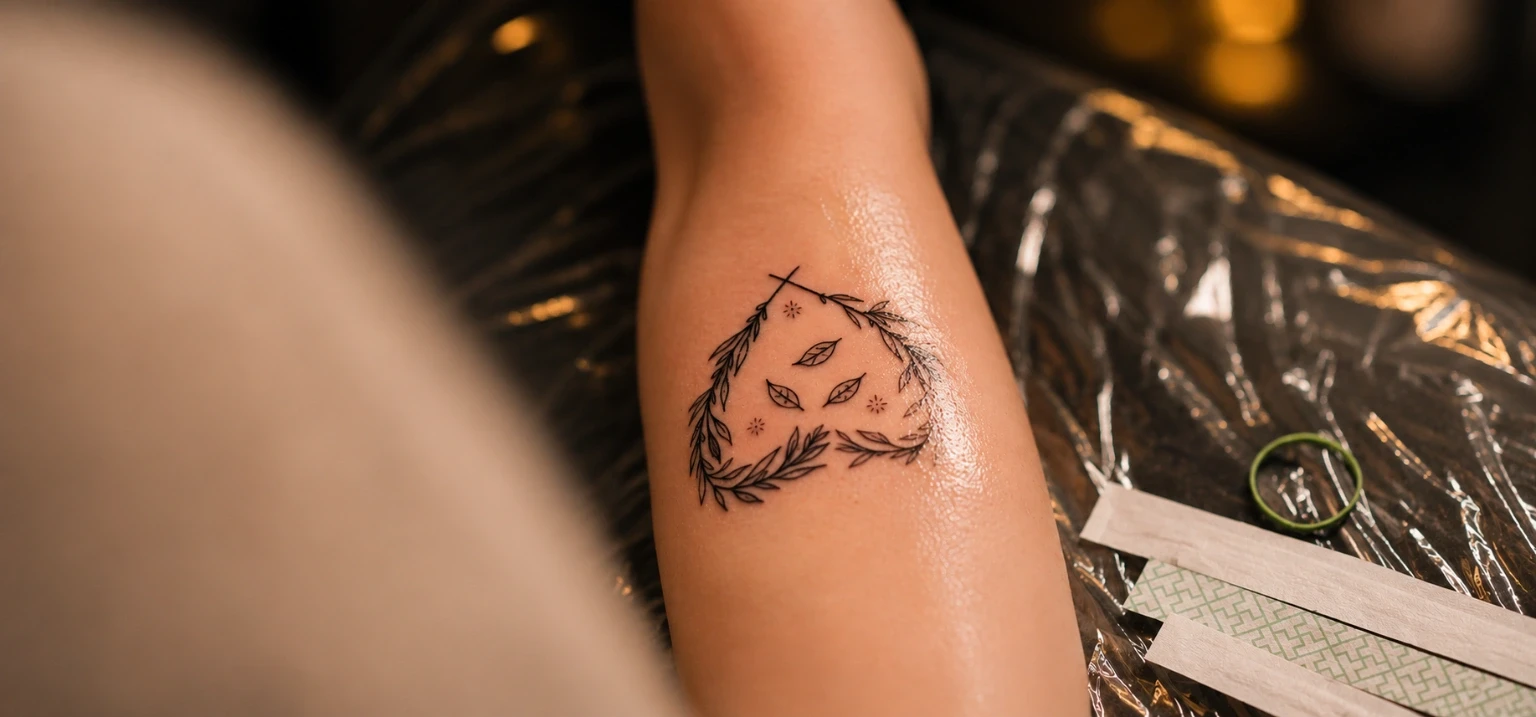
Unlike an airtight plastic sheet, the products discussed here are designed to be water-resistant barriers that permit moisture vapor transmission. Saniderm describes its original film as a polyurethane medical bandage with an acrylic adhesive. Recovery describes Derm Shield as a transparent, matte, latex-free protective film that is waterproof while allowing perspiration to pass through.
The purpose is to provide a temporary protective covering during the early aftercare period. It helps separate the tattoo from normal contact with clothing, dust, and other external irritants while the seal stays intact. It does not replace the rest of the aftercare your artist recommends.
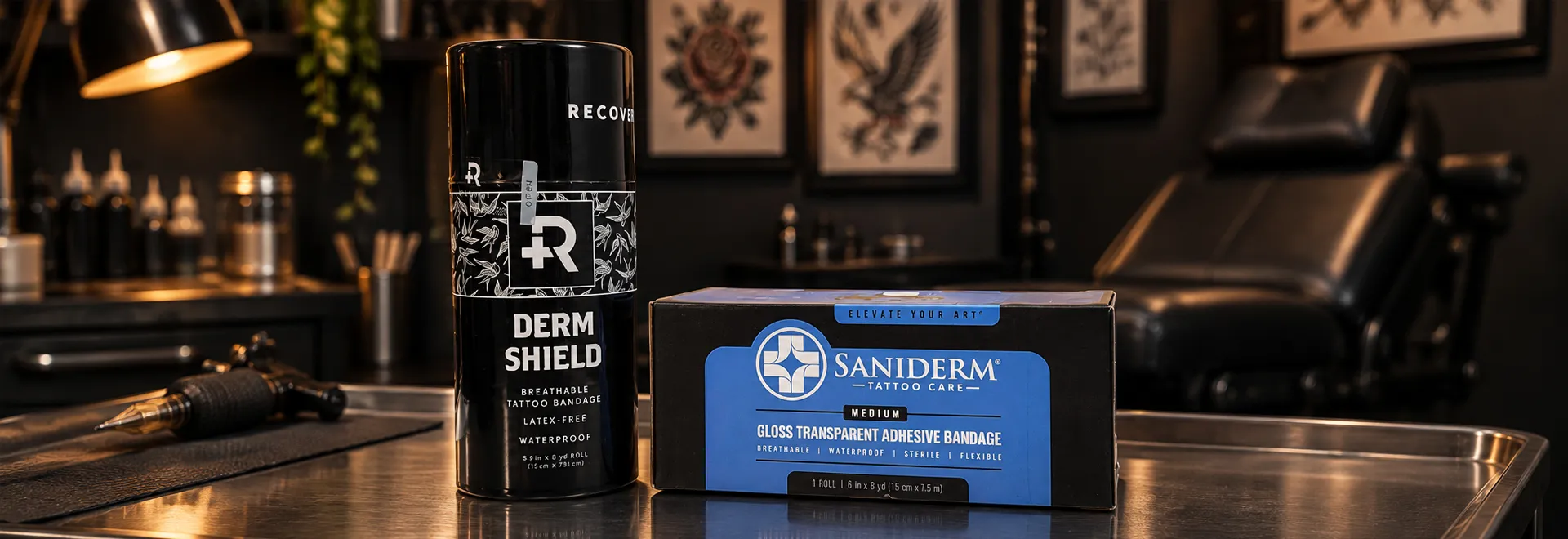
Recovery Derm Shield and Saniderm both offer roll-based products that artists can cut for different tattoo sizes. Recovery also offers rectangular precut sheets and small circular Bangers. The right choice depends on the artwork's dimensions, the surrounding clean-skin margin, the body location, and how much film a studio typically uses.
"Second skin" describes a dressing category, not a universal set of directions. Both brands use adhesive protective film, but their instructions for the second application and maximum wear should be read separately. Use the guidance for the actual product provided by your tattoo artist.
WHAT THE MANUFACTURERS DESCRIBE
Benefits of Breathable Adhesive Tattoo Film
The advantages promoted by both manufacturers concern the physical properties of the bandage and the convenience of covering a new tattoo.
Separates skin from outside contact
Both brands describe a barrier against routine dirt and external irritants, provided the film remains properly sealed to the surrounding skin.
Allows vapor to move
The film is designed to permit water vapor transmission while remaining a protective covering. Breathable does not mean that liquid water can safely enter underneath.
Supports normal showering
Manufacturers describe waterproof performance for everyday activities, including showers. Submerging a new tattoo is a separate issue and is not recommended.
Helps reduce rubbing
A covered tattoo has a layer between the skin and normal incidental contact with fabric or nearby surfaces. A bandage can still lift if repeatedly rubbed or stretched.
Follows body contours
Thin film moves with many body areas more comfortably than a rigid dressing. Placement over joints or high-motion skin still requires careful sizing and adhesion.
Makes the covered area visible
The transparent construction lets the artist or client observe fluid buildup, edge lifting, and the general appearance of the covered tattoo.
Both manufacturers also promote maintaining a moisture-supportive covered environment. Saniderm describes retaining naturally released fluid during the first stage, while Recovery emphasizes breathability and flexibility. Recovery's Derm Shield listing says it "eliminates scabbing and reduces risk of scarring."
A practical benefit for clients is less frequent manipulation of the covered area while a piece remains correctly in place. The film still needs observation: if its seal fails, continuing to wear it defeats the purpose of the protective barrier. Normal care resumes when the covering is removed, according to the artist's instructions.
BRAND AND FORMAT COMPARISON
Recovery Derm Shield vs. Saniderm: Side-by-Side
These are both professional tattoo adhesive-film systems. Their differences are clearest in their published instructions, product finish descriptions, and the roll or precut formats that can simplify different workstation tasks.
| FEATURE | RECOVERY DERM SHIELD | SANIDERM ORIGINAL FILM |
|---|---|---|
| Film description | Transparent, matte, latex-free, breathable adhesive film | Transparent polyurethane film with acrylic adhesive; breathable and waterproof |
| First application | About 24 hours, depending on exudation | 8–24 hours; replace by 24 hours |
| Second application | Several days; no exact fixed duration given | Normally 3–5 days; FAQ allows up to 6 days within the total limit |
| Maximum wear guidance | No individual piece longer than one week | No more than seven consecutive days total |
| Cutting margin | 1–2 inches around the tattoo | At least 1 inch; detailed guidance uses 1–2 inches |
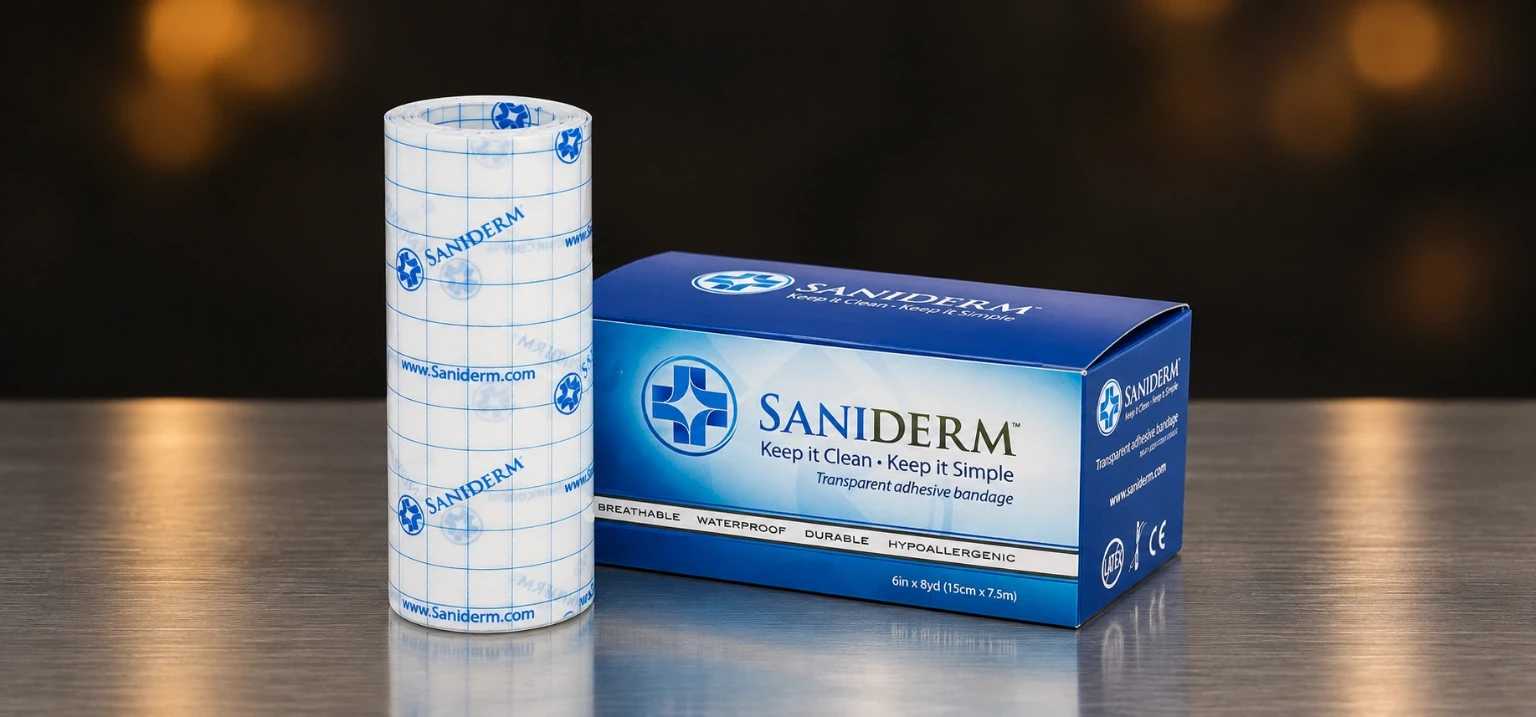
| Form factors discussed | 8-yard rolls, 5.9 x 7.9-inch sheets, 3-inch circular Bangers | 6 x 8-yard, 10.2 x 2-yard, and 10.2 x 8-yard rolls |
| Removal guidance | Slowly pull the film back over itself; do not pull upward | Slowly pull back over itself, preferably with warm running water when needed |
The comparison summarizes published manufacturer directions.
Recovery's main published protocol leaves the second-piece duration as "several days." Saniderm offers more explicit scheduling and a separate overall seven-day limit. That makes it especially important to preserve the brand distinction when explaining aftercare to a client.
Recovery offers formats that reduce measuring for smaller areas, while Saniderm's linked options are cut-to-length rolls. The best stocking choice can therefore be driven by tattoo size and workflow.
FIRST PIECE VS. SECOND PIECE
How Long to Leave Each Piece of Tattoo Film On
The first application is exposed to the initial period when a fresh tattoo may release blood, plasma, and residual ink. Later applications may remain more stable because fluid release generally decreases. This is the reason the manufacturer's initial-wear interval is shorter than the later-wear interval.
Recovery says approximately 24 hours, depending on fluid. Saniderm says 8–24 hours, with earlier replacement if heavy weeping compromises adhesion.
Both brands direct users to gently clean and dry the tattoo between film applications. Saniderm's detailed guide includes allowing additional air-drying time before the next sheet.
Recovery says several days without specifying an exact second-piece number. Saniderm's product directions say 3–5 days and its FAQ permits up to 6 days, subject to seven consecutive days total.
Recovery allows a third application if necessary. Saniderm describes replacing a fluid-filled second piece after another 24 hours and adjusting the third piece to remain within its seven-day total.
Neither manufacturer's schedule tells the client to keep a leaking or irritating bandage in place until an arbitrary date. The condition of the seal and skin matters throughout wear. An artist should explain the intended first-change time before the client leaves the studio.
Recovery's "no individual piece longer than one week" wording is not the same as Saniderm's "seven consecutive days total." Saniderm's six-day second-piece FAQ allowance is also not a Recovery instruction. Follow the actual brand, packaging, and professional aftercare plan.
MANUFACTURER PROTOCOL / RECOVERY
Recovery Derm Shield: First, Second, and Third Applications
Recovery's official Derm Shield Instructions for Use begin with a cleaned and dried tattoo and surrounding skin. Recovery specifies removing remaining soap or residue, cutting enough film for a 1–2 inch margin, and smoothing it from the center outward without stretching.
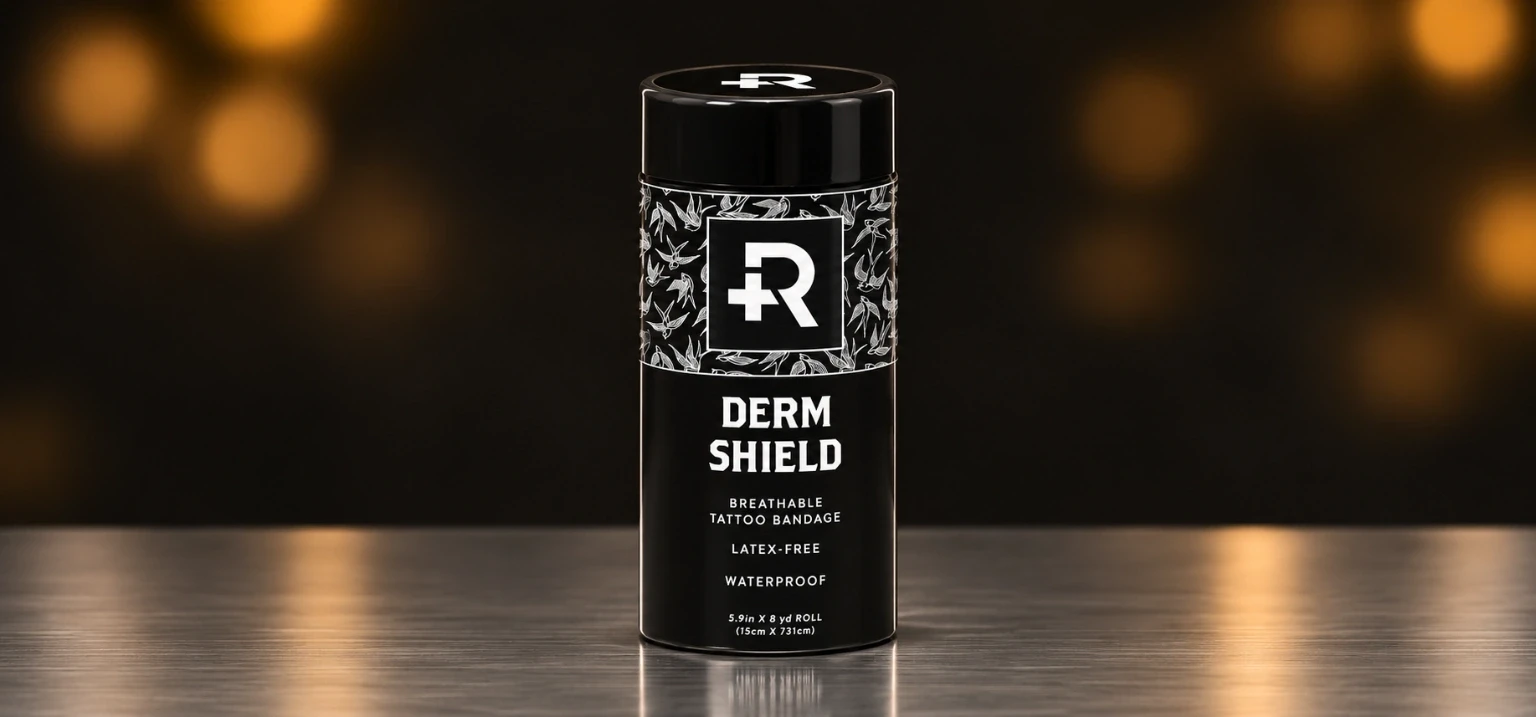
The manufacturer says the first Derm Shield application should stay in place for 24 hours, depending on the level of exudation. It also notes that blood and fluid collecting under the covering can be normal. Fluid amount influences whether the bandage remains properly sealed and appropriate to continue wearing.
After removal, Recovery instructs users to gently clean and dry the area between applications. A second piece may stay on for several days, and a third may be used when necessary. Recovery does not give an exact 3-day, 5-day, or 6-day second-piece rule in the main protocol.
Recovery states that no individual Derm Shield piece should be worn longer than one week. That does not establish a recommended minimum wear time. If irritation, adhesion failure, or another problem occurs, the piece may need removal before its planned change.
For removal, Recovery directs users to peel from an edge and slowly pull the film back over itself, not upward away from the skin. Its caution says to discontinue use if irritation or an adhesive reaction occurs and to consult a physician if the response is severe.
The protocol applies to Derm Shield film, whether selected from an appropriately sized roll or sheet. An unusual shape, high-motion placement, or very small circular cut does not override the need for clean surrounding skin and a secure border.
MANUFACTURER PROTOCOL / SANIDERM
Saniderm: The 8–24 Hour First Piece and Longer Second Piece
Saniderm's official wear-time guidance recommends leaving the initial bandage for 8–24 hours. It explains that heavy weeping can require an earlier change if fluid affects adhesion. Regardless of modest buildup, the manufacturer advises changing the first piece by the 24-hour mark.
The product pages describe a second application for 3–5 days. Saniderm's separate FAQ allows the second bandage to remain for up to six days when conditions are appropriate. These statements fit together when the first piece is removed within the first day and total consecutive bandage use stays at or below seven days.
If significant weeping continues underneath the second piece, Saniderm says to remove it at the next approximately 24-hour change, clean and dry the tattoo, and consider a third piece. Its FAQ describes a third piece worn for up to five days when that schedule stays within the total seven-day period.
The brand's detailed guide describes gently removing the old film under warm running water when needed, cleaning the area, patting dry with a clean disposable towel, and allowing roughly 5–10 minutes of additional air drying before applying the next piece.
The manufacturer also cautions against continuing use when the film leaks, water enters, the seal becomes compromised, or an adhesive reaction develops. Its seven-day total limit applies across successive bandages, rather than restarting whenever a new sheet is applied.
With Saniderm, changing the first dressing does not reset the overall seven-day maximum. The appropriate second or third application depends on when the tattoo was done, the condition of the skin, and the current film's seal.
APPLICATION WALKTHROUGH
How to Apply Tattoo Second Skin Film
Proper application begins with preparation, not with stretching film across the tattoo. Both brands emphasize a clean, dry surface and sufficient border area for the adhesive to attach to surrounding skin. The tattoo artist should select the piece and perform the initial application using appropriate professional handling.
-
Clean the tattoo and surrounding area.
Follow the chosen brand's directions and the artist's procedure. Remove residual soap and other material that would interfere with adhesion. Handle fresh tattooed skin carefully.
-
Dry the skin thoroughly.
Gently pat with a clean disposable towel and allow remaining moisture to evaporate. A film applied to wet surrounding skin is more likely to lose its intended seal.
-
Cut or choose a large enough piece.
Recovery specifies an additional 1–2 inches on all sides. Saniderm specifies at least 1 inch, with detailed instructions also recommending 1–2 inches. Check the margin before removing the backing.
-
Expose the adhesive carefully.
Peel away the backing according to the product's liner design, avoiding unnecessary contact with the adhesive surface. Use clean hands or gloves as directed.
-
Center the film over the tattoo.
Position it so the entire tattoo is covered and the border rests on clean, dry skin. Do not assume a partially covered tattoo has adequate protection.
-
Smooth from center to edges.
Use gentle pressure to move air outward and establish contact. Recovery specifically says not to stretch its film during application; avoid pulling film tight across moving joints.
-
Remove the outer carrier and check the seal.
Follow the film's liner-removal sequence and inspect all edges. Confirm that the border is lying flat and is not immediately being lifted by skin folds or clothing.
A few visual wrinkles outside the tattoo are not necessarily the same as a broken seal. The important questions are whether the film covers the tattoo completely, whether the adhesive perimeter remains continuous, and whether the person can move normally without pulling the covering loose.
When changing film at home according to the artist's instructions, use a completely new piece. A removed dressing should not be reapplied, and a used adhesive surface should not be treated as freshly prepared film.
GENTLE REMOVAL
How to Remove Derm Shield or Saniderm Without Pulling Straight Up
The two brands agree on the basic removal direction: peel the film slowly back over itself rather than lifting it directly away from the skin. Pulling upward creates unnecessary tension on the tattoo and the surrounding adhesive area.
Locate an accessible edge
Start from a corner or edge that you can lift gently without scraping or rubbing the tattooed area.
Fold back, do not lift up
Keep the removed portion low against itself as you peel. Saniderm recommends moving in the direction of hair growth.
Use warmth when appropriate
Saniderm specifically recommends a warm shower if removal is difficult. Use gentle water flow, not forceful pulling or prolonged soaking.
Clean and assess the area
After removal, follow the brand's and artist's directions for gentle cleaning. Reapply only if another film application is still appropriate.
Saniderm also discusses methods for loosening stubborn adhesive at the edges in its separate removal FAQ. Those are not part of Recovery's primary protocol, so do not assume every supplemental removal technique is automatically appropriate for every film or skin condition.
If removal is unusually painful, skin appears damaged, or a reaction is developing, do not keep pulling aggressively. Seek guidance from the tattoo artist or an appropriate healthcare professional.
WHEN THE PLAN MUST CHANGE
When Should You Remove or Replace the Film Early?
Both manufacturers make it clear that the published wear period assumes the dressing is functioning as intended. A good seal is more important than reaching a target day. A film that no longer covers or adheres properly cannot be treated as an intact protective dressing.
Saniderm says excessive weeping can weaken the bandage's adhesion, and when pooling becomes excessive or compromises adhesion, it says to remove the film, clean the area, and reapply. Do not wait for the originally planned change time once the protective edge fails.
Saniderm advises removing or replacing film when its adhesion fails. A loose area outside an intact border is different from a channel that lets outside material reach the tattoo.
Saniderm directs users to remove a bandage if water enters beneath it, clean the area, and decide with the artist whether a new film is appropriate. A waterproof surface is not protection after the seal is compromised.
Saniderm allows earlier replacement when heavy weeping threatens adhesion or leakage. A moderate amount of fluid under an intact first bandage is different from a pouch that can no longer stay sealed.
Recovery instructs users to discontinue use if irritation or allergy occurs. Saniderm advises removal and cleaning when moderate or severe redness, swelling, or discomfort develops under the adhesive.
Recovery also warns against applying Derm Shield to infected wounds. If the tattoo's appearance raises a medical concern, do not simply cover it again. Consult a healthcare professional for symptoms such as worsening redness, warmth, increasing pain, fever, or unusual discharge.
Changing film and stopping film use are different choices. A new piece may be appropriate when the artist's plan and manufacturer's timing still allow it. Repeatedly peeling, cleaning, and covering irritated skin is not automatically the right response.
WHAT YOU MAY SEE UNDERNEATH
Is Blood, Plasma, or Excess Ink Under Second Skin Normal?
A new tattoo may release fluid after the session. Both manufacturers acknowledge that blood and other exudate can collect under the first application. Saniderm specifically describes a mixture of plasma, blood, and excess ink that can form a visible pocket under the transparent film.
The tattoo may temporarily look blurred, darker, or obscured by this collected material. That appearance does not automatically mean the bandage is defective or the tattoo is damaged. The more useful observation is whether the film remains sealed and whether the amount of fluid is manageable.
Do not puncture the film to drain fluid. Doing so would break the barrier. If the amount becomes excessive or begins escaping around the edges, follow the manufacturer's early-change guidance.
Saniderm's protocol requires removing the first application by 24 hours even when the seal remains intact. Recovery also describes an approximately 24-hour initial period, adjusted according to exudation. The presence of fluid should not be used as a reason to leave the first application untouched for several days without reviewing the brand's actual instructions.
A second piece with renewed substantial fluid buildup also deserves attention. Saniderm instructs users to remove and reassess at the following 24-hour point if significant weeping continues. Recovery allows subsequent applications as needed but does not publish the same precise second-piece schedule.
EVERYDAY WEAR
Can You Shower, Move, and Wear Clothing With Tattoo Film?
Recovery and Saniderm both market their films as waterproof and breathable. In practical terms, a correctly applied, intact dressing can accommodate normal showering and ordinary activity more conveniently than an unprotected tattooed area exposed to routine friction.
Saniderm advises against submerging a new tattoo in baths, swimming pools, or hot tubs, even while the bandage is on. If water enters under the film, the manufacturer's instructions call for removing it rather than assuming the barrier remains effective.
Movement is another consideration. Skin around elbows, knees, wrists, ankles, or clothing contact points stretches and folds throughout the day. Choosing sufficient film area and a stable border can help, but a flexible dressing is not guaranteed to stay sealed through every movement or workout.
Saniderm also cautions that high perspiration, repeated friction, and prolonged movement may loosen the dressing. Recovery emphasizes flexibility for everyday activities but still requires correct application.
Transparent film should not be treated as sunscreen. Saniderm explicitly says it does not provide sun protection. Protect a fresh tattoo from unnecessary direct sun according to the artist's guidance, whether or not film is present.
ROLLS, SHEETS AND SMALL CIRCLES
Which Derm Shield or Saniderm Format Fits Your Tattoo?
Film size should be selected from the tattoo dimensions plus the required adhesive margin, not only the visible design. A piece that is exactly as wide as the tattoo may not leave enough clean surrounding skin for a continuous seal.
Recovery Derm Shield: flexible roll choices
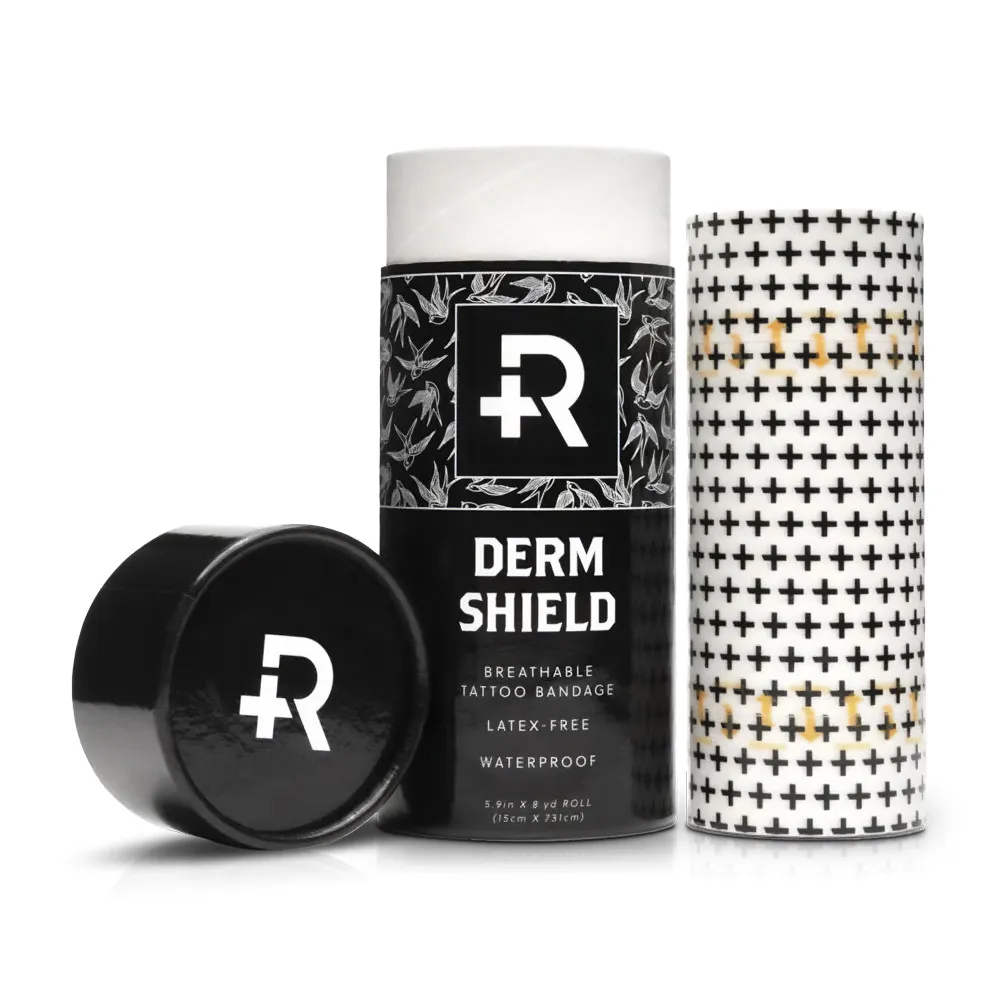
Recovery lists professional roll widths of 5.9 inches, 7.9 inches, and 10 inches, each in an 8-yard length. Its range also includes shorter personal-size roll options. The linked SVT Shop Derm Shield listing offers the 5.9-inch, 7.9-inch, and 10-inch 8-yard rolls.
Narrower rolls can be practical for compact artwork, while a wider roll can cover a broader tattoo and its surrounding margin without automatically needing multiple pieces. Studios using rolls can cut lengths to match the design and reduce unnecessary excess when the artwork dimensions are predictable.
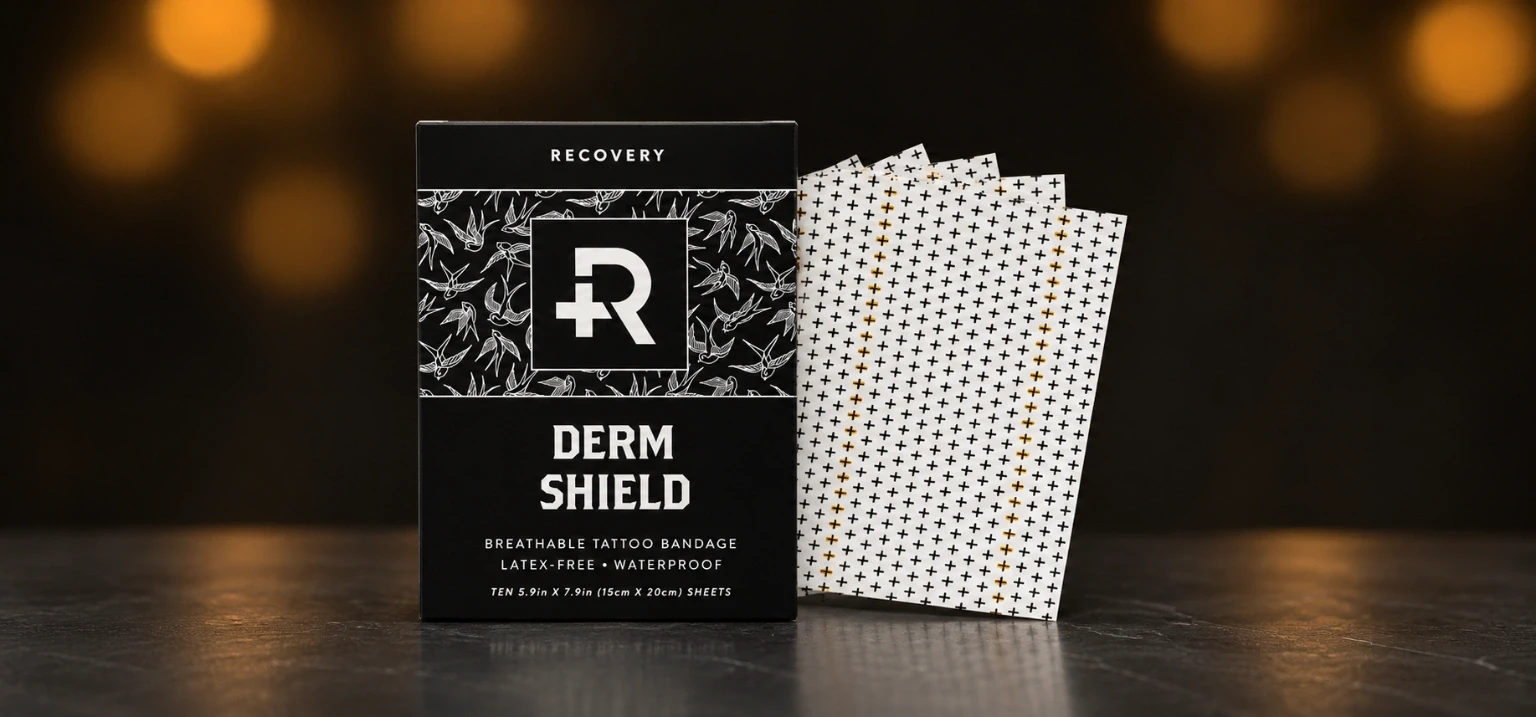
Recovery Derm Shield Sheet Pack: 5.9 x 7.9 inches
The 5.9 x 7.9-inch Derm Shield Sheet Pack contains 10 precut sheets, according to Recovery. The manufacturer also expresses the dimensions as approximately 15 x 20 cm. This is a useful format when repeatable rectangular sizes suit the studio's workflow and a roll cutter is unnecessary.
The advertised sheet dimensions are the complete sheet, not the maximum tattoo dimensions. Recovery's 1–2 inch surrounding margin must still fit. If the artwork and margin exceed the sheet, select an appropriately sized film format rather than treating a short border as sufficient.
Recovery Derm Shield Bangers: small circular patches
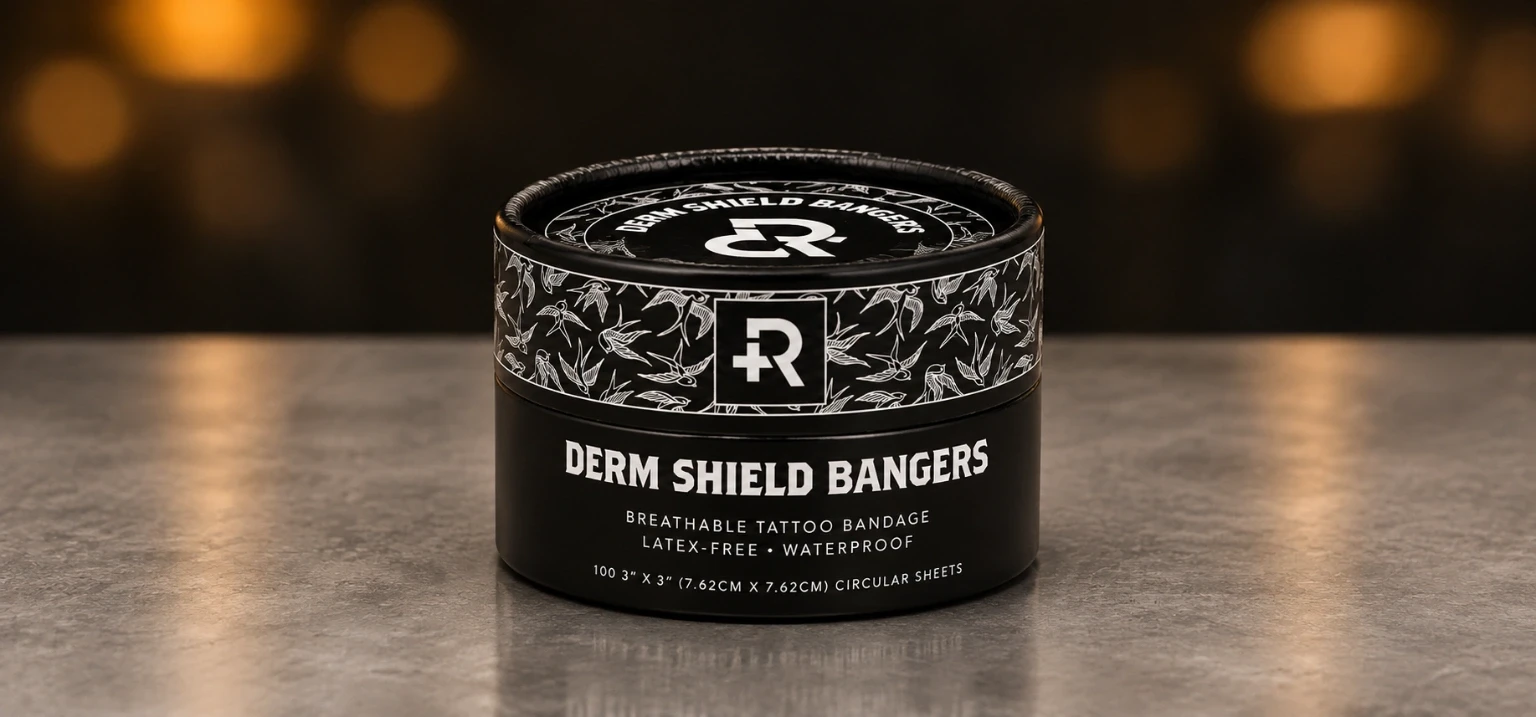
Recovery Derm Shield Bangers are 3-inch diameter circular adhesive films, supplied in a tub of 100. Recovery describes them as a convenient format for small tattoos. The circular shape can reduce cutting and sorting when an artist frequently completes compact designs.
A three-inch circle is not equivalent to a three-inch tattoo coverage allowance: the required clean-skin perimeter uses some of that diameter. For a larger small tattoo or one close to a crease, a larger rectangular sheet may provide a more reliable usable border.
Saniderm: three linked Original roll sizes
The Saniderm options linked at SVT Shop are 6 inches x 8 yards, 10.2 inches x 2 yards, and 10.2 inches x 8 yards. These are cut-to-length rolls of Saniderm Original tattoo adhesive film.
A 6-inch-wide roll can suit recurring smaller or medium pieces. A 10.2-inch-wide roll provides more width for larger artwork and border allowance. The 2-yard option offers that wider dimension in a shorter roll; the 8-yard option offers a greater total length for repeat studio use.
| SVT SHOP PRODUCT | PUBLISHED FORMAT | PRACTICAL REASON TO CHOOSE IT |
|---|---|---|
| Recovery Derm Shield Film | Manufacturer's 8-yard professional rolls: 5.9, 7.9, or 10 in widths | Cut custom lengths for varied tattoo sizes |
| Recovery Derm Shield Sheet Pack | 10 sheets, each 5.9 x 7.9 in | Repeatable precut rectangular coverage |
| Recovery Derm Shield Bangers | 100 circular pieces; 3 in diameter | Small designs when the full required margin fits |
| Saniderm 6 in x 8 yd | Professional roll | Narrower cut-to-length format for repeat use |
| Saniderm 10.2 in x 2 yd | Wide, shorter roll | Broader pieces when less total roll length is needed |
| Saniderm 10.2 in x 8 yd | Wide professional roll | Broader coverage across repeated sessions |
Roll length measures available material, not how long a bandage stays on the skin. Eight yards of film does not imply eight days of wear. Select by coverage requirements and studio usage, then follow the brand-specific timing instructions independently.
HOW PROFESSIONALS PLAN COVERAGE
How Tattoo Artists Choose Film Size and Explain the Change
A professional aftercare-film workflow starts before the final cleaning. The artist considers the artwork's widest points, the available surrounding skin, body movement, and whether the selected dressing will remain flat where it needs to adhere.
For a small, compact design, a precut Recovery sheet or Bangers circle may reduce cutting time if the required margin is available. For an irregular shape or large piece, a roll allows a tailored length. For broad work, the 10-inch or 10.2-inch roll formats deserve consideration because the width may simplify coverage.
High-motion or curved areas require particular attention. A piece cut too narrowly can peel as the client bends the limb. A piece stretched tightly during application may pull or lift. Recovery explicitly instructs users not to stretch the film; a stable, relaxed application should take priority over forcing the dressing around the contour.
The artist should also explain exactly when the first dressing comes off, whether a second application is expected, how to clean and dry between changes, and which changes in the seal require earlier action. Brand-specific instructions are more useful than an unexplained instruction to "leave it on for a few days."
If the client is expected to change the film at home, the artist should provide or identify the correct replacement size and show the intended removal direction. A client who has only one piece should know the alternative aftercare instructions to follow rather than keeping a compromised film in place.
AVOID THESE PROBLEMS
Common Tattoo Second Skin Mistakes
- Leaving the original piece on for multiple days without checking the label. Both manufacturers describe an initial period of about one day or less.
- Applying Saniderm's six-day second-piece guidance to Derm Shield. Recovery describes several days rather than the same numerical limit.
- Restarting Saniderm's seven-day clock after each change. Its total limit applies across consecutive applications.
- Cutting film exactly to the tattoo outline. Both brands require a clean-skin adhesive margin beyond the artwork.
- Applying film over damp or residue-covered skin. Moisture and residue can undermine proper adhesion.
- Stretching Derm Shield tightly during application. Recovery explicitly instructs users not to stretch the film.
- Puncturing the dressing to release pooled fluid. Opening a hole defeats the intact barrier.
- Ignoring leakage or a peeled edge over the tattoo. A broken seal calls for removal and reassessment.
- Pulling the film straight upward. Both brands describe low, slow removal back over itself.
- Assuming waterproof means swimming is appropriate. Saniderm advises against submerging a new tattoo.
- Assuming film provides sunscreen. Saniderm says it does not protect against UV exposure.
- Reapplying a used sheet. A removed dressing is not a fresh adhesive film.
- Ignoring new irritation. Both brands advise changing course when significant discomfort or adhesive reaction occurs.
BEFORE THE APPOINTMENT ENDS
Tattoo Film Buying and Application Checklist
- I know whether my artist is using Derm Shield or Saniderm.
- I have checked the exact product's current instructions.
- The chosen format covers the tattoo plus its margin.
- I know when the first piece must be changed.
- I know whether a second piece is planned.
- I understand the second-piece duration for my brand.
- I know which maximum-use rule applies.
- The skin is clean and fully dry before film application.
- The adhesive perimeter is continuous and not under tension.
- I can recognize fluid that threatens to break the seal.
- I know how to peel the film back over itself.
- I know when irritation or leakage requires earlier removal.
- I have my artist's instructions for care after removal.
The right roll or sheet makes it easier to produce a continuous covering, but the product's actual instructions and the client's skin condition determine wear time. A well-stocked workstation should support correct sizing, controlled application, and a clear replacement plan.
SHOP THE SIX LINKED FILM OPTIONS
Recovery Derm Shield and Saniderm at SVT Shop
SVT Shop helps tattoo artists, apprentices, and studios select professional supplies for practical workflows. Based in El Paso, Texas, SVT Shop offers Next Day Delivery in El Paso; confirm delivery availability when placing an order.
Compare film by available width, total roll length, precut format, and manufacturer instructions. Choose enough material for the actual tattoo and the required surrounding border.
 RECOVERY / FILM ROLLS
Derm Shield Adhesive Film
Cut-to-size transparent matte film for varied tattoo dimensions.
VIEW DERM SHIELD FILM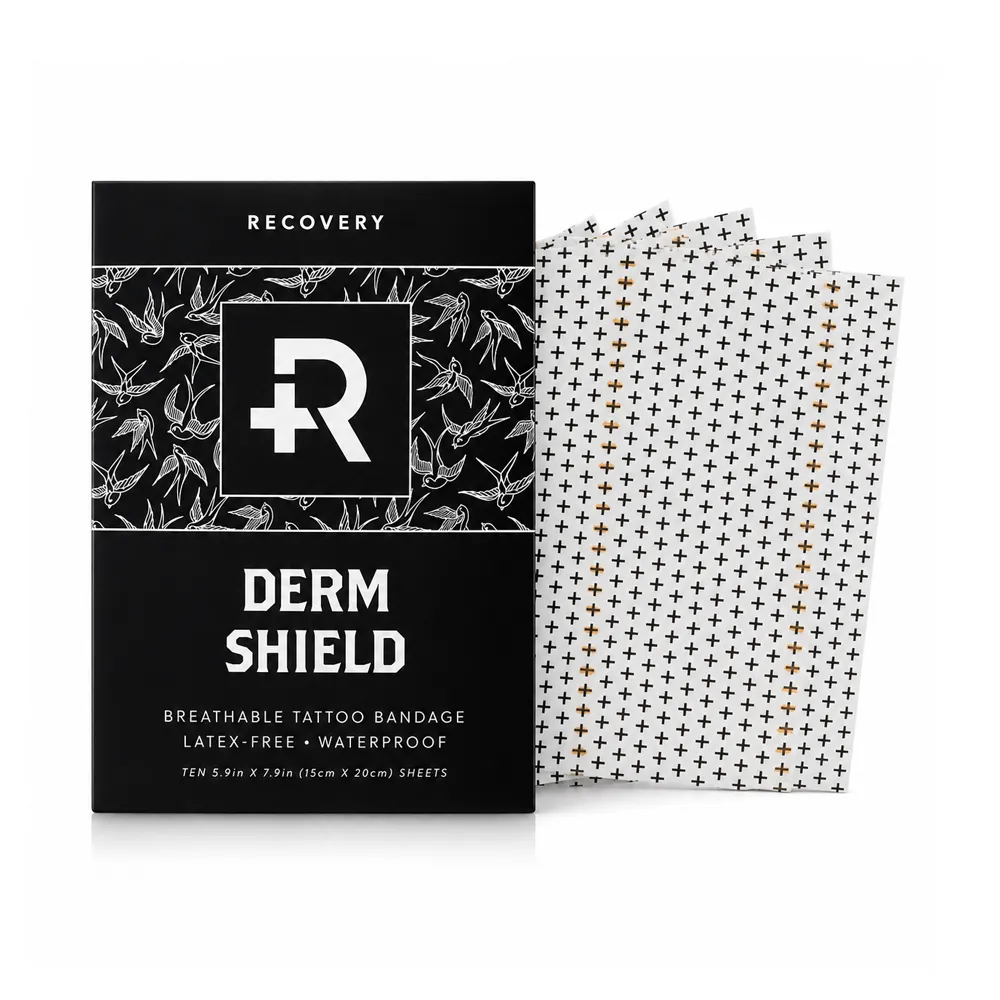 RECOVERY / PRE-CUT SHEETS
Derm Shield 5.9 x 7.9 in
Pack of 10 rectangular sheets for convenient repeatable coverage.
VIEW SHEET PACK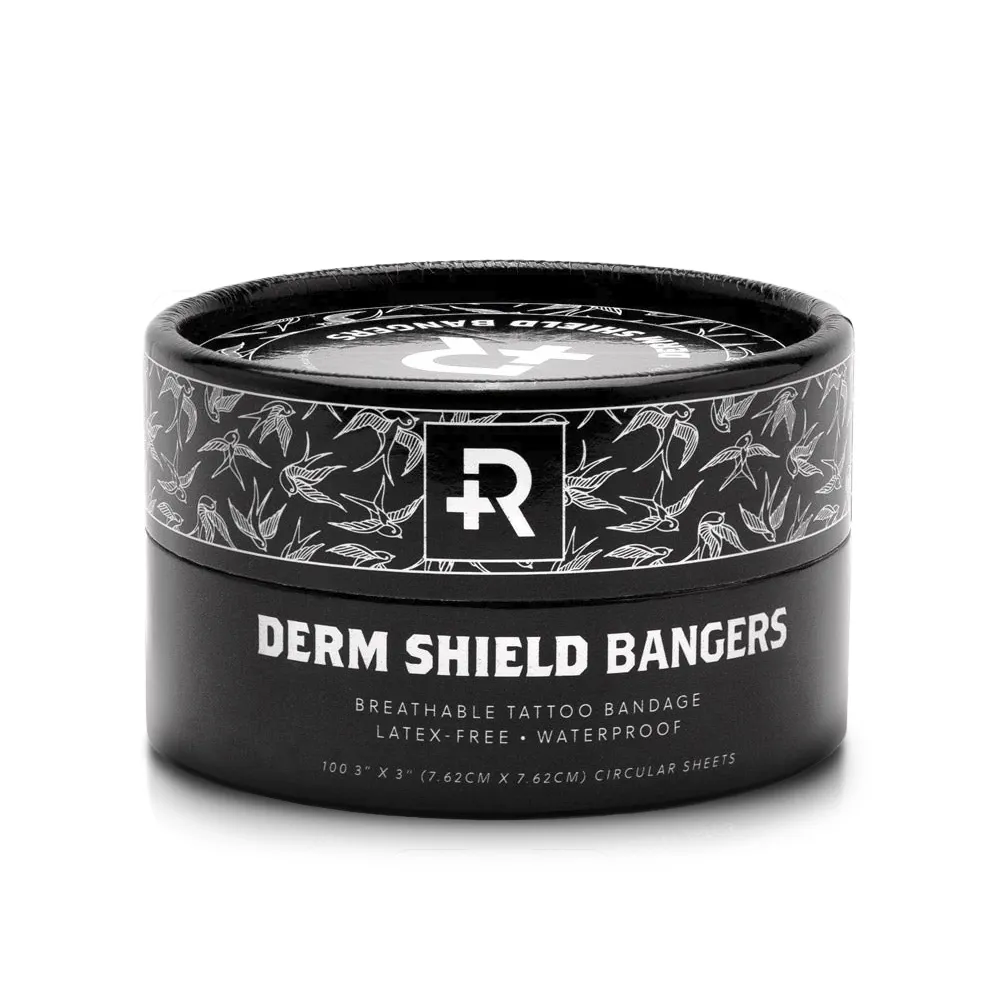 RECOVERY / SMALL CIRCLES
Derm Shield Bangers
Three-inch circular film, supplied in a tub of 100.
VIEW BANGERS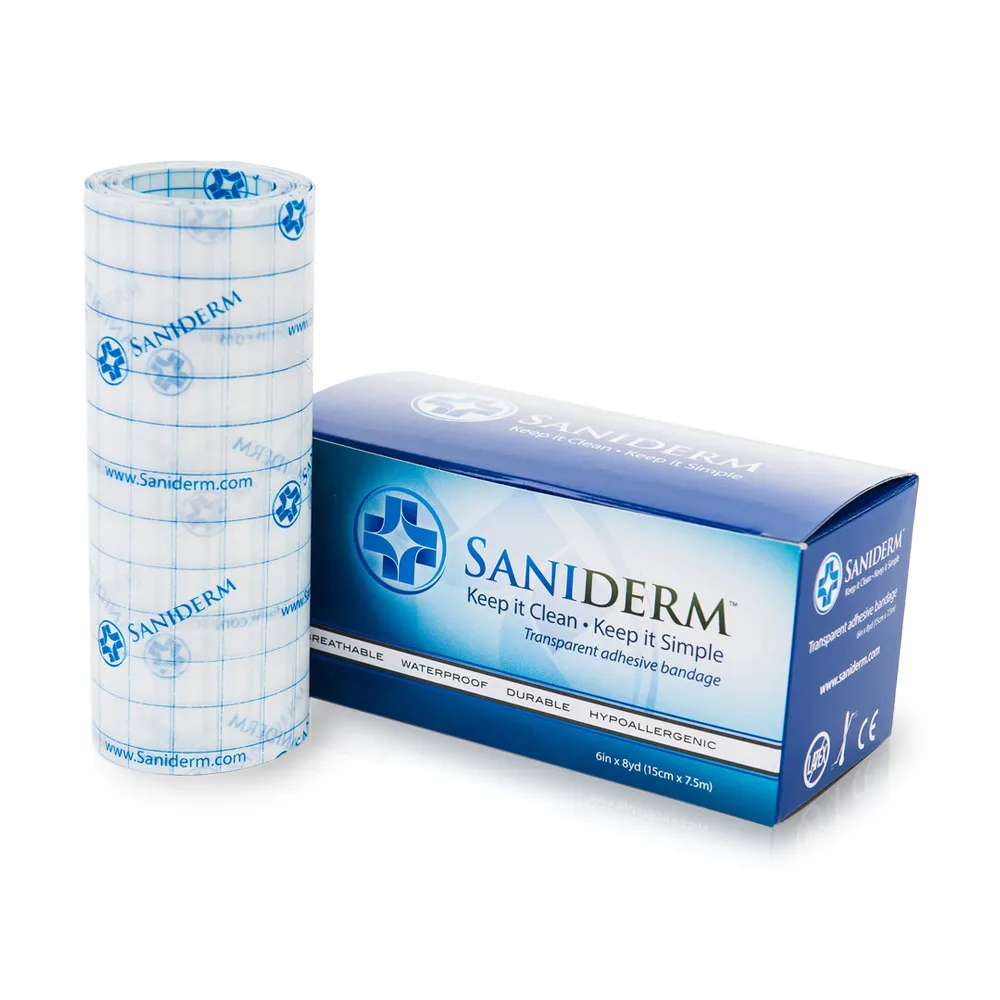 SANIDERM / 6 IN X 8 YD
Original Narrower Roll
Six-inch width for cut-to-length studio coverage.
VIEW 6-INCH ROLL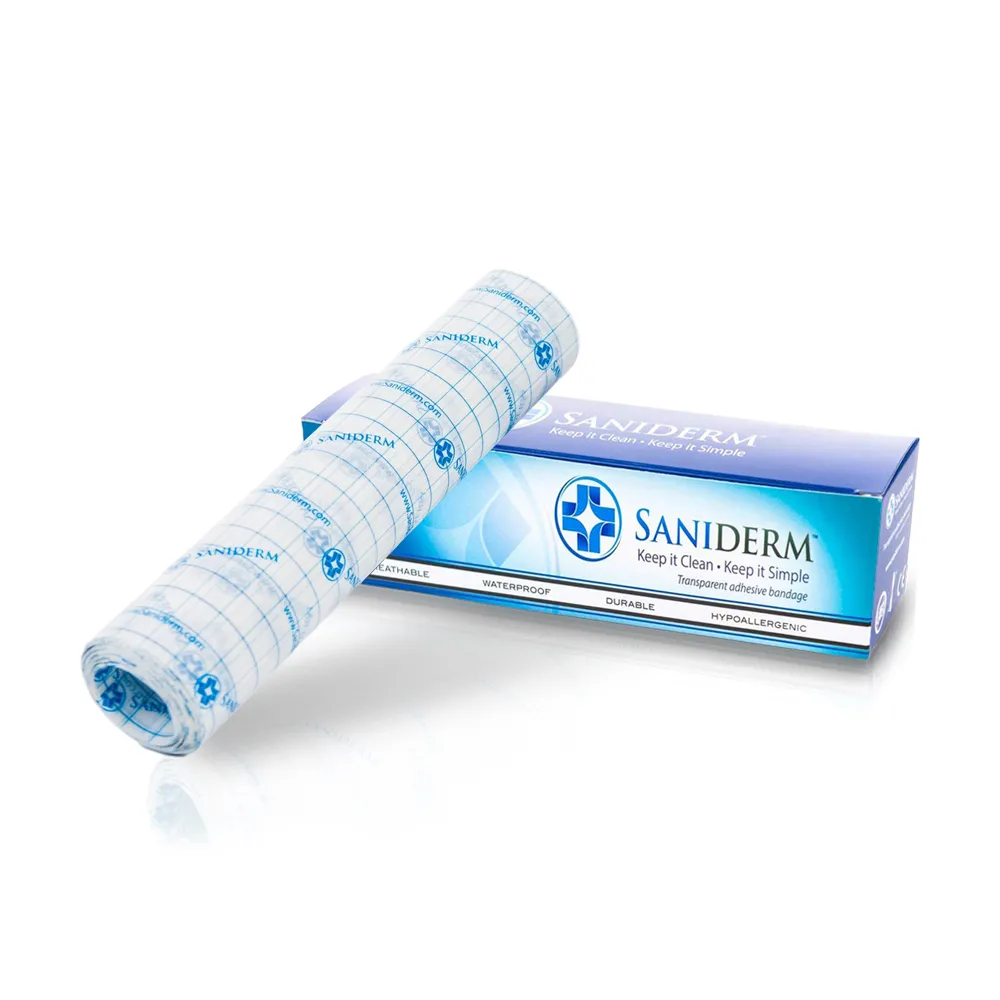 SANIDERM / 10.2 IN X 2 YD
Original Wide Short Roll
Wider coverage with a shorter total roll length.
VIEW 2-YARD ROLL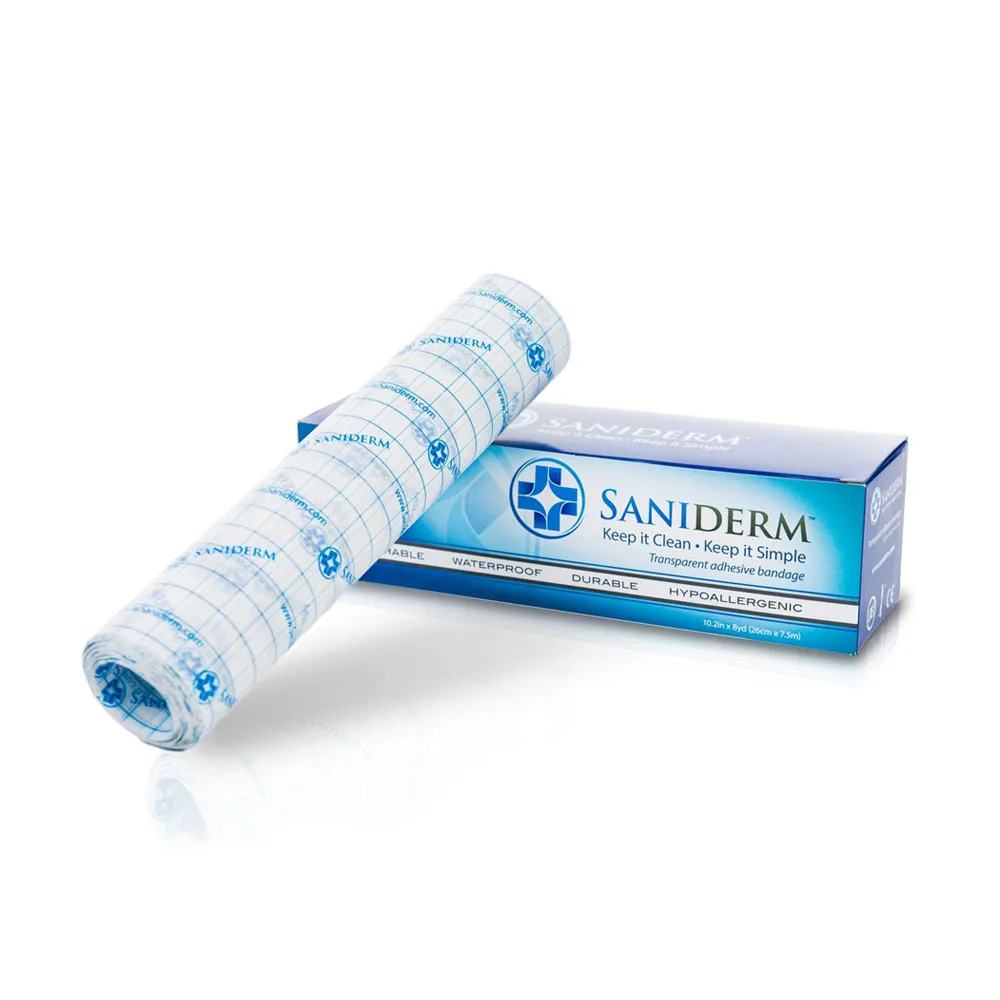 SANIDERM / 10.2 IN X 8 YD
Original Wide Studio Roll
Wider cut-to-length format for repeated professional use.
VIEW 8-YARD ROLLExplore the complete linked category: Bandages & Protective Films at SVT Shop.
COMMON CLIENT AND ARTIST QUESTIONS
Frequently Asked Questions
What does tattoo second skin film actually do?
It is a transparent adhesive dressing designed to form a temporary barrier over the tattoo while permitting moisture vapor transmission. Recovery and Saniderm describe protection against ordinary dirt, friction, and external irritants when the film remains correctly sealed.
How long do I leave the first Recovery Derm Shield on?
Recovery's instructions state approximately 24 hours, depending on how much fluid the tattoo releases. The manufacturer says some fluid accumulation beneath the film is normal. Remove sooner if irritation occurs or the film stops functioning as an intact cover.
How long does the second Derm Shield stay on?
Recovery says a second application can be used for several days and a third if needed. Its main protocol does not state an exact 3–5-day rule for the second piece. Recovery also says not to wear any individual Derm Shield piece longer than one week.
How long should the first Saniderm stay on a tattoo?
Saniderm recommends between 8 and 24 hours and says the first dressing should be changed by the 24-hour mark. Heavy weeping that threatens adhesion can justify an earlier change according to its instructions.
Can the second Saniderm stay on for six days?
Saniderm's product directions describe 3–5 days for the second piece, while its FAQ permits up to six days. In every case, its guidance says not to exceed seven consecutive days across all Saniderm applications. Discomfort or a compromised seal can require earlier removal.
Do I need a third piece of tattoo film?
Not necessarily. Recovery says a third Derm Shield application may be used if needed. Saniderm describes using a third piece if substantial fluid returns under the second one, with a change around the following 24-hour point and the seven-day total still observed.
Is it normal for fluid and ink to collect under second skin?
Both manufacturers acknowledge fluid accumulation after tattooing. Saniderm specifically discusses blood, plasma, and excess ink beneath the first dressing. A modest pocket is not automatically a reason for concern, but significant buildup, leakage, or loss of adhesion calls for reassessment.
Should I remove film immediately if it starts leaking?
Saniderm says excessive weeping can weaken adhesion; when pooling becomes excessive or compromises adhesion, it says to remove the film, clean the area, and reapply a new piece. An exposed tattoo should not remain beneath a dressing that is no longer sealed while waiting for the scheduled change.
How do I remove tattoo film without pulling my skin?
Both brands direct users to peel slowly back over the film itself rather than lifting straight upward. Saniderm recommends removal in the direction of hair growth and suggests a warm shower when adhesion makes removal difficult. Do not rip the film away.
Can I shower with Derm Shield or Saniderm?
Both brands describe waterproof film intended for ordinary everyday use, including showers when correctly sealed. Saniderm advises against baths, swimming, hot tubs, and other submersion; if water gets beneath the dressing, remove it and reassess.
Does transparent second skin protect my tattoo from the sun?
Do not rely on it for UV protection. Saniderm specifically says its film does not contain sun protection and recommends avoiding unnecessary sun exposure while the tattoo is fresh.
Which Recovery Derm Shield format works for tiny tattoos?
Derm Shield Bangers are 3-inch circular pieces supplied in a tub of 100. They are intended for small tattoos, but Recovery's required 1–2-inch clean-skin margin still matters. Select a larger sheet when the actual design leaves insufficient space inside the circle.
How many sheets are in the Recovery 5.9 x 7.9-inch pack?
Recovery describes a pack of 10 precut 5.9 x 7.9-inch sheets. Each sheet must cover the tattoo plus the required adhesive margin, so the dimensions are not the maximum tattoo size.
What is the difference between Saniderm 10.2 x 2 yd and 10.2 x 8 yd?
Both are approximately 10.2 inches wide, but the 8-yard roll contains four times the total roll length of the 2-yard version. Choose according to expected use and cutting needs; roll length does not change Saniderm's wear-time instructions.
What if the film causes redness, itching, or discomfort?
Recovery says to discontinue use if an adhesive reaction or irritation occurs. Saniderm advises removal and gentle cleaning for moderate or severe symptoms under the adhesive. Contact your tattoo artist and seek medical advice if symptoms are significant or persist.
MANUFACTURER RESEARCH
Sources Consulted
Product features, sizing, and application schedules were reviewed against Recovery Aftercare and Saniderm's published materials.
- Recovery Aftercare — Derm Shield Instructions for UseCleaning, application border, first and later dressing intervals, removal, and adhesive cautions.
- Recovery Aftercare — Derm Shield CollectionProfessional roll widths, sheet and circular formats, and product descriptions.
- Recovery Aftercare — 5.9 x 7.9-inch Sheet PackTen-sheet pack specifications and product directions.
- Recovery Aftercare — Derm Shield BangersThree-inch circular format and 100-count tub.
- Saniderm — Original Tattoo Bandage RollsOriginal-film roll widths and lengths.
- Saniderm — What Is Saniderm?Polyurethane film, acrylic adhesive, barrier properties, breathability, and moisture behavior.
- Saniderm — How Long Should I Keep Saniderm On?First, second, and third dressing intervals and overall wear limit.
- Saniderm — Guide to New Tattoo CareStep-by-step application, removal, drying, showering, and early-change situations.
- Saniderm — How to Remove SanidermPeel-back technique and warm-water removal guidance.
- Saniderm — Could I Have an Allergic Reaction?Signs of adhesive sensitivity and circumstances requiring removal.
- Saniderm — Sun Exposure and SanidermSaniderm contains no sun protection; avoid prolonged sun exposure.
Editorial note: Last updated November 12, 2026. This is an educational guide to two adhesive tattoo-film products, not a medical treatment plan. Follow the instructions for the exact film you are using and your tattoo artist's aftercare guidance. Consult a healthcare professional for significant irritation or suspected medical complications.