Powered by Comercia.io
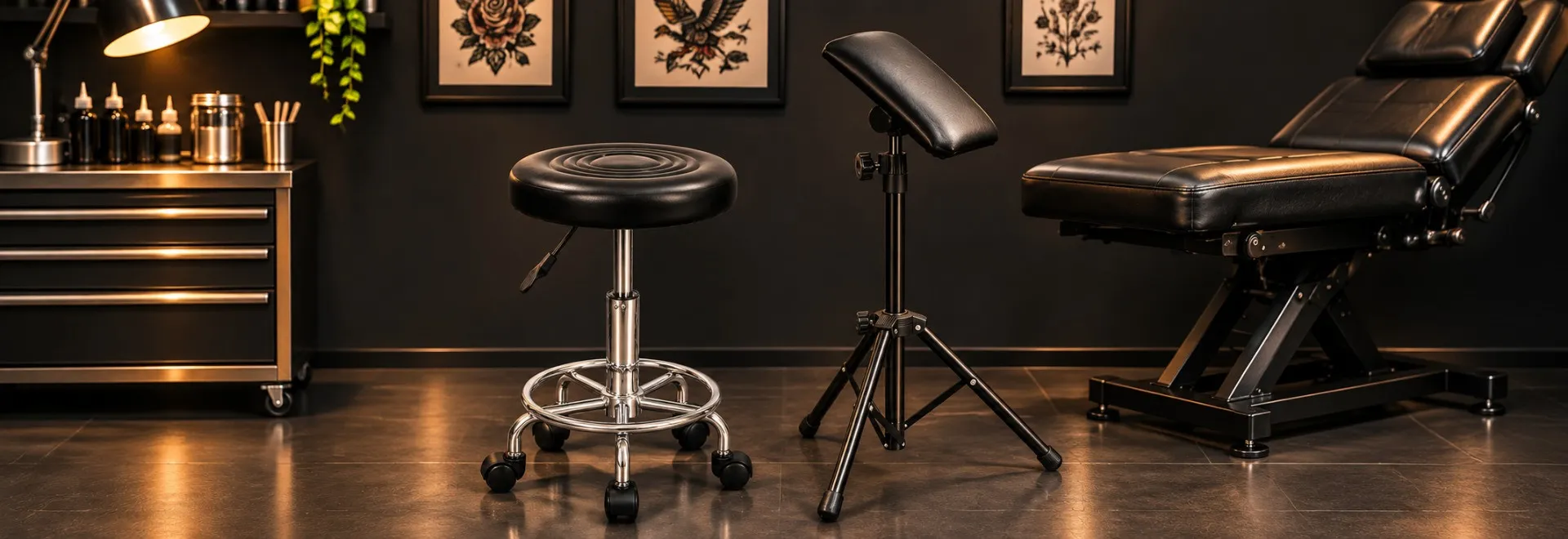
Build a practical tattoo station with the right reclining bed or portable chair, adjustable armrest, artist stool, workstation or work table, and single-use furniture covers. Compare adjustments, client positioning and daily studio workflow before investing in furniture.
EXPLORE TATTOO FURNITURE COMPARE THE FURNITURE
START WITH THE ESSENTIALS
Quick Answer: What Furniture Does a Tattoo Station Need?
A professional tattoo station needs stable support for the client, an appropriately positioned artist stool, a usable work surface, an armrest when the tattoo location requires it, and protective covers for exposed surfaces. Choose a reclining bed for varied body positioning or a folding chair for a mobile setup, then compare the specific back, leg, arm, height and angle adjustments you will actually use. Select furniture with surfaces you can clean and a practical between-client procedure for replacing covers and decontaminating contaminated equipment.
A COMPLETE WORK AREA
What Furniture Belongs in a Professional Tattoo Station?
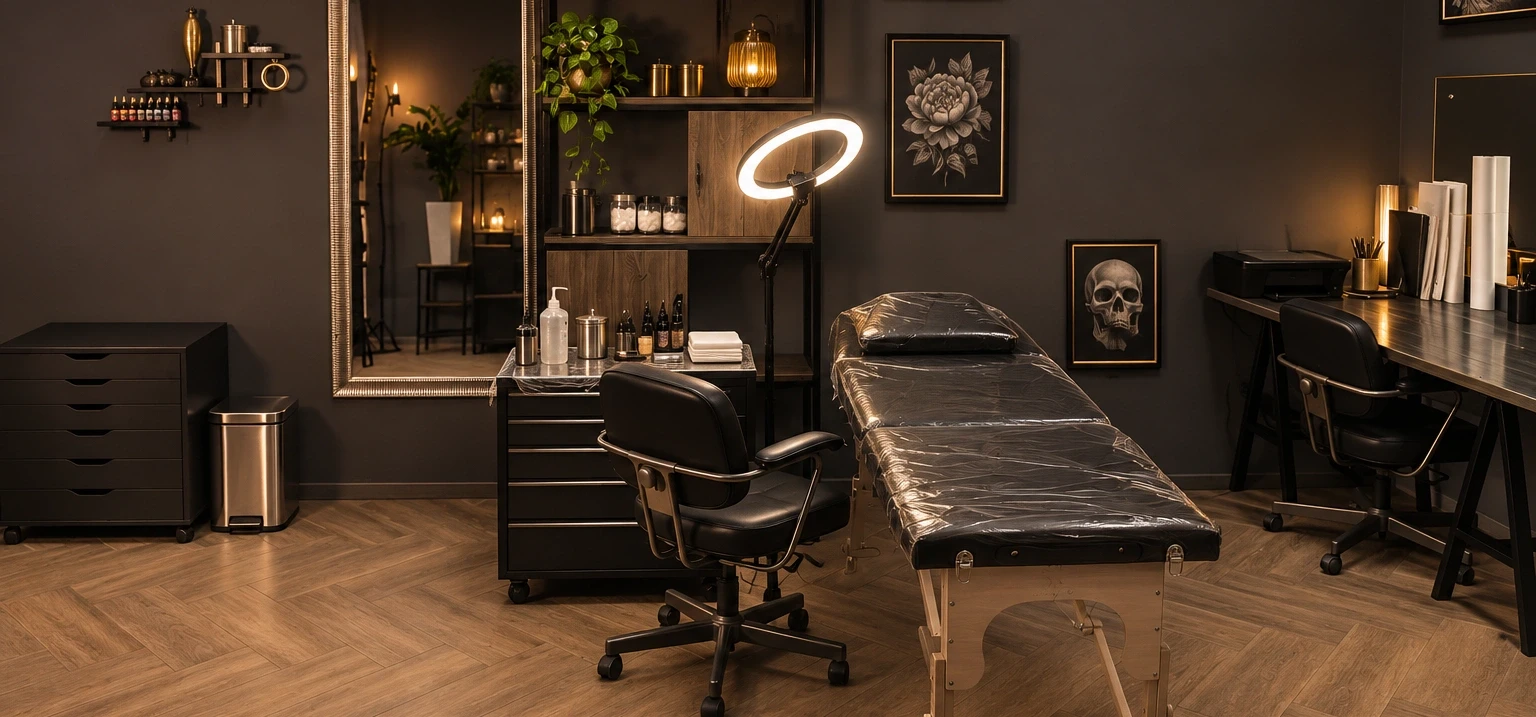
Tattoo furniture is more than a place for the client to sit. A well-planned station supports three activities at once: positioning the client, allowing the artist to work without fighting the furniture, and keeping frequently used supplies accessible in an orderly workspace. The furniture pieces should work together rather than simply fit beside one another.
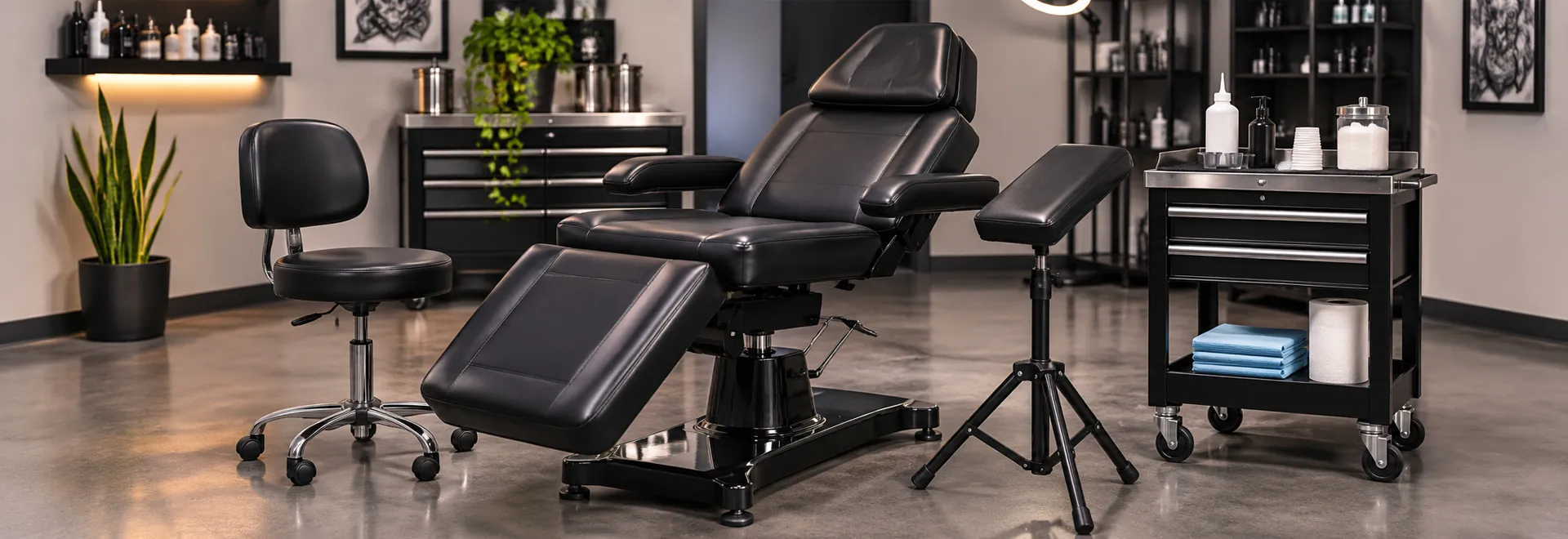
A typical permanent station begins with a reclining tattoo bed or chair, an artist stool, and an accessible work table. An independent armrest can provide more flexibility for forearm, wrist, hand and other arm-related work. Disposable furniture covers and an established cleaning procedure complete the practical setup.
Not every station needs the same arrangement. An artist concentrating on sleeves may use an armrest regularly. An artist doing back pieces and larger leg work may prioritize a reclining bed with separate sections. A guest artist moving between studios or convention booths may place a higher priority on a folding client chair.
Start by asking where your most common tattoos are placed, how often clients must change positions and how much repositioning the furniture requires during a session. Those answers are more useful than judging a bed, stool or workstation only by its appearance.
Bed or folding chair
Supports the client while the artist adjusts the body position needed to reach the tattoo area.
Stool and armrest
Helps the artist establish workable seating and support without relying on an unstable surface.
Table and covers
Provides a designated surface for prepared supplies and a practical system for protection and cleanup.
Furniture is only one part of a professional studio. Machines, cartridges, lighting, appropriate protective equipment and other tools belong in the larger setup plan. For that wider equipment overview, read SVT Shop's First Professional Tattoo Setup guide.
LET THE TATTOO LOCATION GUIDE YOU
Tattoo Bed or Tattoo Chair: Which Body Areas Do You Work On?
The best starting point is the type of client positioning your work requires. A tattoo bed that allows the back and legs to change position separately can serve several orientations. A portable chair with head, chest, arm and leg supports can help establish seated or forward-leaning arrangements when those positions suit the procedure.
For back, shoulder and upper-arm tattoos, the artist may need the client upright, forward-leaning or reclined depending on the design. A folding chair with adjustable chest and head supports can be worth considering for some seated back sessions. A reclining bed may be more appropriate when the client needs to change orientation during a larger piece.
For thigh, calf and other leg tattoos, separate leg adjustments may simplify positioning. For forearm, wrist and hand work, a dedicated armrest can position the target area independently of the client bed or chair. For chest, ribs and torso work, a reclining support with an appropriate back configuration may be useful.
These are workflow examples, not a universal positioning chart. The individual client, tattoo location, session length, accessibility and the artist's technique influence which support arrangement is suitable. A professional should always verify stability and comfortable access before beginning.
If your work regularly shifts between back, legs, chest and arms, compare furniture with more independent adjustments. If you usually perform compact seated designs or travel to guest spots, a folding chair and separate armrest may be a more relevant combination.
CLIENT SUPPORT / TWO RECLINABLE OPTIONS
Reclinable Tattoo Bed FCH-008 vs. FCH-007A
Both beds are intended to provide adjustable support for tattoo sessions, but their documented features are different. One emphasizes independent controls and hydraulic height adjustment; the other provides a fully reclining format with separate back and leg adjustments. The choice depends on which controls matter in your studio.
Reclinable Tattoo Bed FCH-008
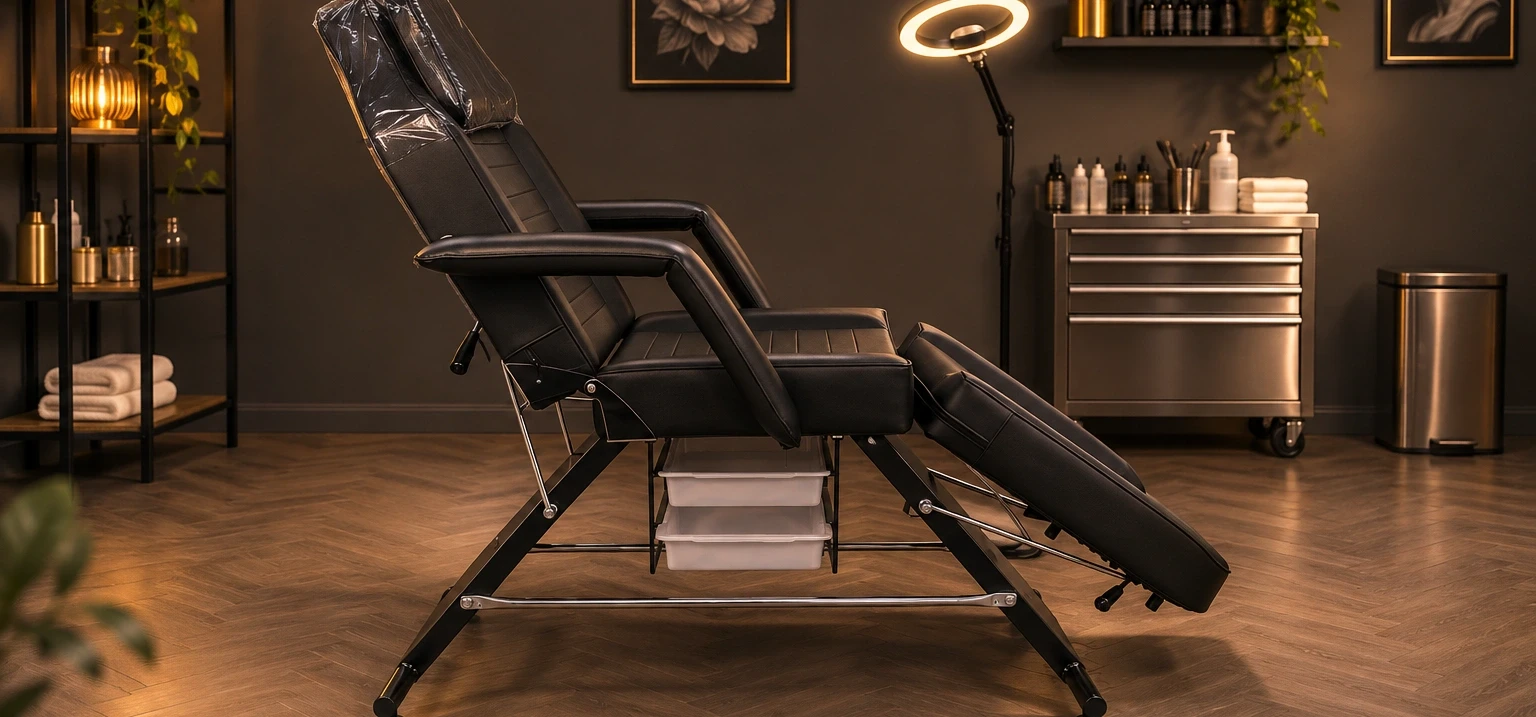
The FCH-008 has a backrest, leg sections and arm supports that recline separately. Its height is raised or lowered with a hydraulic mechanism. The bed includes high-density padding and an easy-to-clean synthetic-leather surface.
That combination can be helpful when a client must change orientation or when the artist wants to adjust working height without changing the main reclining position. The separate arm adjustments may also be relevant for positioning during upper-body work. Their presence does not eliminate the possible need for an independent armrest.
If you work across several tattoo locations throughout the week, compare how easily each section can be adjusted while the station remains stable.
VIEW RECLINABLE BED FCH-008Reclinable Tattoo Bed FCH-007A
The FCH-007A is a fully reclinable tattoo bed with separate backrest and leg adjustments. The upholstery is synthetic leather, making the listed surface relevant when planning routine cleaning and protective-cover use.
This is a practical model to compare if the studio needs reclining client support and independent back and leg positioning without a more complex feature list than the artist uses. If hydraulic height adjustment matters to you, choose the FCH-008.
Check the space it needs, how easily the client can be repositioned and how the artist will reach the work area before ordering.
VIEW RECLINABLE BED FCH-007A| FEATURE | FCH-008 | FCH-007A |
|---|---|---|
| Backrest | Separately reclining | Separately adjustable |
| Leg support | Separately reclining | Separately adjustable |
| Arm supports | Separately reclining | — |
| Height adjustment | Hydraulic elevation | — |
| Surface | Easy-to-clean synthetic leather | Synthetic leather |
| Padding | High-density padding | — |
If exact measurements matter for your room layout or client access, contact SVT Shop before ordering.
PORTABLE CLIENT FURNITURE
Folding Tattoo Chair FCH-003 for Guest Spots and Conventions
A folding tattoo chair becomes relevant when the artist does not work exclusively in one permanent room. Guest spots, conventions and temporary workstations often require furniture that can be packed and reassembled, then adjusted to the available working area.
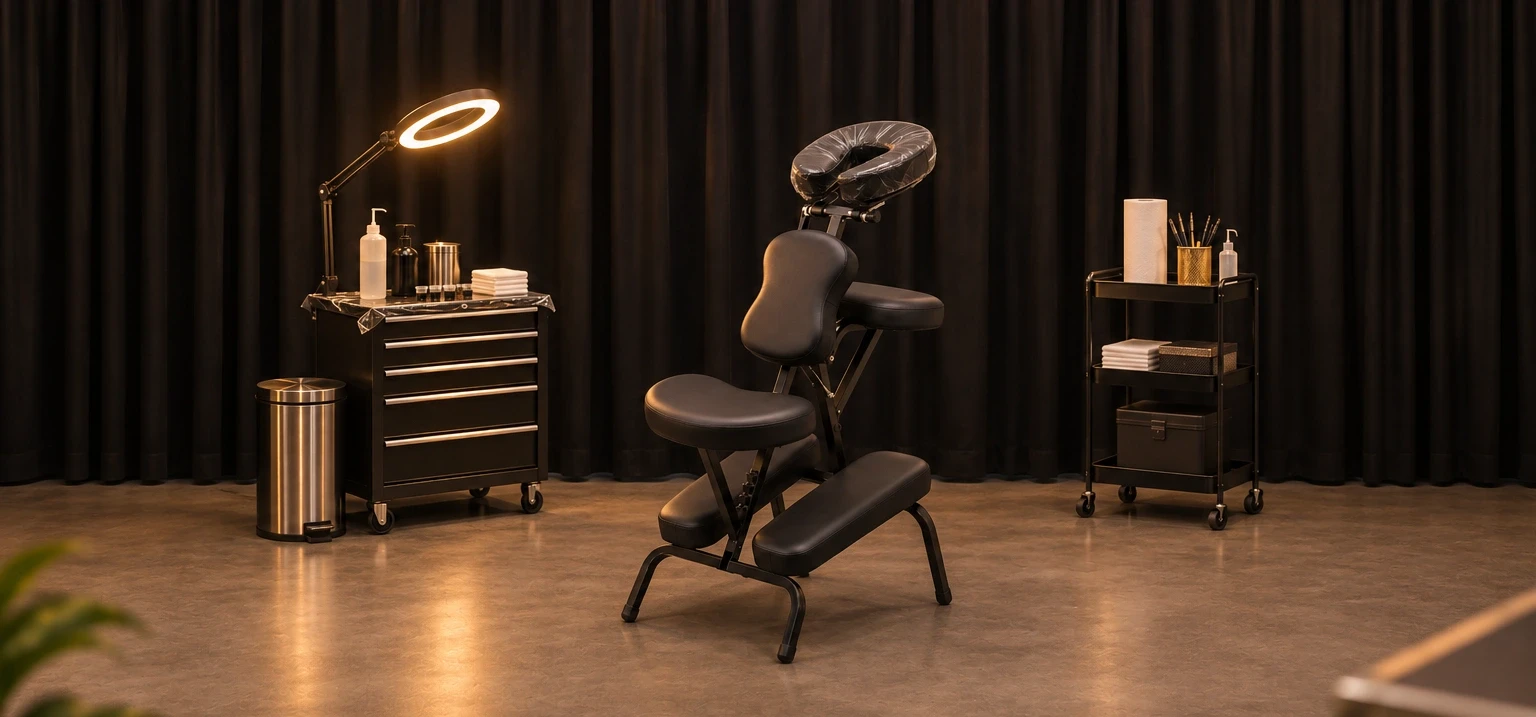
The Folding Tattoo Chair FCH-003 has a folding design and adjustable headrest, armrests, chest support and leg supports.
The separate chest and head supports make it useful to evaluate for seated or forward-leaning arrangements, while the arm and leg adjustments add flexibility for other positions. A portable chair should still be assessed for each tattoo location; folding construction alone does not mean it replaces a fully reclinable bed for every appointment.
For a convention, think about transportation, the event's approved equipment requirements, the assembled footprint, where the client enters and exits the chair, and how the artist moves around it. The chair must be stable and properly positioned before use.
A folding chair is also worth considering as a secondary client-support option in a permanent studio that occasionally hosts guest artists. That can be more useful than buying two identical pieces if the sessions involve different body positions.
VIEW FOLDING TATTOO CHAIR FCH-003POSITIONING SUPPORT
Tattoo Armrests: Folding Tripod vs. Flat-Base Design
A dedicated tattoo armrest helps create an independent support point for the area being worked on. It can be especially useful when tattooing forearms, wrists or hands, or when the client chair's built-in arm support does not place the skin where the artist needs it.
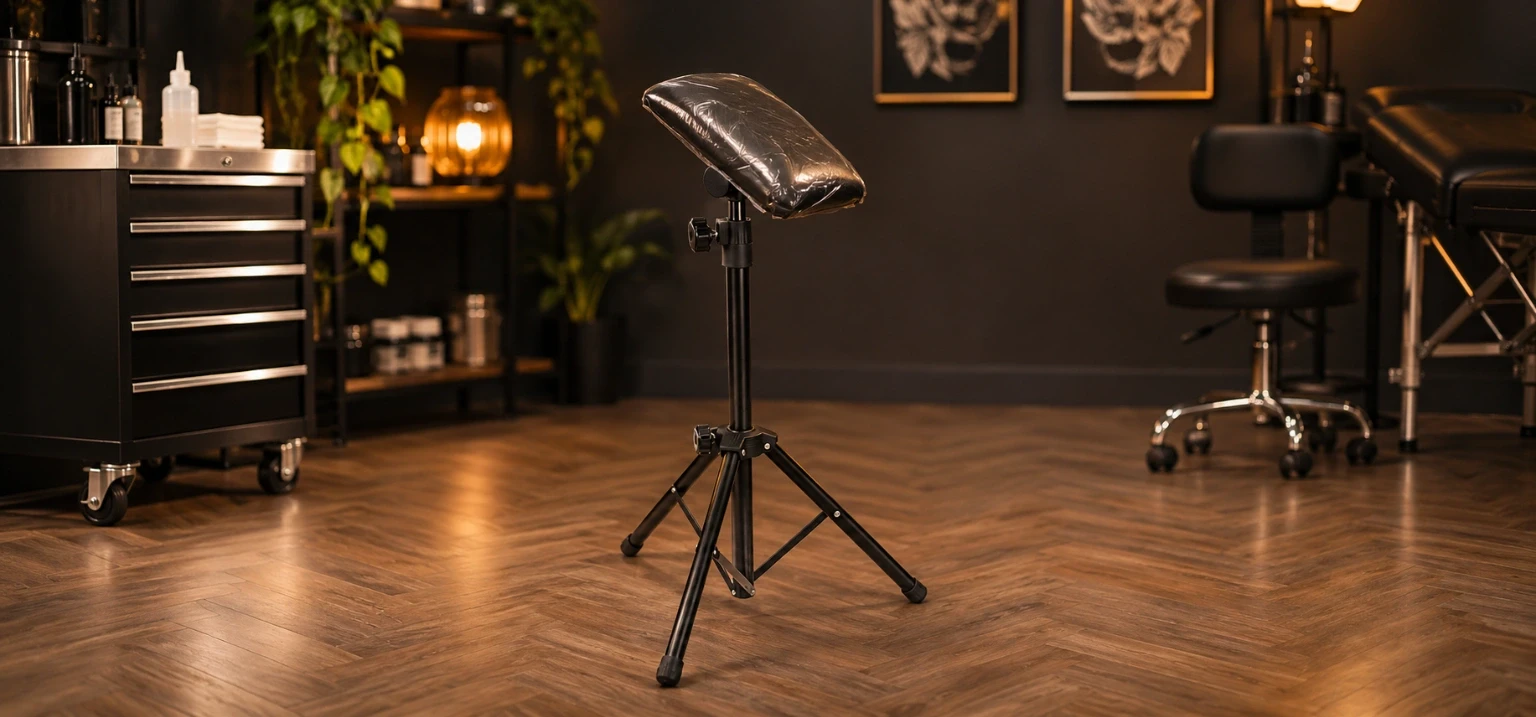
The Tattoo Armrest FTA-044B has a folding tripod base, an adjustable height and angle, and a padded synthetic-leather surface. That makes it relevant for artists who want a support that can be repositioned separately from the client furniture and folded when not in use.
A flat-base armrest is another general furniture design worth comparing. Unlike a tripod, it rests on a single base footprint. The decision between base styles should be made by checking real stability, floor clearance, legroom, movement around the station and the position of the supported limb.
Test whether the support can be positioned without interfering with the artist's stool, work table or client's movement. A versatile armrest is valuable only if its base fits the workspace and its top can be placed where the planned tattoo requires.
VIEW TRIPOD ARMREST FTA-044BTHE ARTIST'S SEAT
Tattoo Artist Stools: With or Without a Backrest?
The artist's stool is part of the working system rather than an afterthought. It needs to pair with the height of the client's support and work surface while allowing the artist to reposition between tasks. Whether a backrest is useful depends on the artist's preferred seating style and the amount of space around the chair or bed.
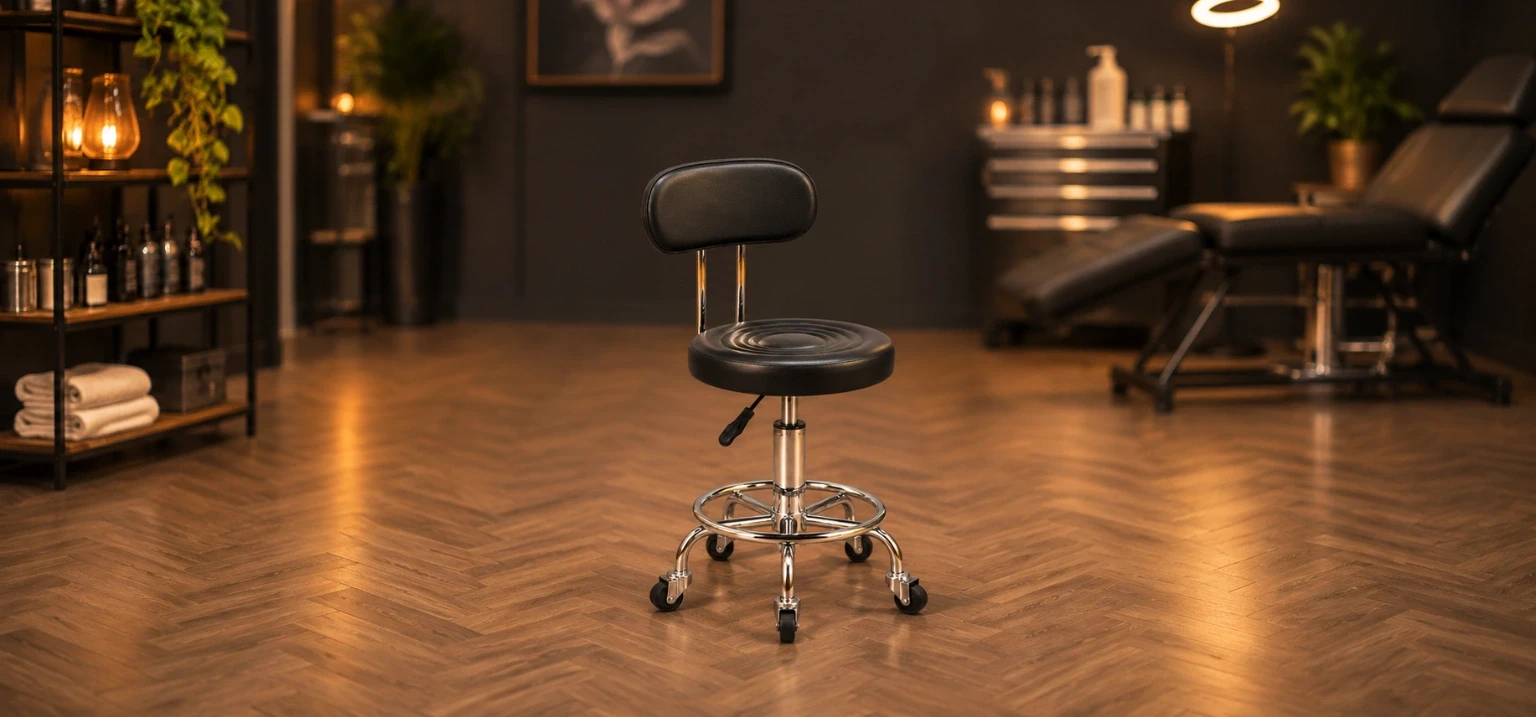
The Tattoo Stool FCH-002A includes a backrest, hydraulic height adjustment, 360-degree swivel, wheels and a chromed-steel frame. The swivel and height adjustment are useful features to compare for artists moving between the tattoo area and nearby work surface.
A backless stool provides a different seating profile and may allow movement without a backrest behind the artist; which one works better depends on how the artist prefers to sit.
Compare how the stool fits under or beside the workstation, whether the caster movement suits the floor, and whether the artist can reach the working area without unstable leaning.
Evaluate the stool with the selected tattoo bed or chair, armrest and work table. Being able to adjust one item does not ensure the entire station is positioned correctly; the useful result comes from how their working heights fit together.
ACCESSIBLE TOOLS AND SUPPLIES
Tattoo Workstation AH033 vs. Adjustable Work Table FTA-045C
A work table keeps prepared supplies accessible within the artist's workflow. The important features are the usable work surface, appropriate height, stability and how the table moves relative to the client chair and artist stool. A work surface should make it easier to organize tools without placing them on the client's furniture or in the path of routine movement.
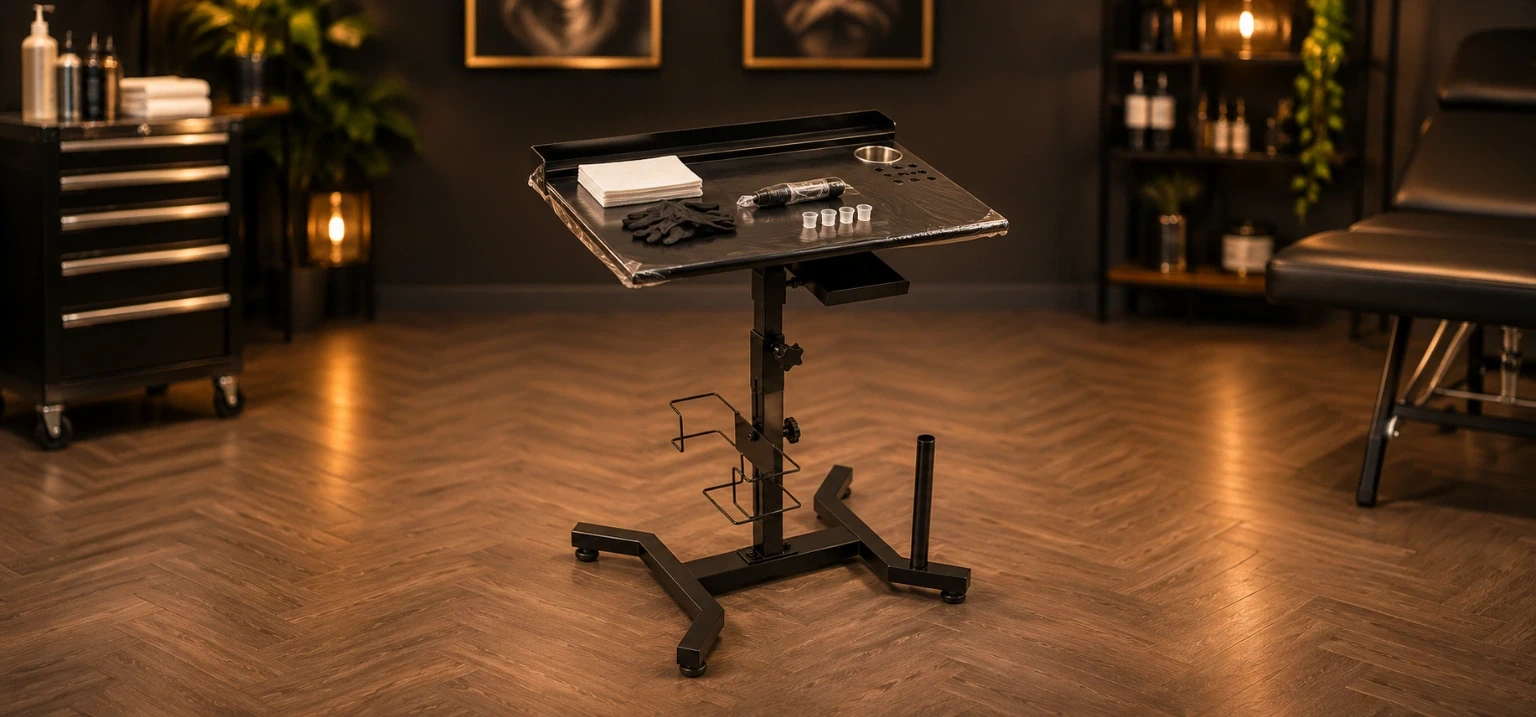
Tattoo Workstation AH033
The AH033 is a steel workstation with a 50 x 35 cm worktop, a tray and cup holder, and a documented 66–92 cm height-adjustment range. The height is secured with a locking knob, and the workstation uses an H-style base.
Its specification also states tool-free assembly. That feature may simplify initial setup or relocation within a studio.
This model is useful to compare when you want a known worktop dimension, an explicit height range and designated spaces for organizing small items. The tray and cup holder are convenience features, not substitutes for a clean supply layout or appropriate protective barriers.
VIEW WORKSTATION AH033Adjustable Tattoo Work Table FTA-045C
The FTA-045C is an adjustable work table with height and surface-angle adjustment plus wheels equipped with brakes. Those features are most relevant to artists who frequently reposition the working surface or want the table angle to change with the task.
The wheels allow the table to be moved; the brakes are intended to secure it once positioned. They should be checked before each procedure.
Compared with AH033, the deciding features are the adjustable angle and wheeled base. Choose based on actual workflow and available floor space.
VIEW ADJUSTABLE WORK TABLE FTA-045CA fixed-location station may value repeatable tabletop placement, while a work area that changes position during different appointments may benefit from a movable table. Neither approach is automatically better; an artist should check clearance, locking mechanisms and how the surface will be protected during a session.
EIGHT PRODUCTS / ONE STATION
Tattoo Furniture and Protective Cover Comparison
The table below summarizes the features of each product.
| PRODUCT | CONFIRMED FEATURES | WORKFLOW REASON TO CONSIDER IT |
|---|---|---|
| Reclinable Bed FCH-008 | Independent reclining back, legs and arms; hydraulic height; high-density padding; easy-clean synthetic leather | Station that needs multiple client-position and height adjustments |
| Reclinable Bed FCH-007A | Fully reclinable; separate back and leg adjustment; synthetic leather | Reclining client support with back and leg positioning |
| Folding Chair FCH-003 | Folding frame; adjustable headrest, armrests, chest support and leg supports | Guest spots, conventions or flexible seated positioning |
| Workstation AH033 | Steel; 50 x 35 cm top; tray and cup holder; 66–92 cm knob-adjusted height; H base; tool-free assembly | Known surface dimensions and adjustable working height |
| Work Table FTA-045C | Adjustable height and angle; wheels with brakes | Movable and adjustable work-surface placement |
| Stool FCH-002A | Backrest; hydraulic height; 360-degree swivel; wheels; chromed-steel frame | Adjustable artist seating and movement around the station |
| Armrest FTA-044B | Folding tripod; adjustable height and angle; padded synthetic-leather top | Independent, repositionable support for arm-related work |
| Black Chair Bed Covers FTA-007B | Single-use, water-resistant, universal size designed to fit most beds and chairs | Replaceable furniture covering between clients |
The table also illustrates why it is difficult to rank all eight products as if they performed the same job. A chair, armrest, work table and disposable cover solve different workflow problems. The right purchase sequence depends on which part of the current station is missing or insufficient.
COMPARE THE CONTROLS
Which Furniture Adjustments Matter Most?
A product with more adjustments may be useful across many techniques, but a feature has value only when the artist can use it safely and consistently. Rather than assuming that a higher number of controls makes a bed more professional, compare each adjustment against the actual task.
Client orientation
Relevant when moving between upright, reclined and other positions. Both linked beds provide back adjustments.
Lower-body positioning
Useful to assess for leg tattoos and appointments where the client's leg position changes.
Upper-body flexibility
The FCH-008 separately reclines its arms; the FCH-003 adjusts armrests; FTA-044B adds independent support.
Working-level changes
Hydraulic height is documented for FCH-008 and FCH-002A. AH033 uses a locking knob; FTA-045C is height adjustable.
Support orientation
FTA-044B has an angle-adjustable armrest top. FTA-045C also offers adjustable table angle.
Position and stability
FTA-045C has wheeled brakes; FCH-002A swivels and rolls. Each should be positioned appropriately during use.
When possible, test the adjustment sequence before committing. Consider whether the client must move off the bed to make a change, whether the artist can reach the controls, and whether the final position remains stable.
MAKE THE ROOM WORK
How to Arrange the Bed, Stool, Armrest and Workstation
A useful tattoo station gives the artist an unobstructed working route between the client and prepared supplies. Position the bed or chair first, then establish where the artist will sit or stand, where the independent armrest can fit, and how the work table will be reached.
Leave enough practical clearance for the artist to move around the client, adjust the furniture and complete setup or cleanup without striking the workstation. A stool with wheels and a rolling table can both be convenient, but unnecessary movement during a procedure can make the station less predictable.
Avoid placing the armrest tripod directly in the main foot path. When using the AH033, verify that its H-style base has space in the chosen arrangement. With the FTA-045C, move the table into its intended position and engage the wheel brakes before use.
The work surface should be large enough for the items the artist actually needs for the current procedure, while unrelated supplies remain organized elsewhere. AH033's published 50 x 35 cm top provides a specific size to plan around.
Consider how the station changes between a small forearm tattoo and a larger back piece. If a layout requires constant pushing, pulling and rearranging just to access the tattooed area, the furniture may not be serving the workflow as intended.
Mark the client furniture, artist position, work table, armrest and walking paths. Then list the controls each piece needs. This simple layout exercise can reveal whether a second independent support is useful or would only create congestion.
REPLACEABLE SURFACE PROTECTION
Black Chair Bed Covers FTA-007B: Where Disposable Covers Fit
Reusable tattoo furniture needs a practical method for managing contact and potential contamination. The Black Chair Bed Covers FTA-007B are single-use, water-resistant covers in a universal size designed to fit most tattoo beds and chairs.
Their purpose in the station is to provide a replaceable covering on suitable client furniture. A correctly fitted cover can reduce direct contact with the underlying surface during a session. It does not make the furniture sterile and does not remove the requirement to clean and decontaminate reusable surfaces when appropriate.
The universal size is designed to fit most tattoo beds and chairs; check coverage on the furniture you use, especially on arm sections.
Tears, folds, openings and incomplete coverage can expose the furniture beneath it. After a client, discard the single-use cover rather than attempting to wash it for reuse.
For a studio purchasing new client furniture, plan the cover supply at the same time. A bed that can be repositioned into several configurations may need cover placement to be checked again after an adjustment. Covers should not interfere with the operation of reclining sections or other controls.
VIEW BLACK CHAIR BED COVERS FTA-007BWORKPLACE CLEANING REQUIREMENTS
OSHA 29 CFR 1910.1030: Cleaning Furniture and Work Surfaces
OSHA's Bloodborne Pathogens Standard applies to covered workplaces where workers have reasonably anticipated occupational exposure to blood or other potentially infectious materials. OSHA has specifically addressed its application to tattoo and body-piercing operations. Furniture and work surfaces are therefore part of a larger exposure-control and housekeeping process.
Under 29 CFR 1910.1030(d)(4)(ii)(A), contaminated work surfaces must be decontaminated using an appropriate disinfectant after the procedure. The same provision requires prompt decontamination when a surface is visibly contaminated or after a spill of blood or other potentially infectious material, and end-of-shift decontamination if a surface may have become contaminated since its last cleaning.
The related 29 CFR 1910.1030(d)(4)(ii)(B) addresses protective coverings, including plastic wrap and similar barrier materials. Such coverings must be removed and replaced as soon as feasible when overtly contaminated, or at the end of the work shift when they may have become contaminated during that shift.
For furniture selection, this means considering whether the exposed surfaces can be accessed and appropriately cleaned. FCH-008 specifically lists easy-to-clean synthetic leather, while FCH-007A and FTA-044B also list synthetic-leather contact surfaces. The presence of that material does not establish compatibility with every disinfectant, so follow the furniture-care information and the chosen disinfectant's directions.
OSHA also requires an appropriate housekeeping schedule and cleaning method based on the worksite, surface, soil and tasks. Removing a disposable covering can help protect an item, but a visibly contaminated reusable surface still needs proper decontamination.
Contaminated surfaces: decontaminate with an appropriate disinfectant after completion of the procedure and at the other times specified in the standard. Contaminated protective barriers: remove and replace as soon as feasible, or at the end of the shift if they may have become contaminated. A disposable cover is not a substitute for cleaning a contaminated surface underneath.
Use the complete OSHA text and the studio's established procedures when developing a cleaning schedule. Select and use disinfectants according to their labeling and applicable requirements.
BETWEEN-CLIENT WORKFLOW
A Practical Furniture Reset Between Tattoo Clients
The reset should be organized so the next client arrives to a prepared workstation rather than a hurried rearrangement of used furniture. Treat disposable coverings and reusable surfaces separately, and follow the studio's full professional cleaning and exposure-control procedures.
Discard the FTA-007B cover and other disposable barriers after the client according to the studio's procedures. Replace overtly contaminated protective coverings promptly as OSHA requires.
Check client furniture, armrest, stool and workstation areas for visible soil or potential contamination, including exposed adjustment controls.
Use the appropriate disinfectant and cleaning method for contaminated surfaces, following 29 CFR 1910.1030 and the relevant product directions.
Confirm the reclining controls, stool movement, armrest support and table brakes operate appropriately before repositioning for the next appointment.
Fit a fresh single-use cover and set up the workstation for the next procedure without reusing protective materials from the previous client.
Changing the FTA-007B cover between clients is the sensible use of a single-use product; OSHA's rule addresses contaminated coverings, and the studio's own procedures can add routine replacement.
THREE PRACTICAL BUYING APPROACHES
Build a Setup for a Fixed Studio, a Guest Spot or Arm-Focused Work
Rather than buying every furniture item simultaneously, choose a configuration that addresses the type of appointments you handle.
A flexible, multi-position station
Consider the FCH-008 reclining bed if you need independent back, leg and arm settings with hydraulic height. Pair client support with an artist stool, a work table selected for the actual room layout, and single-use chair or bed covers.
The AH033 is useful when its published 66–92 cm range and 50 x 35 cm worktop meet your needs. The FTA-045C is worth comparing when the table must move or its surface angle must change.
A folding client-support approach
Begin with the FCH-003 folding chair for its adjustable head, chest, arm and leg supports. Add the FTA-044B folding tripod armrest when a separate support position is useful for the planned work.
Before traveling, check event rules, available space, transportation requirements, covering supplies and the selected workstation.
Independent support and accessible tools
Place a suitable client bed or chair with a separate FTA-044B armrest, then set up the artist's FCH-002A stool and a nearby working surface. This lets the artist focus on the relationship between supported arm position, stool height and reach.
A correctly fitted single-use furniture cover belongs in the plan regardless of the main furniture model. A compact design may not require every adjustable feature, but a stable and clean setup remains essential.
If you are setting up a studio for the first time, prioritize the client-support furniture and a suitable work surface before adding secondary pieces based only on appearance. Expand the station as your typical placements and actual working patterns become clear.
AVOID INCONVENIENT PURCHASES
Common Tattoo Furniture Buying Mistakes
- Choosing by appearance alone. A good-looking bed or stool may not provide the adjustments required for your most common work.
- Assuming every reclinable bed is hydraulic. Hydraulic height is a listed feature of the FCH-008; check each bed's listing.
- Expecting a folding chair to replace every bed position. FCH-003 offers adjustable supports, but not every tattoo location calls for the same client orientation.
- Buying an armrest without considering the base footprint. A tripod must fit around the stool, table and walking path.
- Confusing a folding tripod with a flat-base model. The linked FTA-044B is specifically a folding tripod armrest.
- Comparing stools without checking the full station. Artist seating works in relation to client height and workstation position.
- Choosing a table without checking how it moves. The AH033 stands on an H base; the FTA-045C rolls on wheels with brakes and its surface angle adjusts.
- Forgetting to engage work-table brakes. A wheeled surface should be secured at its working location.
- Planning floor space from unverified dimensions. Obtain exact footprints before ordering furniture for a restricted room or booth.
- Assuming a universal cover fits every furniture configuration. FTA-007B is designed for most beds and chairs, not necessarily every shape.
- Reusing a single-use cover. The linked bed and chair covers are disposable products.
- Treating a cover as a replacement for decontamination. OSHA still requires appropriate cleaning and disinfection of contaminated work surfaces.
- Expecting free furniture shipping. Furniture is excluded from free shipping because of size and weight; shipping is calculated at checkout.
REVIEW BEFORE YOU ORDER
Professional Tattoo Furniture Buying Checklist
- I know which body areas I tattoo most often.
- I compared bed and chair positions for those areas.
- I know which back, leg and arm adjustments I need.
- I know whether I need hydraulic height adjustment.
- I confirmed the exact room or convention space available.
- I measured the space the furniture will use.
- I chose a suitable artist stool with the features I will use.
- I considered tripod armrest clearance and stability.
- I compared table height adjustment and surface position.
- I decided between a fixed base and wheels with brakes.
- I have a system for protecting reusable contact surfaces.
- I understand the covers are single-use and water-resistant.
- I have a written cleaning and decontamination procedure.
- I will follow OSHA rules for contaminated surfaces and barriers.
- I know furniture shipping is calculated at checkout.
The best purchase is the item that resolves an actual workflow need. A studio doing varied large-scale work may prioritize bed adjustments, while an artist traveling frequently may prioritize a folding chair and separate support. Accessories should be selected after the essential client and workstation positions are established.
SHOP THE EIGHT FEATURED ITEMS
Build Your Professional Tattoo Station With SVT Shop
SVT Shop helps tattoo artists, apprentices and studios select practical supplies and equipment from El Paso, Texas. Compare the individual furniture functions rather than purchasing every adjustable item without a defined use.
Furniture does not qualify for free shipping due to its size and weight. Shipping is calculated at checkout. Confirm the delivery details and the exact specifications required by your room or event before completing the purchase.
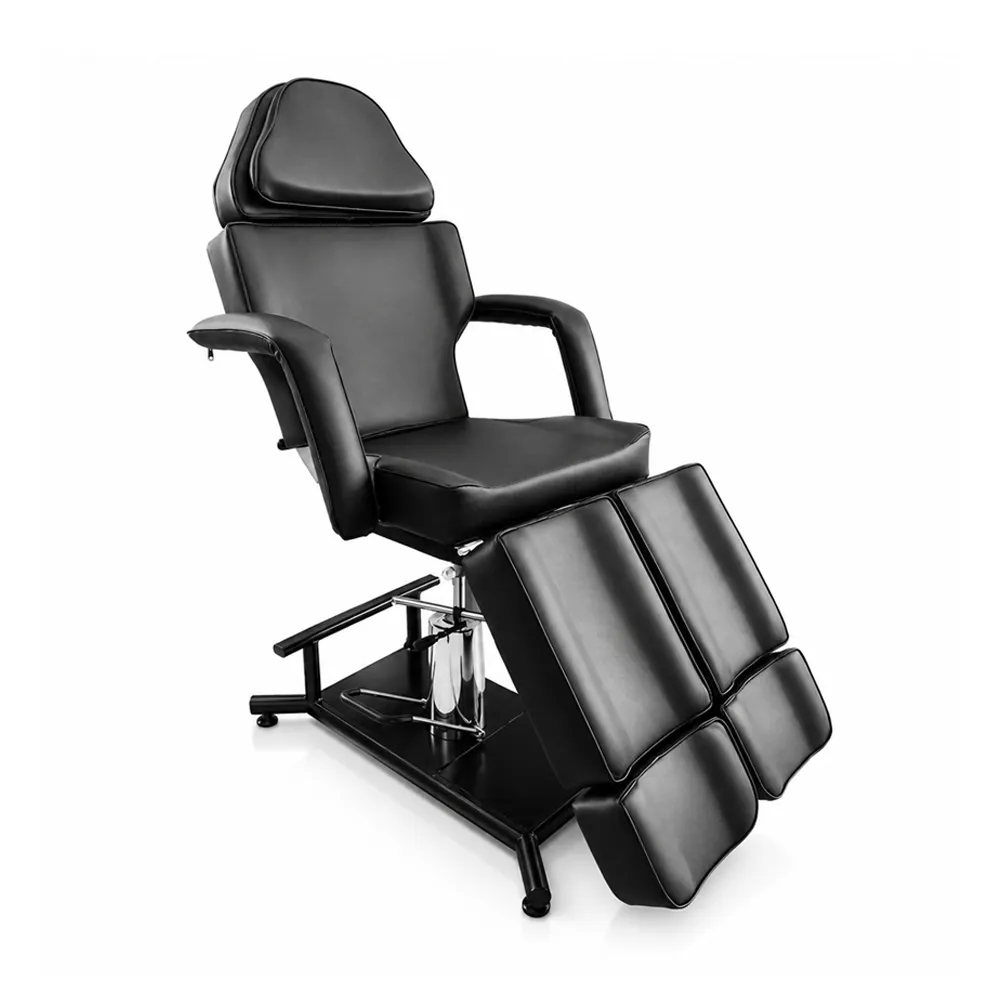 CLIENT SUPPORT / HYDRAULIC
Reclinable Bed FCH-008
Independent back, leg and arm reclining with hydraulic height.
VIEW FCH-008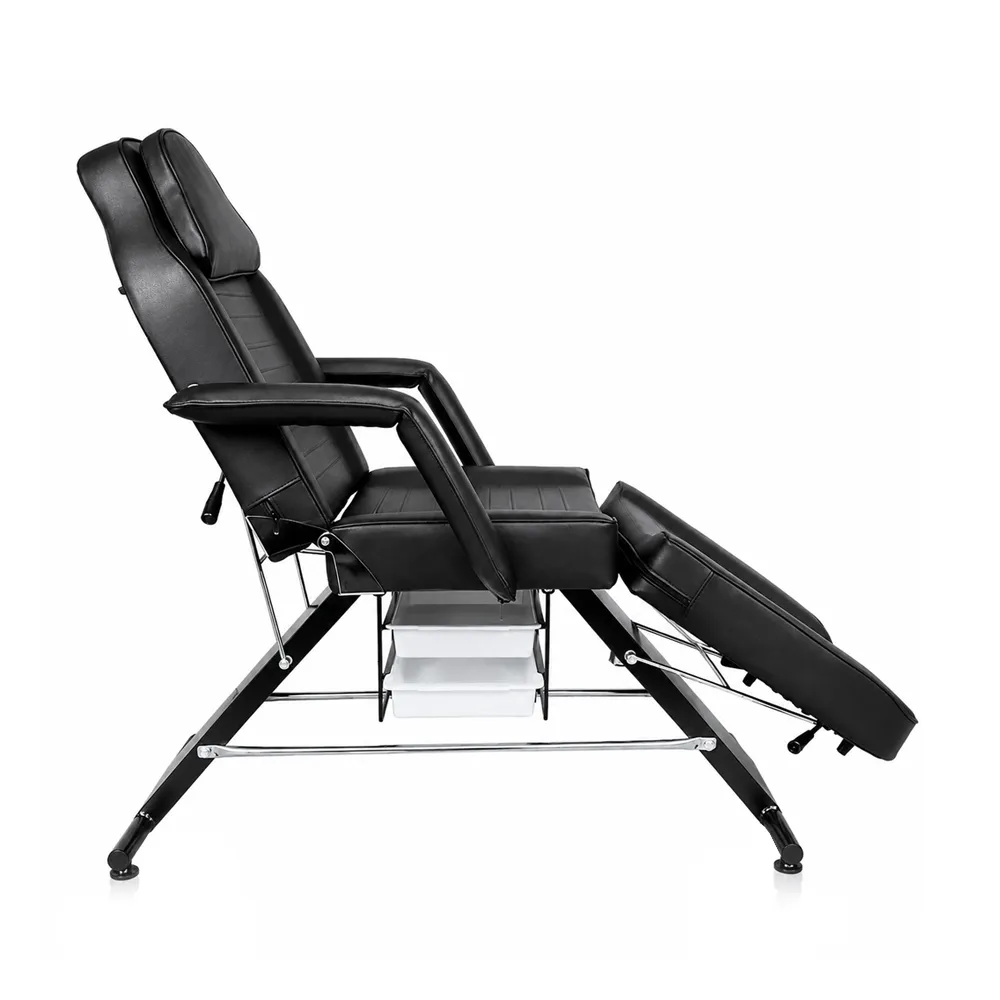 CLIENT SUPPORT / RECLINING
Reclinable Bed FCH-007A
Fully reclining with separate back and leg adjustment.
VIEW FCH-007A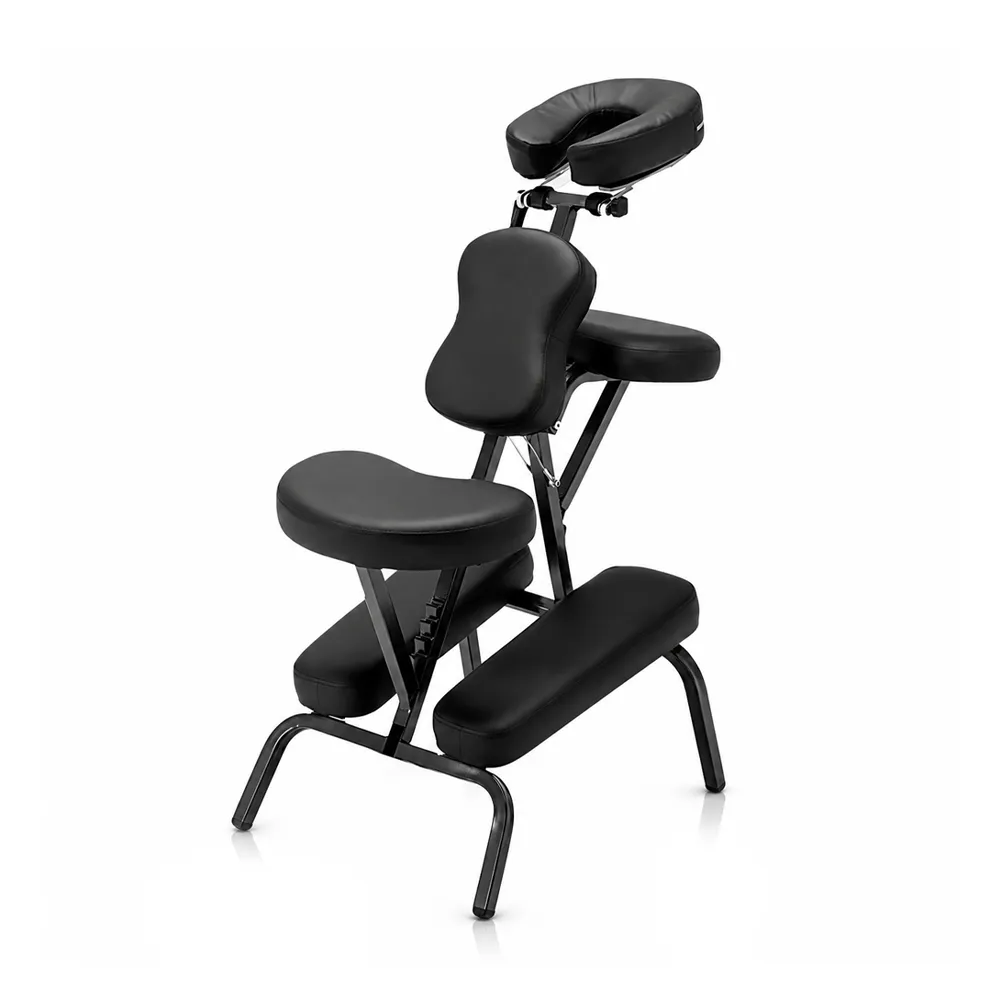 PORTABLE CLIENT SUPPORT
Folding Chair FCH-003
Folding design with adjustable head, chest, arms and legs.
VIEW FCH-003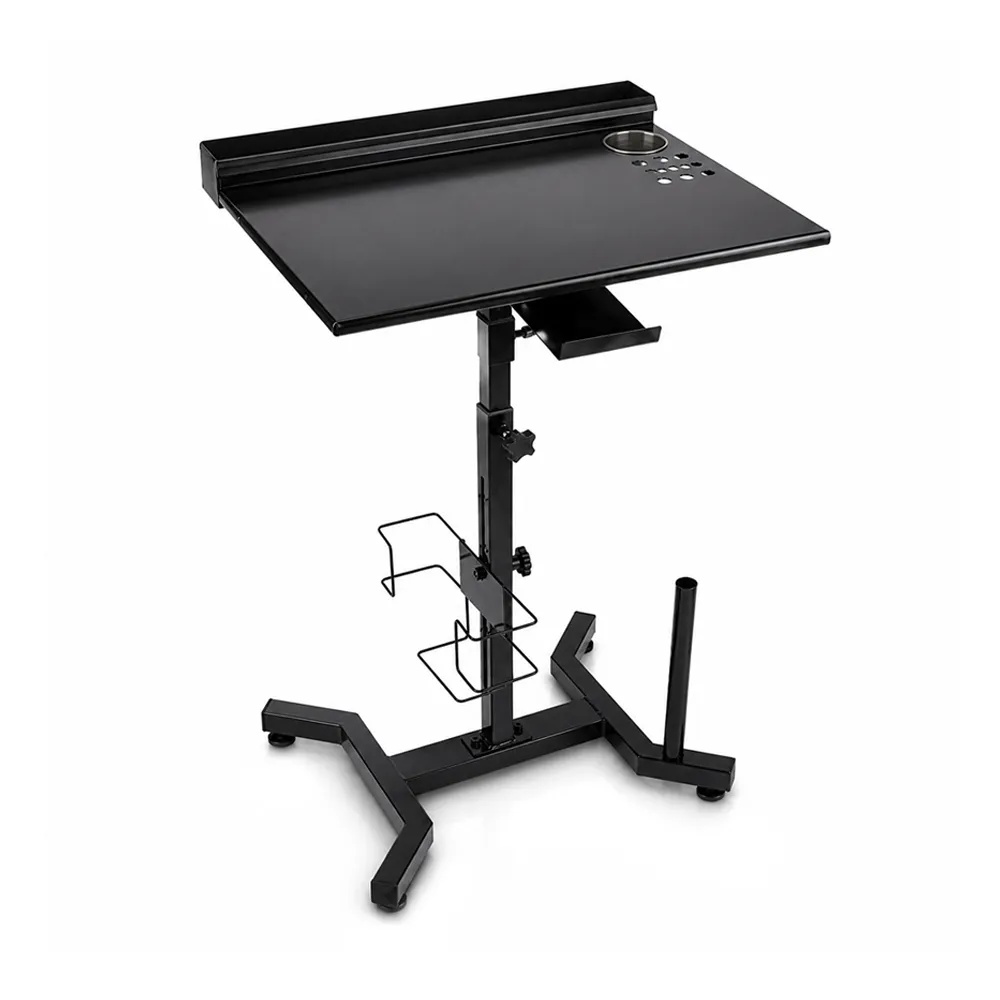 STUDIO WORK SURFACE
Workstation AH033
50 x 35 cm top, 66–92 cm height, tray, cup holder and H base.
VIEW AH033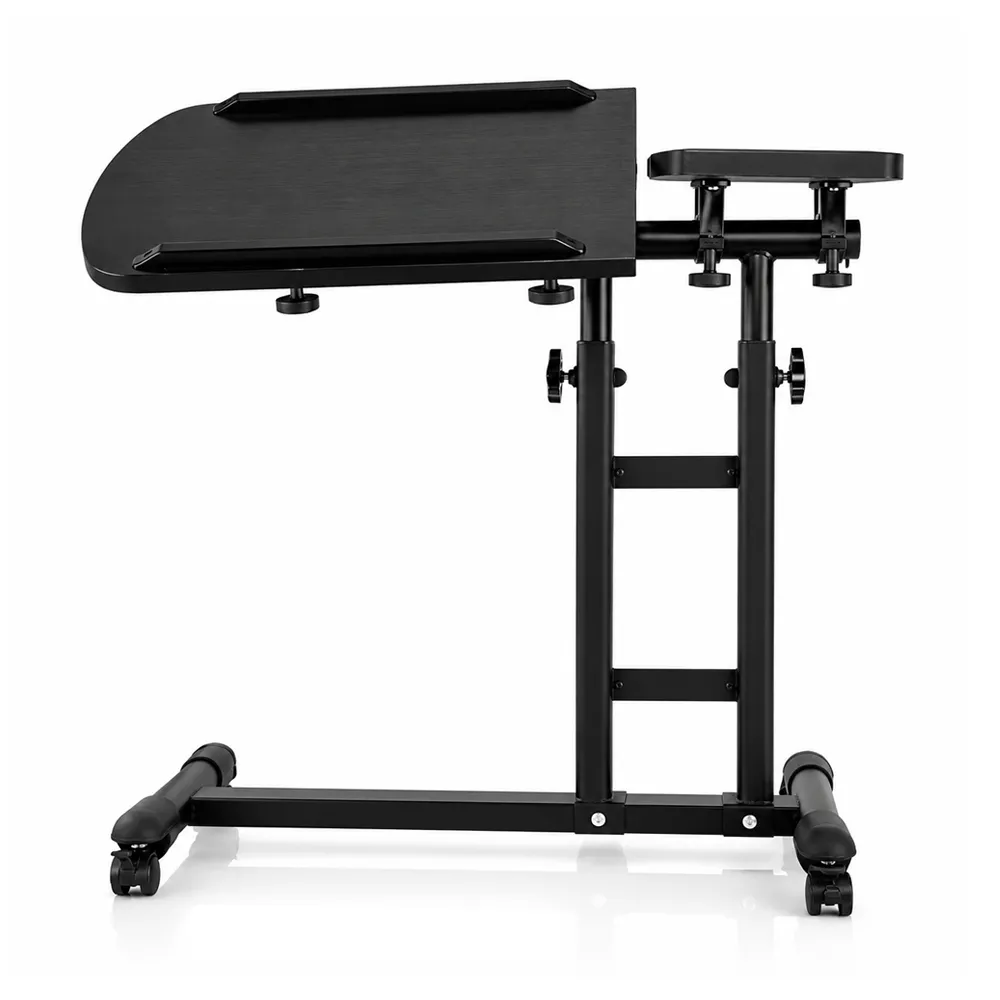 ADJUSTABLE WORK TABLE
Work Table FTA-045C
Adjustable height and surface angle with wheeled brakes.
VIEW FTA-045C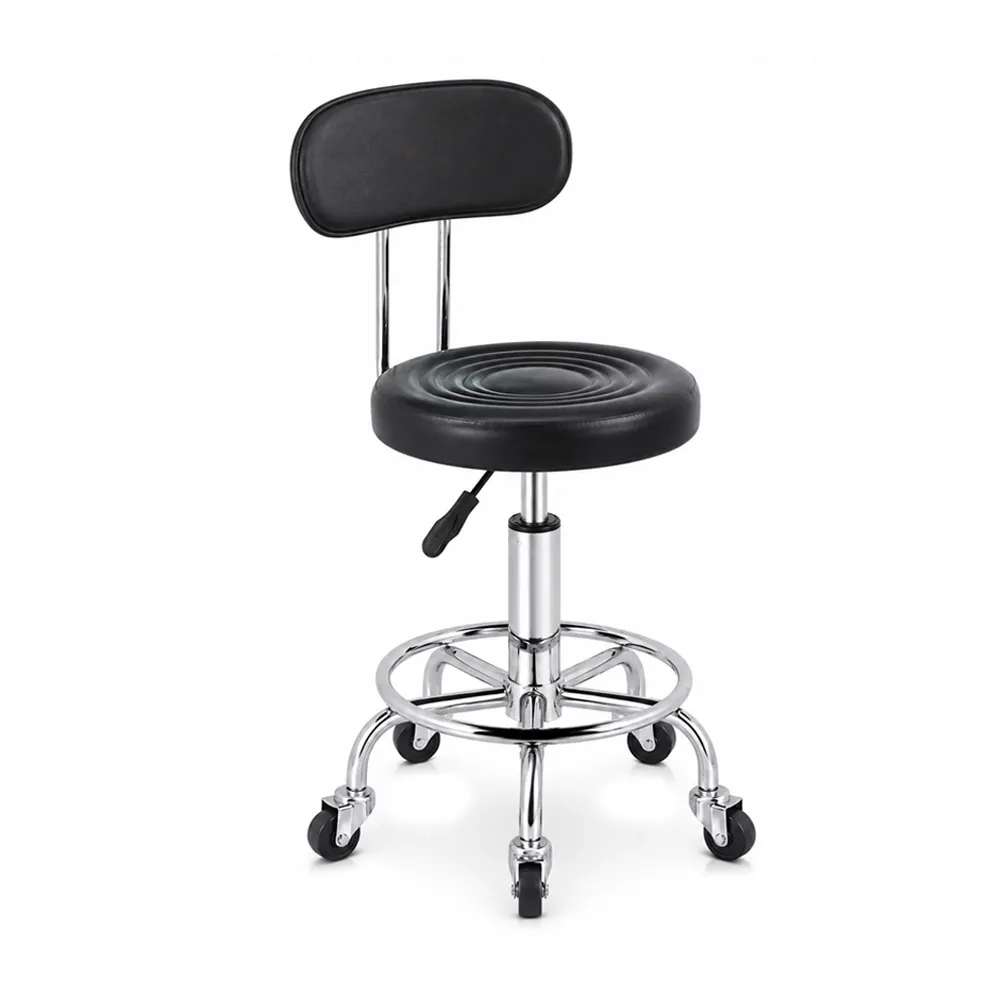 ARTIST SEATING
Stool FCH-002A
Backrest, hydraulic height, 360-degree swivel and wheels.
VIEW FCH-002A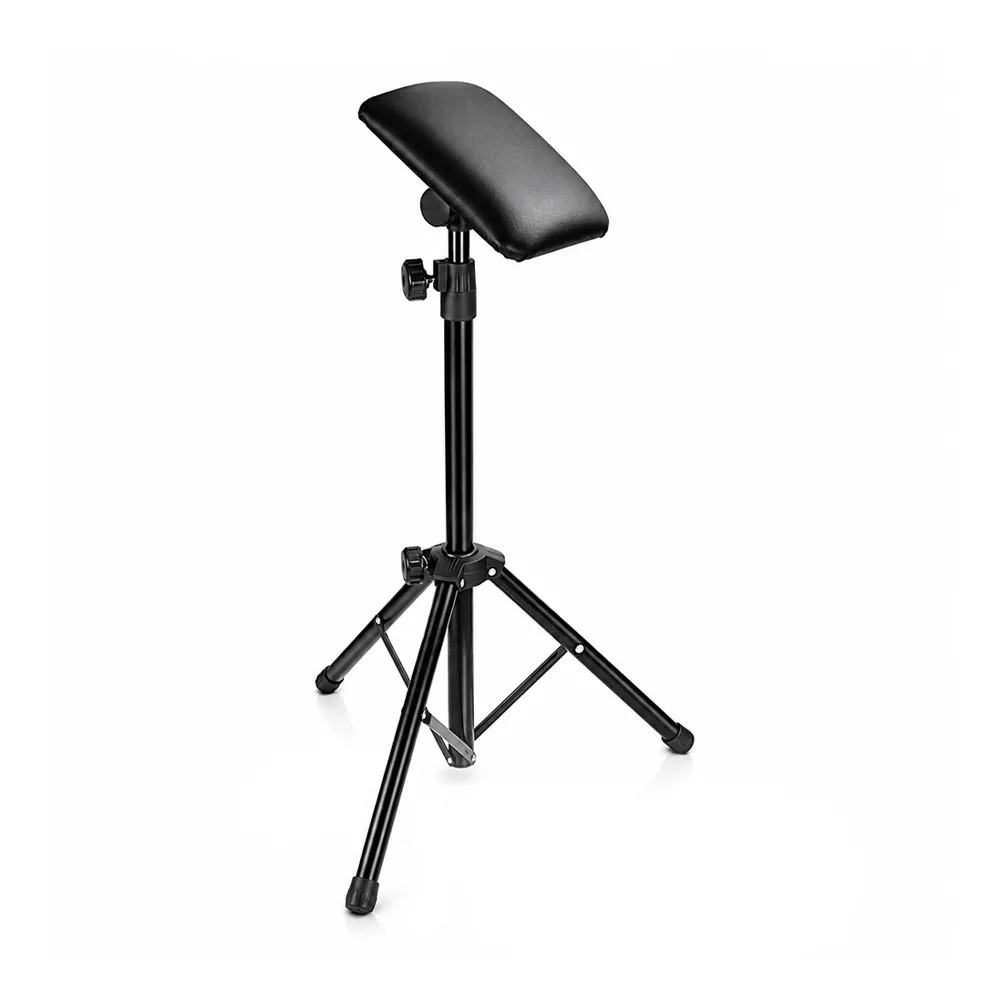 INDEPENDENT ARM SUPPORT
Tripod Armrest FTA-044B
Folding tripod with height- and angle-adjustable padded support.
VIEW FTA-044B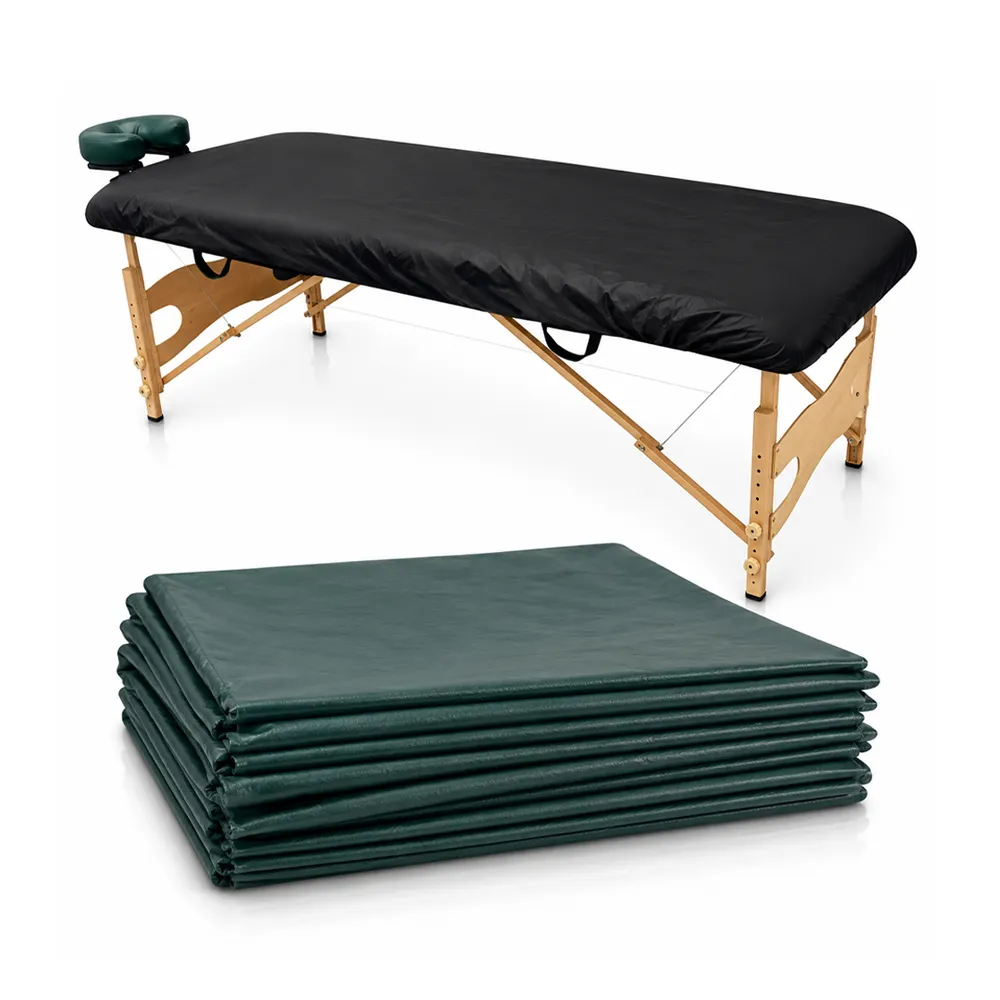 SINGLE-USE PROTECTION
Black Chair Bed Covers
Water-resistant, disposable covers sized for most beds and chairs.
VIEW FTA-007BExplore more options in Furniture at SVT Shop and see how furniture fits into the First Professional Tattoo Setup.
FREQUENT BUYER QUESTIONS
Frequently Asked Questions
What furniture do I need for a first professional tattoo station?
Start with client support, an accessible work surface, artist seating and appropriate protective covers. Add an independent armrest when your tattoo locations require it. The exact setup depends on your studio's workflow and space; furniture alone is not a complete professional tattoo setup.
Is a tattoo bed better than a tattoo chair?
Neither is best for every appointment. A reclining bed may be more versatile for clients who need several positions, while a folding chair can be useful for seated work, guest spots and conventions. Choose according to the areas you tattoo most and the actual controls on the furniture.
What is the difference between FCH-008 and FCH-007A?
FCH-008 has separately reclining back, leg and arm sections, hydraulic height adjustment, high-density padding and easy-to-clean synthetic leather. FCH-007A is fully reclinable with separate back and leg adjustment and synthetic-leather upholstery.
Does Reclinable Tattoo Bed FCH-007A have hydraulic height?
Its listed adjustments are the reclining back and leg sections. If hydraulic height is essential, choose the FCH-008, which includes it.
Is the Folding Tattoo Chair FCH-003 good for conventions?
Its folding construction and adjustable head, chest, arm and leg supports make it a good option to consider for guest spots and conventions. Confirm transport and event requirements before ordering.
Should I buy a tripod tattoo armrest or a flat-base armrest?
Compare positioning, floor clearance, stability and whether the base interferes with the stool or workstation. A tripod like the FTA-044B folds for transport and adjusts in height and angle; a flat base rests on a single footprint.
Do I need an armrest if the bed already has adjustable arms?
Not always. FCH-008 includes separately reclining arm supports, which may suit some work. An independent armrest such as FTA-044B is useful when the tattoo requires a support position that is separate from the bed or chair. Evaluate the setup with the actual client position.
Is an artist stool with a backrest better than one without?
A backrest may suit an artist's preferred sitting style, while a backless stool has a different working profile. The linked FCH-002A offers a backrest, hydraulic height, a 360-degree swivel and casters.
What is the height range of the AH033 tattoo workstation?
The AH033 adjusts from 66 to 92 cm using a locking knob. It also has a 50 x 35 cm top, tray, cup holder, steel construction, H-style base and tool-free assembly.
Does the FTA-045C work table have wheels that lock?
Yes. The listed FTA-045C features wheels with brakes, as well as height and surface-angle adjustments.
Are the Black Chair Bed Covers FTA-007B reusable?
No. They are described as single-use, water-resistant covers that fit most tattoo beds and chairs. Remove and discard used covers according to the studio's procedures. Their use does not remove the need to decontaminate contaminated furniture surfaces.
What does OSHA say about cleaning contaminated tattoo work surfaces?
29 CFR 1910.1030(d)(4)(ii)(A) requires an appropriate disinfectant after procedures involving contaminated work surfaces, prompt action for overt contamination and spills, and end-of-shift decontamination when a surface may have become contaminated since its last cleaning. The related subsection (B) covers replacing contaminated protective barriers.
Does a disposable chair cover replace surface disinfection?
No. A protective covering helps shield a surface but does not correct contamination beneath it or eliminate OSHA's applicable housekeeping requirements. Use new disposable covers appropriately and clean and decontaminate contaminated reusable surfaces.
Do the tattoo beds and other furniture qualify for free shipping?
No. SVT Shop furniture does not qualify for free shipping because of its size and weight. The shipping charge is calculated at checkout, so confirm the delivery total before placing the order.
How do I know the furniture will fit my studio?
Measure the space and plan the station first: client furniture, artist position, work table, armrest and walking paths. If you need exact measurements for a product, contact SVT Shop before ordering.
PRODUCT INFORMATION & OFFICIAL REQUIREMENTS
Sources Consulted
Furniture descriptions and specifications come from the eight linked SVT Shop product listings. Workplace decontamination and protective-cover requirements come from OSHA's official Bloodborne Pathogens Standard and its tattoo-industry interpretation.
- SVT Shop — Reclinable Tattoo Bed FCH-008Independent reclining sections, hydraulic height, padding and upholstery.
- SVT Shop — Reclinable Tattoo Bed FCH-007AFull reclining construction, separate back and leg adjustment, synthetic leather.
- SVT Shop — Folding Tattoo Chair FCH-003Folding construction and adjustable head, arm, chest and leg supports.
- SVT Shop — Tattoo Workstation AH033Steel construction, measured top and height range, tray, cup holder and H base.
- SVT Shop — Adjustable Tattoo Work Table FTA-045CHeight and angle adjustment with braked wheels.
- SVT Shop — Tattoo Stool FCH-002ABackrest, hydraulic height, swivel, caster wheels and frame.
- SVT Shop — Tattoo Armrest FTA-044BFolding tripod, adjustable height and angle, padded synthetic leather.
- SVT Shop — Black Chair Bed Covers FTA-007BSingle-use, water-resistant universal covering description.
- OSHA — 29 CFR 1910.1030, Bloodborne PathogensHousekeeping paragraphs (d)(4)(i), (d)(4)(ii)(A) and (d)(4)(ii)(B), including surface decontamination and protective-cover replacement.
- OSHA — Applicability to Tattoo and Body Piercing IndustriesOfficial explanation of bloodborne pathogen occupational exposure in tattooing and body piercing.
Editorial note: Last updated November 12, 2026. Follow the manufacturer's assembly and care instructions, studio procedures, OSHA requirements where applicable and any relevant local rules. Furniture shipping is calculated at checkout and does not qualify for free shipping.