Powered by Comercia.io
SVT SHOP BLOG / APPRENTICE EQUIPMENT GUIDE
Your First Professional Tattoo Setup: What to Buy First
Build a foundation with a professional wireless pen machine, tattoo cartridges, black ink, skin prep, disposable ink cups, and practice supplies—in an order that makes sense for an apprentice learning under an experienced tattoo artist.
KEY TAKEAWAYS
SVT Shop · El Paso, Texas · Next Day Delivery available in El Paso
START HERE
Quick Answer: What Should a Beginner Tattoo Artist Buy First?
For your first professional tattoo setup, start with one reliable wireless pen machine, a small selection of compatible RL and CM/SEM cartridges, professional black ink, sterile single-use ink cups, and enough synthetic practice skin and stencil supplies to repeat basic drills. Add proper skin-preparation and workstation supplies before supervised client work, and ask an experienced tattoo artist or apprenticeship mentor to approve your equipment choices before you purchase.
THE RIGHT STARTING POINT
What Makes a First Tattoo Setup Professional?
A professional tattoo setup is not defined by the number of items on a worktable. It is a coordinated system of tools that fit together, produce repeatable results in trained hands, and support an organized studio workflow. For someone beginning an apprenticeship, that means choosing equipment they can learn deeply rather than constantly replacing.
The main pieces are straightforward: a dependable pen-style rotary machine with the correct power system; compatible, sterile cartridge needles; tattoo ink; clean ink cups; skin-preparation products; stencil supplies; synthetic practice skin; and appropriate workstation protection. A professional studio also needs additional equipment, cleaning and disposal systems, and compliance procedures that are not covered by a six-product shopping list.
Buying professional tools early can be worthwhile because they reduce avoidable equipment uncertainty. A machine with known specifications, a documented cartridge system, and authentic ink give an apprentice a more stable baseline for evaluating their work. That does not mean any machine automatically produces clean lines. Hand speed, stretch, needle depth, design preparation, and guided technique still determine much of the result.
Before ordering a machine, speak with the tattoo artist supervising your apprenticeship. Some mentors provide equipment or require a particular system, and buying without their input can create unnecessary duplication. If you have not found a mentor yet, concentrate on your drawing portfolio and studio research first.
BUILD IN THE RIGHT ORDER
What to Buy First, Second, and Later
The smartest sequence follows what you will actually practice. You do not need a large inventory of pigment colors or specialty needles to learn basic line control. Start with mentorship and the core machine-and-cartridge system, then add consumables as each exercise requires them.
| PRIORITY | WHAT TO GET | WHY IT COMES NOW |
|---|---|---|
| Before buying | Mentor feedback, drawing materials, and a practice plan | Find out what the studio provides and which machine system your mentor can teach. |
| 01 / Core tool | One professional wireless pen machine | Establish a consistent grip, power source, and machine feel. |
| 02 / Needle system | Focused RL cartridges plus a curved-mag option | Practice linework and shading without unnecessary size changes. |
| 03 / Visible feedback | Black tattoo ink and single-use ink cups | Make lines, fills, and inconsistencies easy to inspect on practice skin. |
| 04 / Repetition | Synthetic practice skin, stencil tools, and a practice log | Repeat simple exercises and measure improvement. |
| 05 / Studio readiness | Skin prep, gloves, barriers, approved disinfectants, sharps handling, and other studio supplies | Learn the complete workflow before any supervised client procedure. |
These are learning priorities, not permission to postpone required protective measures. Even synthetic-skin exercises should use an orderly, mentor-approved workstation; live tattooing must not begin until the required training, supplies, supervision, and local rules are in place.
PIECE 01 / THE MACHINE
Choose One Professional Wireless Pen Machine
A wireless tattoo pen combines a rotary motor, a cartridge grip, and battery-powered operation in a compact format. With no power cable crossing the practice area, it lets the artist focus on positioning, balance, and movement. But wireless design alone says little about suitability: consider stroke length, ergonomics, battery handling, compatible cartridges, manufacturer documentation, and service support.
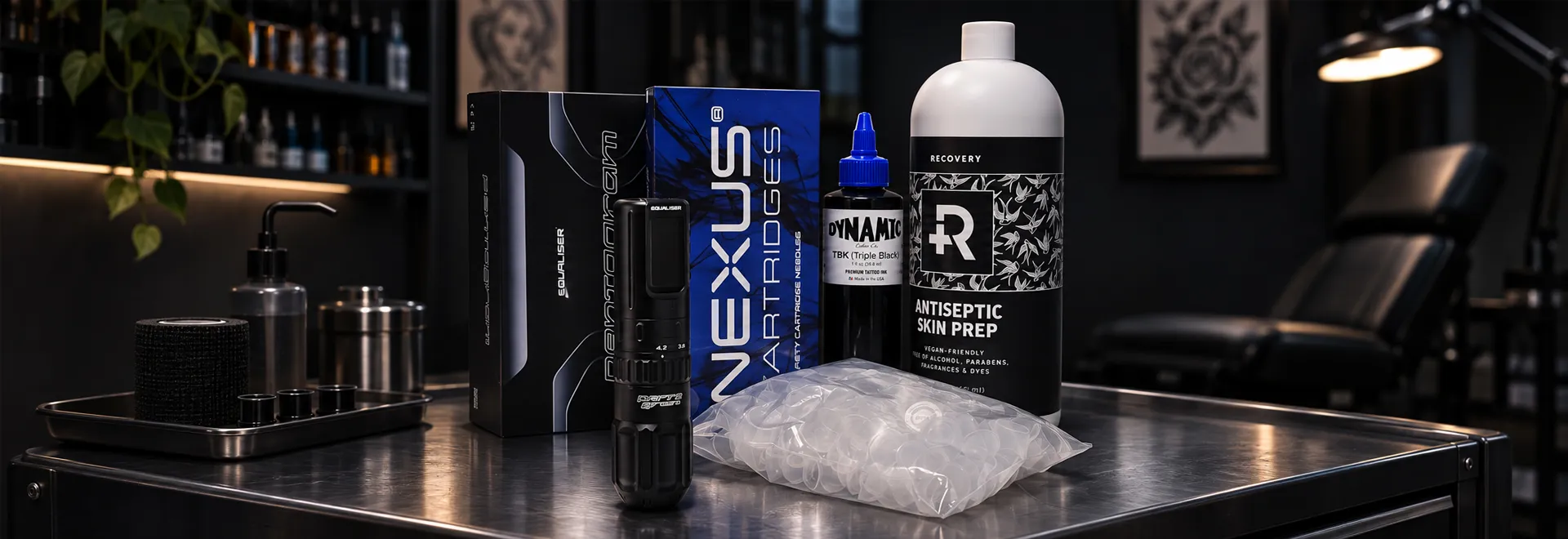
Three professional options available through SVT Shop are Kwadron Equaliser Pentagram, Peak Solice Pro 2, and FK Irons One 4.0 mm. They approach adjustment differently, which makes them useful to compare before an apprentice commits to learning one platform.
Kwadron Equaliser Pentagram
The Equaliser Pentagram is a wireless pen with an adjustable 2.0–4.2 mm stroke, controlled by a rotating dial. The package includes two interchangeable 2000 mAh batteries, giving an apprentice a spare power source while learning how battery changes fit into a workday.
Its main educational advantage is range: the same machine can be configured differently for line drills, soft-shading exercises, and denser fills. However, more settings also create more variables to manage. A mentor should help establish a small number of repeatable starting configurations rather than encouraging constant adjustments.
VIEW KWADRON EQUALISER PENTAGRAMPeak Solice Pro 2 — Matte Black
The Peak Solice Pro 2 offers an adjustable 2.4–4.2 mm stroke and a rechargeable PowerPack battery for wireless use.
This model suits a learning plan where an apprentice needs to explore several techniques while keeping familiar controls. An adjustable stroke can help reproduce a chosen setting, but it cannot replace the mentor's judgment about cartridge grouping, skin response, or hand movement. Check the exact package contents before ordering additional batteries or accessories.
VIEW PEAK SOLICE PRO 2FK Irons One — 4.0 mm Charcoal
FK Irons One 4.0 mm is a professional wireless pen with a fixed 4.0 mm stroke and a rechargeable drop-in battery. Its straightforward design emphasizes familiar operation rather than an adjustable stroke dial.
A fixed-stroke machine removes one variable from the setup, making it easier to concentrate on a consistent hand position and the feel of a chosen cartridge. The trade-off is less flexibility when moving between techniques that a mentor would normally approach with a different stroke. The 4.0 mm value is the machine's stroke—not a recommended needle depth.
VIEW FK IRONS ONE 4.0 MMStroke length describes the machine's needle movement during its cycle; needle protrusion describes how far the needle extends beyond the cartridge tip. Neither number automatically tells a beginner how deeply to tattoo human skin. Learn these distinctions directly from an experienced artist before attempting a client procedure.
THREE PROFESSIONAL OPTIONS
Wireless Tattoo Machine Comparison
| MODEL | STROKE | POWER SYSTEM | MAIN LEARNING TRADE-OFF |
|---|---|---|---|
| Kwadron Equaliser Pentagram | Adjustable 2.0–4.2 mm | Two 2000 mAh interchangeable batteries included | Wide technique range; requires discipline with settings. |
| Peak Solice Pro 2 | Adjustable 2.4–4.2 mm | Wireless rechargeable PowerPack | Versatile stroke adjustment; more settings to learn. |
| FK Irons One 4.0 mm | Fixed 4.0 mm | Rechargeable drop-in battery | Simpler stroke setup; less adjustment flexibility. |
Specifications reflect the linked model variants. Manufacturer battery runtime depends on how a machine is used; do not treat advertised runtime as a guaranteed working duration.
How to choose: If your mentor wants one machine for varied exercises, compare the Kwadron and Peak adjustable ranges. If the mentor prefers teaching with a fixed 4.0 mm stroke, consider the FK Irons One. When possible, try the grip diameter, weight, controls, and balance in a studio before purchasing. No one model is universally best for every apprentice or hand.
PIECE 02 / THE NEEDLE SYSTEM
Start With Cartridges You Can Actually Learn
Tattoo cartridges combine the needle grouping and tip into a disposable unit that installs in a compatible machine or grip. For a new artist, consistency matters: select documented cartridges with appropriate packaging and a reliable membrane system, then repeat exercises using the same groupings before expanding.
Nexus Cartridges Sample Pack — 20 cartridges
The Nexus Cartridges Sample Pack contains 20 cartridges across four configurations, with five of each: 1003RLLT, 1207RLLT, 1209CMLT, and 1015CMLT. That gives you two round liners for smaller and medium line drills and two curved mags for exploring broader shading and fill movement.
This is a useful starting assortment when you want to compare how needle grouping changes the contact area. A 3RL is not interchangeable with a 7RL, and a curved mag responds differently from a tightly grouped liner. All four variations can be studied on synthetic skin through structured exercises rather than random full designs.
VIEW NEXUS 20-CARTRIDGE SAMPLE PACKKwadron Essential Pack Liner — 18 cartridges
The Kwadron Essential Pack Liner focuses exclusively on round liners. It contains 18 cartridges, three each in six RL configurations: 25/3, 25/5, 30/3, 30/7, 30/11, and 35/9. It is particularly useful when a mentor wants an apprentice to study fine detail, medium outlines, and heavier line weights with a single family of cartridges.
Unlike the Nexus sample pack, the Kwadron liner set does not include magnums. It is a focused lining assortment, not a complete lining-and-shading selection. That difference is worth understanding before deciding whether to buy one pack or both.
VIEW KWADRON ESSENTIAL LINER PACK| PACK | CONTENTS | BEST PRACTICE FOCUS | WHAT IT DOES NOT COVER |
|---|---|---|---|
| Nexus Sample Pack | 20: 1003RLLT, 1207RLLT, 1209CMLT, 1015CMLT | Line drills, shading transitions, and curved-mag control | No straight M1/MG or RS in this assortment |
| Kwadron Essential Liner | 18: 25/3, 25/5, 30/3, 30/7, 30/11, 35/9 RL | Comparing different fine-to-bold line configurations | No shading magnums or RS in this assortment |
Understand RL, RS, M1/MG, and CM/SEM
- RL — Round Liner: a tight grouping for outlines, lettering, geometric lines, and other defined strokes.
- RS — Round Shader: a round configuration for compact shading, small fills, and controlled texture work.
- M1/MG — Straight Magnum: a wider arrangement with a flatter working edge for larger fill or packing areas; naming varies by manufacturer.
- CM/SEM — Curved Magnum: a soft-edge magnum with an arched grouping, commonly used for smoother transitions and organic shading. Nexus and Bishop use CM; Kwadron uses SEM.
Codes also communicate needle count, diameter, and taper. For example, the Nexus code 1003RLLT identifies a 0.30 mm diameter, three-needle round liner with long taper; 1209CMLT identifies a 0.35 mm diameter, nine-needle curved mag with long taper. A grouping code describes construction, not a guaranteed finished line width.
For a deeper breakdown, see the SVT Shop guide How to Choose Tattoo Cartridges: Liners, Shaders & Magnums.
PIECE 03 / BLACK INK
Why Start With One Professional Black Tattoo Ink?
Black ink makes it easier to see what a practice stroke is doing. On synthetic skin, you can compare line continuity, broken curves, inconsistent fill density, and the appearance of a repeated grouping. Working with one familiar ink also reduces the number of variables when you are learning.
Dynamic Triple Black is a professional, high-pigment black offered through SVT Shop. Dynamic highlights the smooth flow of its inks, from precise detail work to outlining and shading, and Triple Black is sold as a deep, high-pigment black for lining, shading, and solid fills. Those are manufacturer descriptions, not a guarantee about healed results or an endorsement of a particular technique for every new artist.
A concentrated black deserves careful practice. For initial synthetic-skin drills, track the selected cartridge, machine setting, hand movement, and number of passes; inspect whether the area looks even rather than assuming more pigment automatically means better saturation. Ask your mentor whether this is the appropriate black for the exercises and for any later supervised client work.
Keep original bottle information available, including lot and expiration details, and do not pour used ink back into the bottle. The FDA has documented contamination in some tattoo inks, including sealed products, so recognizable sourcing and correct handling matter alongside color performance.
VIEW DYNAMIC TRIPLE BLACKPIECE 04 / SKIN PREPARATION
Where Recovery Antiseptic Skin Prep Fits
Skin prep is a separate category from ink and needle preparation. Recovery Antiseptic Skin Prep 30 oz contains 3% chloroxylenol and is described by the manufacturer as an antiseptic cleanser for tattoo and related professional procedures. Recovery lists the formula as free of alcohol, parabens, and dyes.
Its published Drug Facts direct users to scrub thoroughly for at least 30 seconds, rinse well, and repeat as needed without diluting. Working artists should follow the complete product label, their studio's established skin-preparation process, and applicable local rules rather than using the existence of a cleanser as proof the workstation is ready.
Think in separate stages: general workstation disinfection, equipment barriers, preparation of the client's skin, stencil placement, and needle work. Recovery Skin Prep is not a surface disinfectant, a needle sterilizer, or a substitute for gloves and barriers. Those jobs need their own appropriate products and procedures.
For an apprentice, the goal is not to improvise a cleansing ritual. Watch a qualified artist perform the sequence, learn why each step happens, and use the specified product correctly during supervised training. Synthetic practice skin is a training surface, not a reason to apply human skin products indiscriminately.
VIEW RECOVERY ANTISEPTIC SKIN PREPPIECE 05 / INK PORTIONING
Choose Sterile, Single-Use Tattoo Ink Cups
Ink cups are small consumables with a major role in keeping the workstation organized. Instead of repeatedly handling the main ink bottle during a session, the artist portions only the amount needed into individual cups. This helps organize the working area and makes it easier to prepare different amounts for different exercises.
SVT Shop's linked sterile single-use cups are available in 11 mm, 14 mm, 17 mm, and 20 mm. Smaller cups suit short line drills or limited quantities; larger diameters provide more room for broader working sessions. Choose according to the amount being portioned, not because the largest cup is automatically better.
Select a stable placement on the protected workstation, avoid unnecessary overfilling, and discard the cup and unused portion after the procedure. Cups described as sterile should still be checked for intact packaging and handled using appropriate studio technique. They are single-use supplies, not reusable containers.
VIEW STERILE SINGLE-USE INK CUPSPIECE 06 / PRACTICE MATERIALS
Practice Skin, Stencils, and Tools for Repetition
Synthetic tattoo practice skin is the surface where an apprentice can begin connecting drawing fundamentals with machine control. Choose a consistent type that allows you to inspect line quality and ink placement. A thicker or more realistic sheet may make certain exercises easier to review, but synthetic material does not reproduce the movement, stretching, or healing of living skin.
Beyond practice skin, plan for stencil paper or transfer materials, drawing paper, a comfortable work light, disposable workstation coverings, gloves, suitable cleaning supplies, and a notebook. These items make practice easier to repeat and evaluate. Ask the studio which supplies it already provides so you do not purchase duplicates.
Drawing and stencil accuracy
Repeat straight lines, circles, parallel paths, lettering shapes, and controlled curves on paper, then transfer simple designs to practice skin. Compare the stencil with the drawing.
Consistent line movement
With a mentor-approved machine and RL grouping, study hand positioning, repeatable movement, and how completed lines read on practice skin. Keep one variable stable while assessing another.
Shading and fill comparison
Use the selected curved mags for controlled exercises in transitions and small areas. Compare results to the reference design and discuss feedback with your mentor rather than chasing instant saturation.
Full workstation rehearsal
Practice arranging materials, preparing the station, switching cartridges appropriately, keeping records, and completing cleanup using the studio's procedure.
Keep a simple practice log: date, design or drill, machine model, stroke setting if adjustable, cartridge code, ink, practice-skin type, what felt difficult, and the mentor's feedback. Photographs taken under consistent lighting can help you compare sessions without relying entirely on memory.
SVT Shop's existing article What Tattoo Supplies Do You Need to Start Practicing? expands on practice surfaces, stencil work, basic drills, and workstation organization.
CHECK THE COMPLETE SYSTEM
Compatibility and Real-World Performance Checks
A professional-looking setup can still be frustrating if the parts do not match. Before buying, verify that the machine accepts the intended cartridge format, that the selected cartridges seat correctly, and that the manufacturer supports the chosen power and charging method.
- Machine plus cartridges: check standard cartridge fit with the exact machine and grip, then confirm secure installation and operation according to the manuals.
- Machine plus battery: confirm the included battery type, charger or cable, and whether any additional power accessory is required. Battery platforms are not interchangeable simply because two machines are wireless.
- Cartridge plus design: use RL for defined lines, CM/SEM for soft-edge shading, RS for compact shading, and M1/MG where a straight-mag working edge is appropriate.
- Ink plus training goal: one professional black provides clear feedback, but the mentor should approve the formula and exercise before you change techniques.
- Practice materials plus workflow: test how the stencil transfers, how ink wipes, and whether the synthetic surface gives consistent feedback between sessions.
If the result looks uneven, resist changing the machine, cartridge, ink, and practice skin simultaneously. A better troubleshooting method is to record the problem, discuss likely causes with your mentor, and change one factor at a time. Equipment can influence the experience, but a different product will not automatically correct inconsistent hand movement.
Documented specifications, access to manufacturer support, cartridge compatibility information, and consistent replacement supplies make learning more manageable. Invest in the pieces you will train with—not in features you do not yet understand or need.
THE SKILL BEHIND THE SUPPLIES
Why an Apprenticeship Matters More Than an Equipment List
Tattooing is a permanent procedure performed on living skin. Learning to operate a pen on synthetic skin is only a small part of the profession. A meaningful tattoo apprenticeship with an experienced working artist should develop drawing, design for anatomy, workstation setup, infection-control habits, client communication, and safe supervised technical practice.
Before progressing to people, an apprentice needs appropriate training and must meet applicable health, licensing, and studio requirements. In the United States, OSHA explains that tattooing work involving reasonably anticipated occupational exposure to blood falls within its Bloodborne Pathogens Standard. State and local body-art requirements may impose additional rules.
A strong mentor does more than approve a machine purchase. They review drawings, demonstrate their equipment, explain technique choices, observe work, identify mistakes, and decide when the apprentice is ready for the next stage. Professional equipment becomes valuable because there is someone qualified to teach its correct use.
If you are still searching for an apprenticeship, build a drawing portfolio and visit reputable studios to understand their expectations. Do not treat a completed practice-skin design, an online video, or a new machine as permission to begin tattooing friends or clients independently.
ARTIST COMMUNITY EXPERIENCE
What Artists and Forums Say About First Setups
Reddit's tattoo-apprentice communities contain useful first-person discussions, but posts are anecdotal and do not establish universal performance or training rules. Three recurring themes are especially relevant when buying your first professional equipment.
Ask what the studio provides before buying
In a discussion about required apprenticeship equipment, contributors described very different studio arrangements. A repeated suggestion was to speak with the mentor first because some shops provide tools while others expect apprentices to supply them, and mentors may prefer particular equipment.
READ THE DISCUSSIONPractice skin helps, but progress takes time
In a June 2026 thread, an apprentice described struggling with line consistency despite repeated practice-skin sessions. Responses emphasized patience and feedback. Other artist discussions point out that synthetic skin differs substantially from living skin, making mentorship essential for interpreting what practice results mean.
READ THE DISCUSSIONNotebooks and questions are practical tools
In an apprenticeship advice thread, community members recommended asking mentors questions and keeping notes about equipment, assignments, and shop procedures. The lesson is simple: a written practice record may be more useful for improving consistency than frequently purchasing different supplies.
READ THE DISCUSSIONCommunity experiences support a practical approach: ask the mentor first, practice fundamentals repeatedly, and invest in reliable equipment that fits the training plan. None of these discussions proves that one machine, cartridge, or ink is best for every apprentice.
AVOID UNNECESSARY SETBACKS
Common First Tattoo Setup Mistakes
- Buying a machine before talking to the mentor. You may end up with equipment the studio does not use or support.
- Confusing machine stroke with needle depth. Adjustable stroke specifications do not provide a universal needle-depth setting.
- Choosing too many cartridge configurations. Changing groupings constantly can make it difficult to compare practice results.
- Buying a liner-only pack expecting shading needles. The Kwadron Essential Pack Liner contains only RL configurations; the Nexus sample offers RL and CM.
- Ignoring battery and charging details. Confirm the actual included components and how the machine is powered before the first session.
- Blaming every inconsistent line on equipment. A mentor needs to review drawing control, movement, positioning, and the practice surface.
- Assuming concentrated black ink solves fill problems. Ink formulation matters, but technique and repetition still require training.
- Forgetting consumables. Cups, gloves, barriers, stencil materials, and appropriate cleaning products are part of the workflow.
- Confusing skin prep with station disinfectant. Recovery Antiseptic Skin Prep is a skin cleanser, not a replacement for separate workstation cleaning procedures.
- Practicing complete designs without fundamentals. Straight lines, circles, controlled curves, and small fill exercises provide clearer feedback.
- Moving to human skin too quickly. Practice-skin progress does not replace supervision, legal requirements, or bloodborne pathogen training.
READY TO BUILD YOUR LIST?
First Professional Tattoo Setup Buying Checklist
- My mentor has reviewed the equipment I plan to buy.
- I chose one professional wireless pen that fits my intended training.
- I know whether its stroke is fixed or adjustable.
- I verified battery, charging, grip, and cartridge compatibility.
- I selected a small assortment of useful RL cartridges.
- I have CM/SEM cartridges if the practice plan includes shading.
- I checked that my ink is authentic and the bottle information is readable.
- I have sterile, single-use cups sized for my training exercises.
- I have practice skin, stencil supplies, drawing materials, and a log.
- I understand which workstation and skin-preparation supplies are still required.
- I will not tattoo people without the appropriate training, supervision, and compliance.
Start with fewer tools, become consistent with them, then add more specialty cartridges, ink colors, and advanced equipment as your technique and studio responsibilities develop. A professional setup should grow with skill—not run ahead of it.
BUILD YOUR SETUP WITH SVT SHOP
Shop the Professional Essentials
SVT Shop helps tattoo artists, apprentices, and studios compare real equipment and supplies. Based in El Paso, Texas, SVT Shop offers Next Day Delivery in El Paso; confirm delivery details when ordering. Choose the products that fit your mentor-approved setup instead of buying everything at once.
Start With One Pen
Compare the Kwadron Equaliser Pentagram, Peak Solice Pro 2, and FK Irons One 4.0 mm.
SHOP MACHINES & ACCSBuild a Small Needle Set
Start with the Nexus sample assortment or focus on line drills with the Kwadron liner pack.
SHOP TATTOO NEEDLESComplete the Essentials
Add professional black ink, suitable skin prep, disposable ink cups, and practice materials.
SHOP BLACK TATTOO INKNeed more guidance? Read How to Choose Tattoo Cartridges and What Tattoo Supplies Do You Need to Start Practicing?.
BEGINNER QUESTIONS
Frequently Asked Questions
What is the first tattoo machine an apprentice should buy?
Choose a professional machine that your mentor can teach and support. The Kwadron Equaliser Pentagram and Peak Solice Pro 2 offer adjustable stroke ranges, while FK Irons One 4.0 mm is a fixed-stroke option. Your hand, training plan, and studio workflow matter more than a universal ranking.
Is a wireless pen machine suitable for professional tattoo training?
Yes, a professional wireless pen can be a useful learning platform when the mentor approves it. Check cartridge compatibility, battery operation, handling, maintenance, and whether the artist supervising you knows the machine.
What is the difference between adjustable and fixed stroke?
An adjustable machine allows changing the length of needle movement; a fixed-stroke model uses its specified stroke. That does not automatically determine needle depth or the right technique. Your mentor should explain when a different stroke response is useful.
Which tattoo cartridges should a beginner practice with?
A small RL selection is useful for line drills. A curved mag marked CM or SEM adds shading practice. The Nexus sample pack combines both; Kwadron Essential Pack Liner focuses on six RL configurations. Learn what each grouping does before expanding.
Does the Kwadron Essential Liner Pack include magnums?
No. It contains 18 round liner cartridges across six configurations: 25/3, 25/5, 30/3, 30/7, 30/11, and 35/9 RL. For curved-mag practice, look at the Nexus sample pack or a mentor-approved magnum selection.
Is Dynamic Triple Black suitable for a first setup?
It is a professional high-pigment black sold for lining, shading, and solid fills. It can be considered for a first setup if your mentor approves the formula and planned exercises. It does not replace technique training.
What ink cup sizes should I start with?
The linked sterile single-use cups come in 11, 14, 17, and 20 mm. A smaller size can reduce waste for short line drills; a larger one may be convenient for broader exercises. Use the size appropriate to the work and dispose of each cup after use.
Do I need skin prep if I am only practicing on synthetic skin?
Learn the professional skin-preparation process from your mentor, but do not assume human skin cleansers are necessary on every synthetic training surface. The product's label and the surface's material matter. Before tattooing a person, the studio must have its complete preparation and infection-control process in place.
Can I learn tattooing with practice skin alone?
Practice skin is useful for machine familiarity, line drills, and repeated design exercises, but it does not behave like living skin. It cannot replace hands-on instruction, supervised progression, or the legal and safety requirements of professional tattooing.
Should I buy every supply before finding an apprenticeship?
Usually it is better to ask your future mentor what the studio provides and what equipment they prefer. In the meantime, focus on drawing, building a portfolio, and learning what responsible professional training involves.
MANUFACTURER & PROFESSIONAL REFERENCES
Sources Consulted
Technical specifications were checked against brand information and the supplied SVT Shop listings. Professional training, ink-handling, and studio notes draw on the sources below; Reddit experiences are identified as anecdotal.
- Equaliser / Kwadron — Pentagram specificationsAdjustable stroke, power system, and included batteries.
- Peak — Solice Pro 2 product informationAdjustable stroke, controls, battery, and features.
- FK Irons — One wireless machineFixed-stroke model and manufacturer product information.
- Kwadron — Cartridge System Liner Essential PackManufacturer's six RL configurations and pack contents.
- Dynamic Color — Triple BlackManufacturer's black-ink formulation and intended workflow.
- Recovery Aftercare — Antiseptic Skin PrepManufacturer's 3% chloroxylenol skin-prep information.
- U.S. FDA — Final Guidance on Tattoo InksMicrobial contamination concerns and manufacturing guidance.
- OSHA — Bloodborne Pathogens and the Tattoo IndustryApplication of the occupational exposure standard.
- Alliance of Professional Tattooists — Training ResourcesProfessional training context for tattoo practitioners and apprentices.
Editorial note: Updated November 12, 2026. Product specifications correspond to the named variants and may change. Forum comments describe personal experience, not controlled testing. This guide is educational and does not authorize unsupervised tattooing. Follow manufacturer directions, your mentor's guidance, and applicable studio, health, and licensing requirements.