Powered by Comercia.io
Threadless vs internally threaded jewelry: what is the difference, and how do you change each one? A threadless flat-back labret holds its decorative end with a tension-fit pin, while internally threaded piercing jewelry secures an end with screw threads inside the post. Both leave a smooth portion passing through the piercing; here is how they work, how to remove a healed piercing end, and when to have a qualified piercer perform the change.
Shop Sterilized Piercing Jewelry Explore Labret Jewelry
QUICK ANSWER
Is threadless jewelry better than internally threaded, and how do you remove it?
Both threadless and internally threaded jewelry meet APP initial-piercing standards when the whole piece is appropriate. Threadless ends pull out of a friction-fit post; internally threaded ends unscrew. NeoMetal advises a slight twist only when a threadless end is tight. During healing or when stuck, see a qualified piercer.
THREADLESS
No screw threads. A bent pin and friction hold the end; the pieces pull apart when released.
INTERNALLY THREADED
The end screws into the smooth post. Remove or install it using its matching threaded connection.
WHEN TO GET HELP
Any jewelry change during healing, a stuck attachment, or a piece that will not reinsert easily belongs with a qualified piercer.
START WITH THE CONNECTION
What are threadless, internally threaded and externally threaded piercing jewelry?
APP distinguishes three closures by how the decorative end attaches: threadless uses a tension-fit pin, internally threaded jewelry screws an end into the post, and externally threaded jewelry has exposed threads on the shaft.
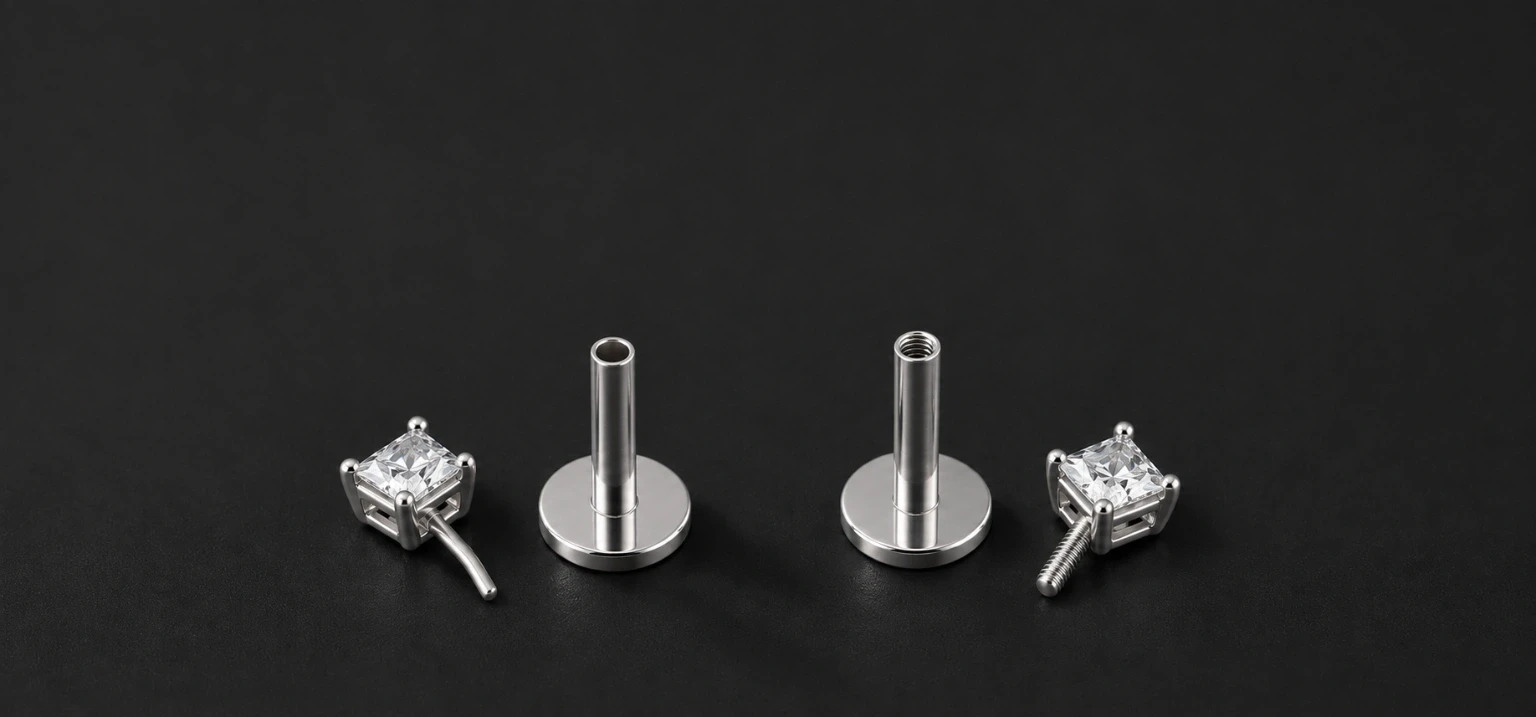
Threadless or press-fit
APP: friction and spring tension hold the decorative pin inside its smooth post.
Internally threaded
APP: the end screws into the smooth post; its threads do not travel through tissue.
Externally threaded
APP: exposed post threads can scrape the piercing channel.
APP accepts high-quality internally threaded and threadless options for initial piercings. Its guidance makes jewelry size, material, quality and smooth finish as important as the closure system itself.
THE PIN HOLDS THE END
How does threadless jewelry stay in without a screw?
NeoMetal, which introduced threadless body jewelry in 1997, explains that a slightly bent pin on the decorative end creates friction and tension inside the post. No screw is involved.
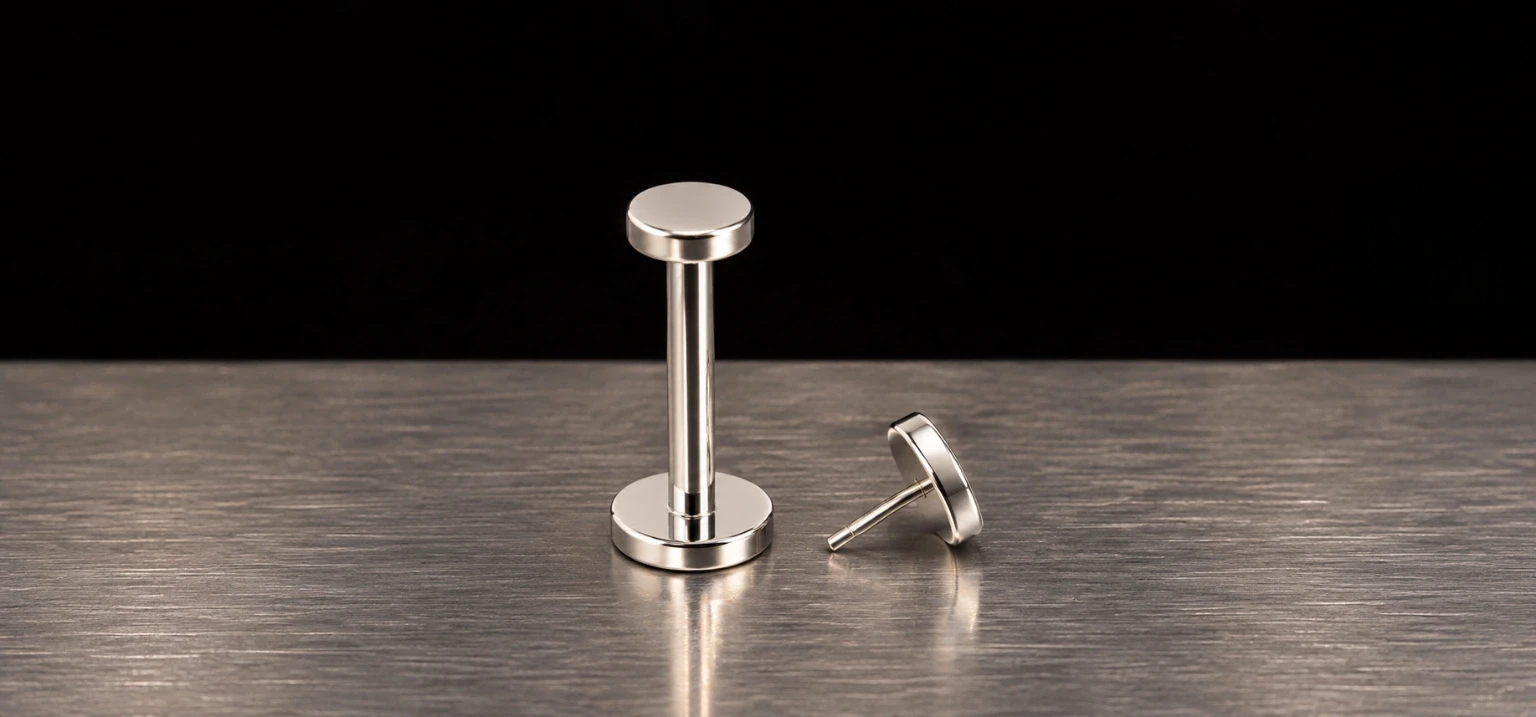
NeoMetal says a larger bend increases tension and a smaller bend loosens it. Different jewelry shapes need different adjustments.
Threadless does not mean a loose decorative end
APP describes press-fit jewelry as held together by friction and spring tension. A properly assembled end should sit snugly; if it repeatedly opens or develops a gap, have a piercer inspect its tension and component fit.
A threadless end may be a flat disk, a gem, a ball or another ornament. The appearance of the top does not tell you whether the post is the correct gauge or length for your anatomy. See our body jewelry size guide for measurement terminology.
TWO ACCEPTED OPTIONS
Threadless vs internally threaded jewelry: which is easier to use?
APP accepts both systems for appropriate initial piercings. Compare their attachment method, fit and the ease of checking each connection rather than declaring one universally better.
| Question | Threadless / push-in | Internally threaded |
|---|---|---|
| What holds the end? | Pin tension and friction inside the shaft. | Matching screw threads on the end and inside the post. |
| What passes through tissue? | A smooth post without exposed threads. | A smooth post with an internal threaded opening. |
| How is the end removed? | NeoMetal: pull it apart; add slight twisting motion if tight. | Hold the post and unscrew the matching removable end. |
| How is it secured? | Properly fitted pin with the required tension, pressed fully in. | Compatible threads engaged and end seated without gaps. |
| Initial piercing? | APP accepts appropriate threadless jewelry. | APP accepts appropriate internally threaded jewelry. |
| Common fit issue? | Loose pin tension or incompatible end. | Loose end or incompatible threaded connection. |
| Professional assistance? | Changes during healing and difficult removals. | Changes during healing and difficult removals. |
Choose a closure system you understand and a qualified piercer can support. The construction does not replace the importance of anatomy-specific size, material and surface finish.
NEW PIERCING OR HEALED?
Can you change threadless or internally threaded jewelry in a new piercing?
Changes during healing belong to a qualified piercer. APP advises keeping suitable initial jewelry in place unless size, style or material needs professional adjustment.
| Piercing condition | What APP recommends | Practical next action |
|---|---|---|
| Fresh or still healing | Leave suitable initial jewelry in; see a qualified piercer for needed changes. | Book a professional fit and closure check. |
| Healing and jewelry is too long | A qualified piercer may perform a downsize before healing ends. | Ask about post length, swelling room and new jewelry. |
| Healed, comfortable, not crusting | APP says home replacement may be an option with clean hands, jewelry and work area. | Make a gentle change only if the connection and fit are understood. |
| Jewelry resists or the channel tightens | Never force insertion; visit a piercer for help. | Stop and arrange professional assistance. |
Read our piercing aftercare guide for why a piercing can seem healed before the channel is ready. APP says even a healed piercing can shrink or close quickly when left empty.
FOR FULLY HEALED PIERCINGS
How do you remove a threadless flat-back earring or nose stud?
NeoMetal says to pull the end away from the shaft, adding a slight twisting motion if tight. APP's home-change precautions apply only after the piercing is fully healed; never force a stuck end.
Confirm the piercing is healed
APP: the piercing must be healed, comfortable and no longer crusting.
Clean the hands, jewelry and work area
APP: clean your hands, the jewelry and work area.
Stabilize the post
Identify and steady the post before separating its end.
Separate the end from the shaft
NeoMetal: pull apart; add a slight twist only if tight.
Stop rather than force a stuck piece
APP: never force stuck jewelry. Visit a piercer if it resists.
Keep the channel occupied when appropriate
APP: channels can shrink quickly; arrange help if needed.
PROFESSIONAL PIN FIT
How do you insert a threadless end and adjust its tension?
NeoMetal explains a pin-bending procedure for its own straight barbells and labret posts. Piercers adjust the pin's bend to create a secure tension fit, following the actual jewelry manufacturer's method.
Check end and post compatibility
Confirm matching end, pin and post components.
Test the pin partway in the shaft
NeoMetal starts with the pin one third inside the shaft.
Set the manufacturer's recommended bend
NeoMetal's straight-post example uses a 10–20-degree bend. Other shapes differ.
Press the pin fully into the shaft
NeoMetal says to push the pin fully into the shaft.
Have the piercer correct loose or excessive tension
A piercer checks tension; more bend grips harder, less bend loosens it.
For a routine decorative end change in a fully healed piercing, a compatible post may remain in place. For a new piercing or fit change, APP directs the client to a qualified piercer.
A DIFFERENT CLOSURE MECHANISM
How do you change an internally threaded labret or barbell end?
Internally threaded ends unscrew from matching threads inside the post. APP says healed-piercing changes require clean hands and gentle insertion, while changes during healing belong to a piercer.
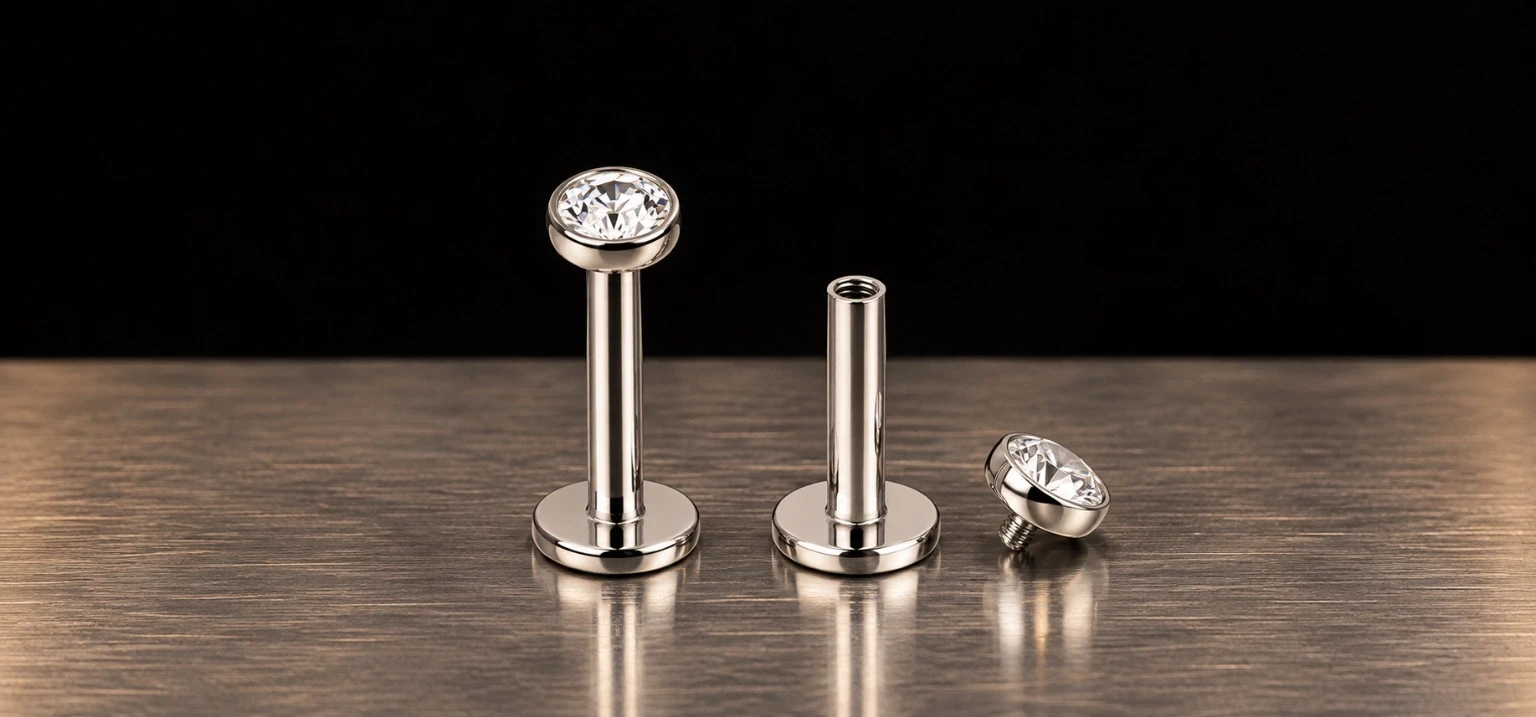
Confirm healing and clean the area
APP: home changes are for fully healed, comfortable piercings.
Identify the removable threaded end
Hold the post steady so it does not tug through tissue.
Loosen the screw connection gently
Gently unscrew the end. Stop if it resists or misaligns.
Match the new end to the post
APP: use a matching threaded end without gaps.
Secure the replacement and inspect it
Seat the replacement securely; ask a piercer if it will not fit.
The method differs from threadless jewelry: do not push a threaded end into a smooth press-fit shaft or attempt to screw a pin that is held by friction.
WHEN THE END WILL NOT MOVE
Why will my threadless jewelry not come out, or why is a threaded end stuck?
A threadless end can resist because of strong pin tension; a threaded end has a different screw connection. APP warns against forcing jewelry, so stop and consult a piercer if it remains stuck.
Threadless end feels firmly attached
NeoMetal suggests pulling apart, with slight twisting if tight. Stop if it still resists.
Threaded end will not turn comfortably
Ask the piercer to identify and inspect the screw connection rather than forcing it.
End keeps falling out
APP says repeated loosening may indicate a defective end; request a fit check.
Post will not go back in
APP warns channels can shrink quickly. Ask a piercer for reinsertion help.
A stuck end in a healing piercing is a piercer visit
Do not invent a home tool or grip trick to force a jewelry change while the piercing is still healing. APP reserves healing-stage jewelry changes for qualified piercers.
FOR TRAINED PIERCERS
What is an insertion pin or taper for threadless and internally threaded jewelry?
APP calls tapers professional insertion instruments, not force tools. NeoMetal explains that a taper pin can guide a matching threadless labret post; internal-threaded jewelry uses an appropriately matched connection.
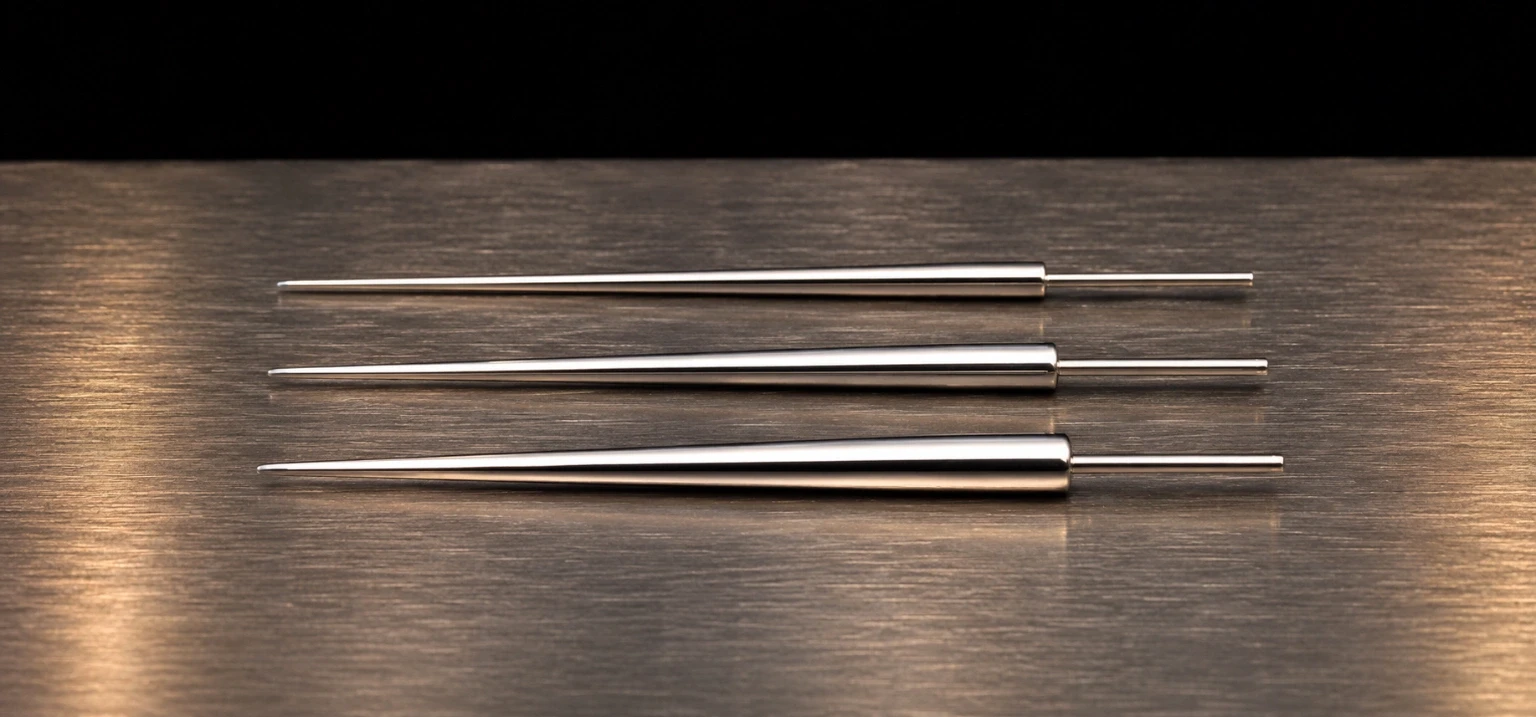
| Tool | Connection purpose | Important limit |
|---|---|---|
| Threadless insertion pin | Helps a professional guide compatible threadless jewelry into place. | It is an insertion instrument, not a wearable piece or a home force tool. |
| Internally threaded insertion pin | Uses a compatible connection for an internally threaded jewelry change. | Check the tool and jewelry dimensions and have a trained piercer use it. |
| Other insertion taper shapes | APP describes tapers with different end shapes for different jewelry systems. | The tool must actually match the jewelry; it is not universally interchangeable. |
SVT Shop lists sterilized insertion pins for both connection systems. The threadless version is a single-use professional tool; the internally threaded steel pin is listed in 1.2 mm and 1.6 mm options. A qualified piercer chooses the correct instrument for the actual jewelry and piercing.
CHECK BEFORE MIXING COMPONENTS
Do all threadless ends fit every post, and does gauge matter?
NeoMetal says its own threadless ends fit its 18, 16, 14 and 12 gauge posts. Do not apply that compatibility claim to other brands; verify the exact connection, gauge and post length.
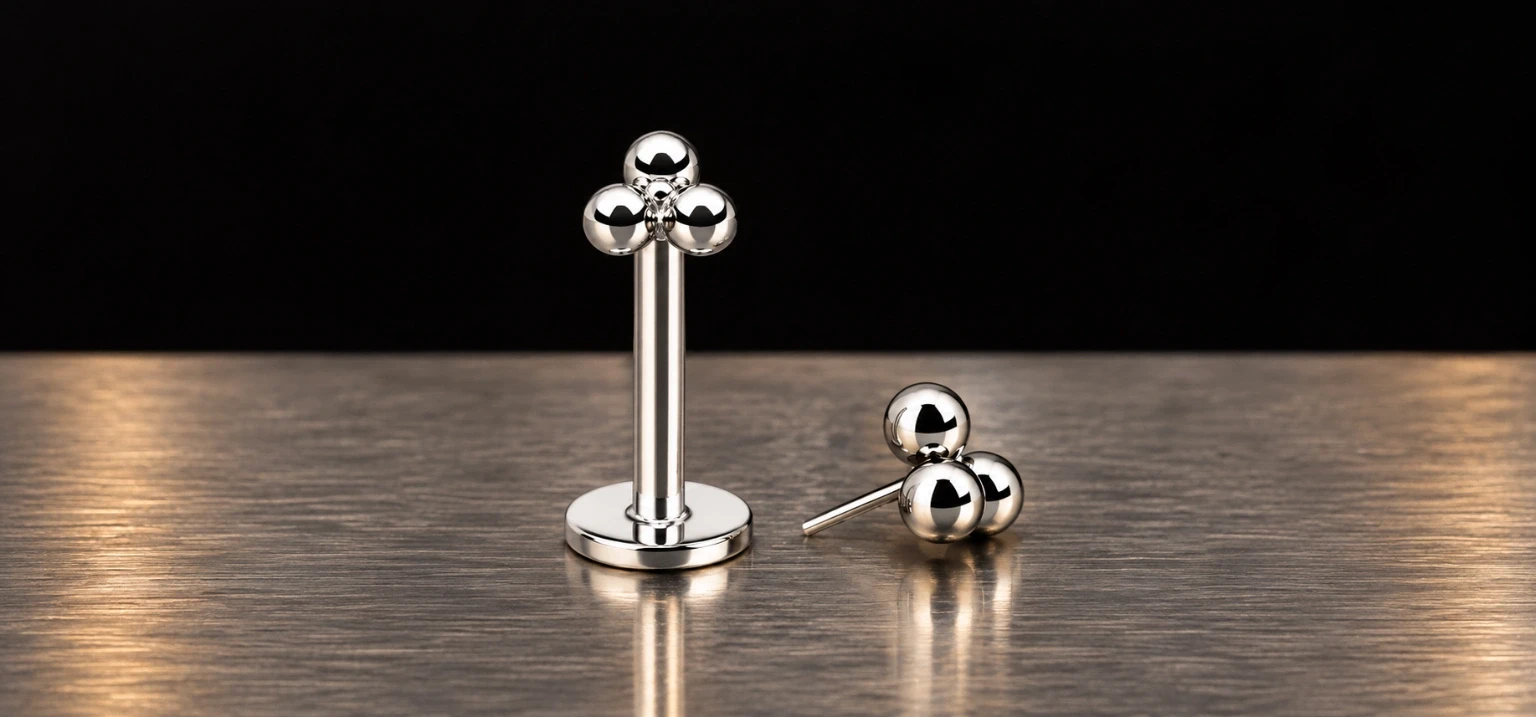
Three measurements and compatibility checks
- Gauge: The thickness of the post; NeoMetal's stated compatibility applies to its own products.
- Wearable length: The dimension the piercer chooses for the tissue and stage of healing, independent of the decorative top.
- End connection: Threadless pins and internal screws must match the corresponding post and manufacturer specifications.
- Decorative size: The end also needs to suit the anatomy and the intended piercing placement.
APP warns that a post too short can embed, while jewelry that is too long can snag and cause trauma. Good component compatibility does not correct an unsuitable length. See our body jewelry sizing guide before asking the piercer to select a replacement.
THE CLOSURE IS ONLY ONE REQUIREMENT
What material and finish should you choose for a new piercing?
APP prioritizes correct fit, a polished surface and suitable material, including titanium meeting ASTM F-136 or F-67 and qualifying steel such as ASTM F-138. The closure alone does not determine quality.
SVT Shop High Polish jewelry and new piercings
The sterilized titanium options below are suitable candidates for new piercings because they come sterilized, but the client's trusted piercer decides whether the specific piece's material grade, length, gauge, end and finish meet the requirements of the placement. Sterilization and a High Polish description are only part of that selection.
Read SVT Shop's implant-grade titanium and sterilized jewelry guide to understand the material terminology before comparing closures.
AVOID THE COMMON ERRORS
What mistakes cause threadless or internally threaded jewelry changes to go wrong?
APP and NeoMetal emphasize matching the closure mechanism, using compatible components and never forcing jewelry through a resistant piercing.
Trying to unscrew threadless jewelry
NeoMetal: threadless pins do not screw on. Gently pull apart when appropriate.
Pulling the entire post during an end change
APP warns a piercing may shrink after jewelry removal. Keep the post stable when changing only the top.
Changing a still-healing piercing at home
APP: a piercer handles changes and downsizes during healing.
Overbending a threadless pin
NeoMetal cautions against overbending; other designs may need different bends.
Mixing unconfirmed ends and posts
NeoMetal's cross-gauge fit applies to its own parts, not all brands.
Using external threads or forcing insertion
APP discourages exposed threads for new piercings and forcing jewelry through tissue.
SVT SHOP HIGH POLISH SELECTION
Which threadless labrets, internally threaded barbells and insertion tools should you compare?
SVT Shop lists sterilized High Polish titanium labrets and barbells for both systems, plus professional insertion pins. Have a qualified piercer confirm the specific gauge, length, finish, material grade and connection before use.
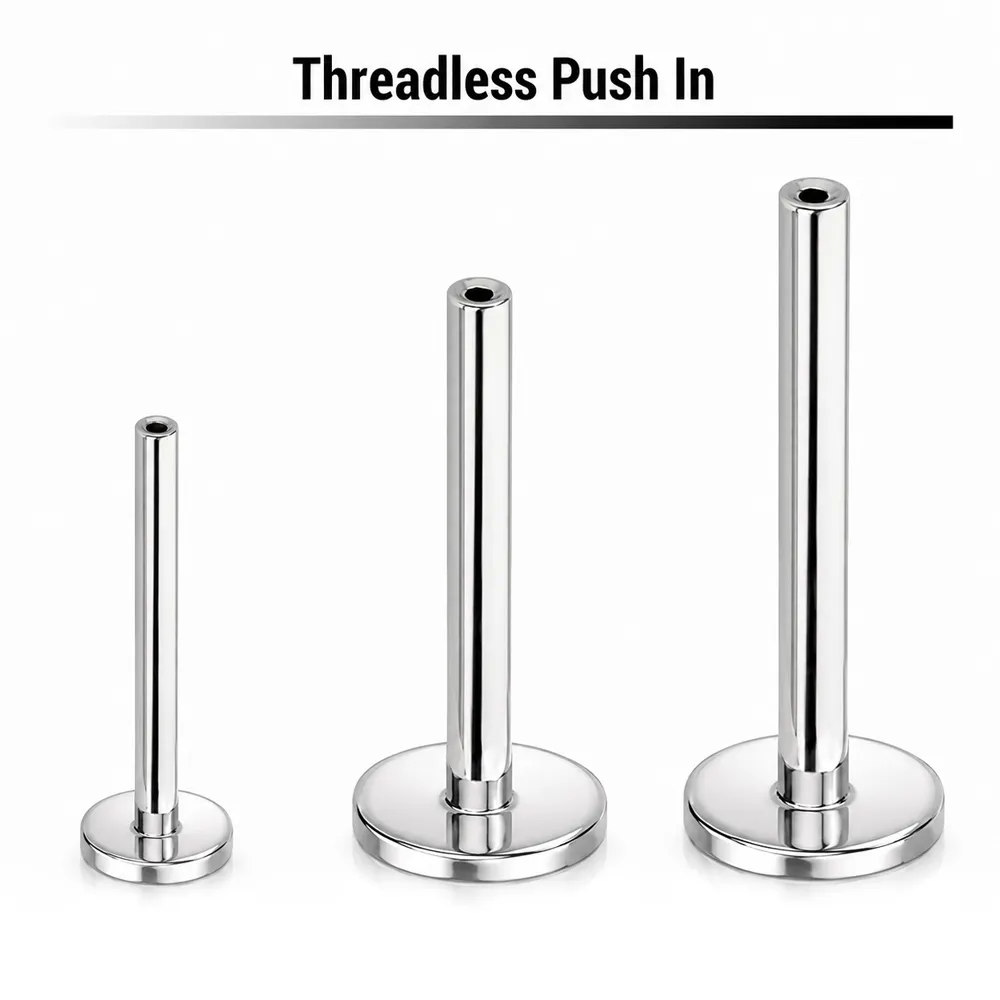 Threadless post without decorative end
Sterilized Titanium High Polish Threadless Push In Labret Post
Separate High Polish titanium post without a top. Your piercer selects length, gauge and a matching end.
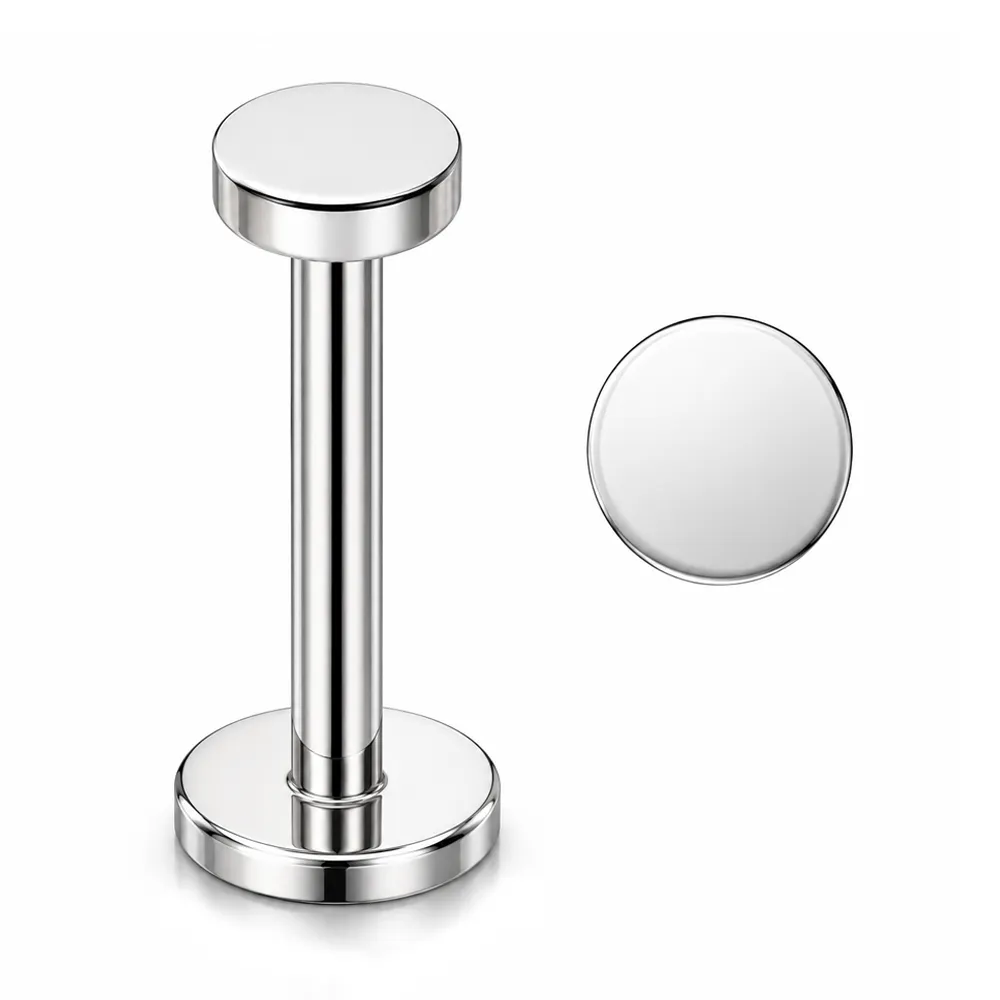 Threadless flat-back example
Sterilized Titanium High Polish 3mm Disk Labret Threadless
Threadless flat-back titanium labret with a 3 mm disk top for comparison.
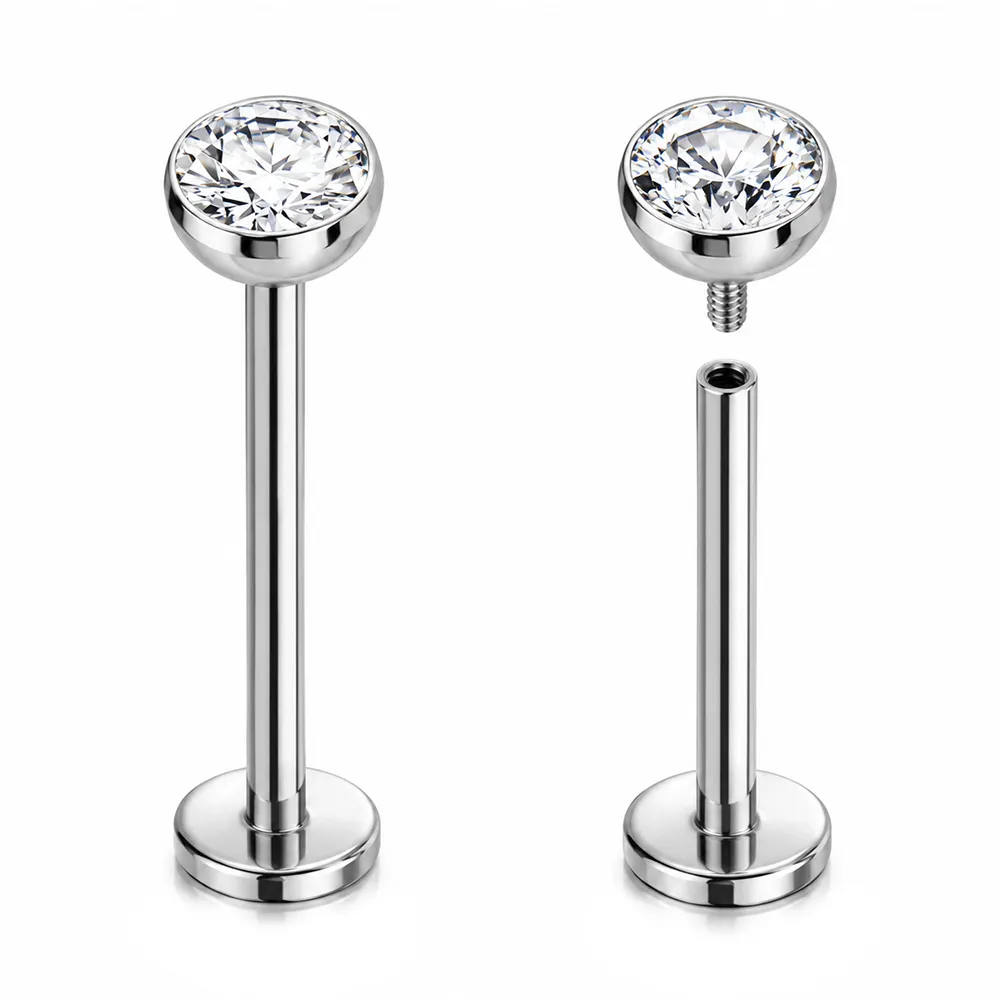 Fine-gauge threadless example
Sterilized Titanium High Polish Jewel Ball Labret 0.8mm Threadless
Threadless titanium labret with a listed 0.8 mm post; the piercer determines gauge suitability.
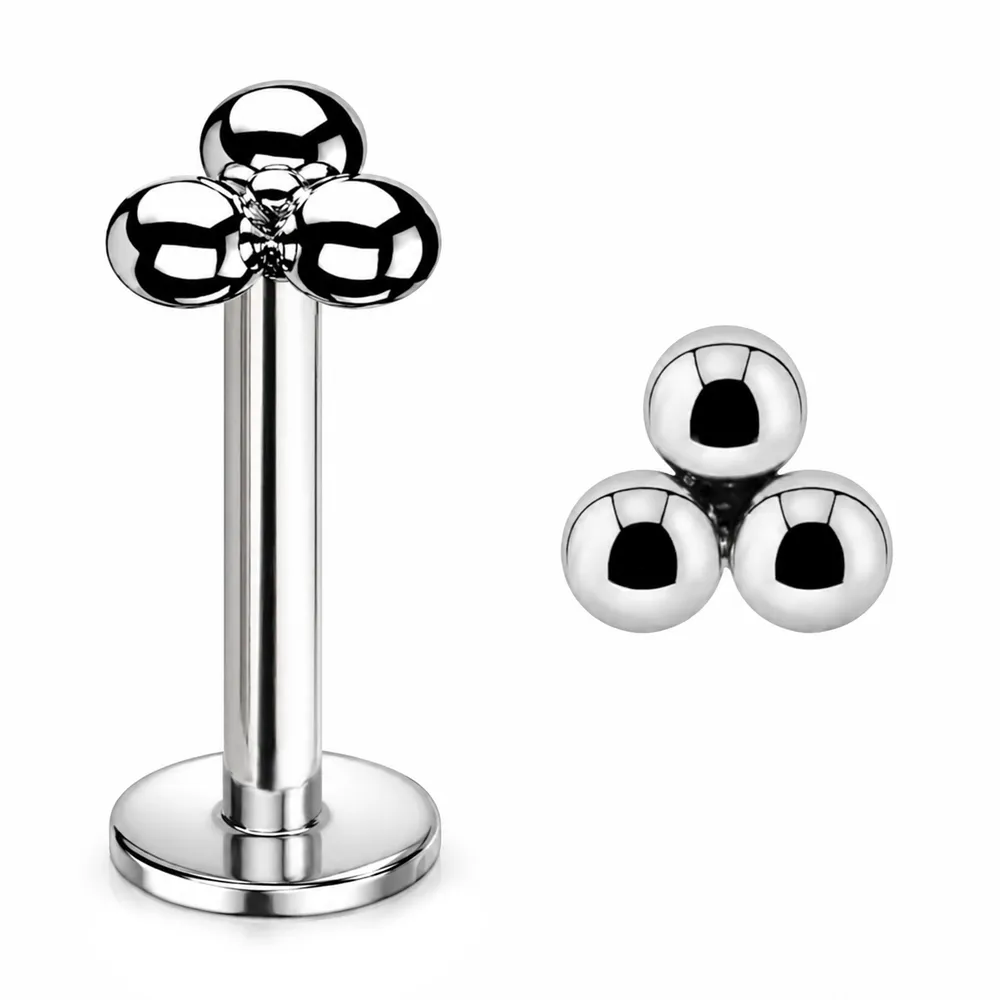 Decorative threadless style
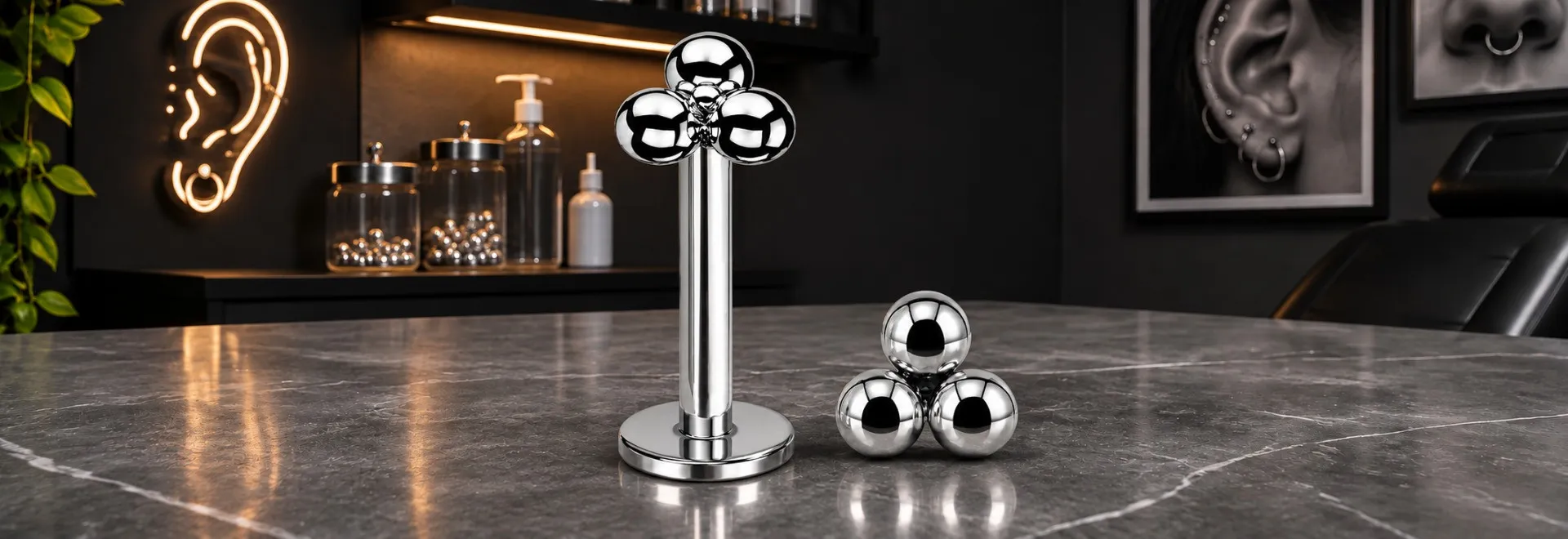
Sterilized Titanium High Polish Trinity Labret Threadless
Sterilized titanium labret with a decorative trinity top and push-in connection.
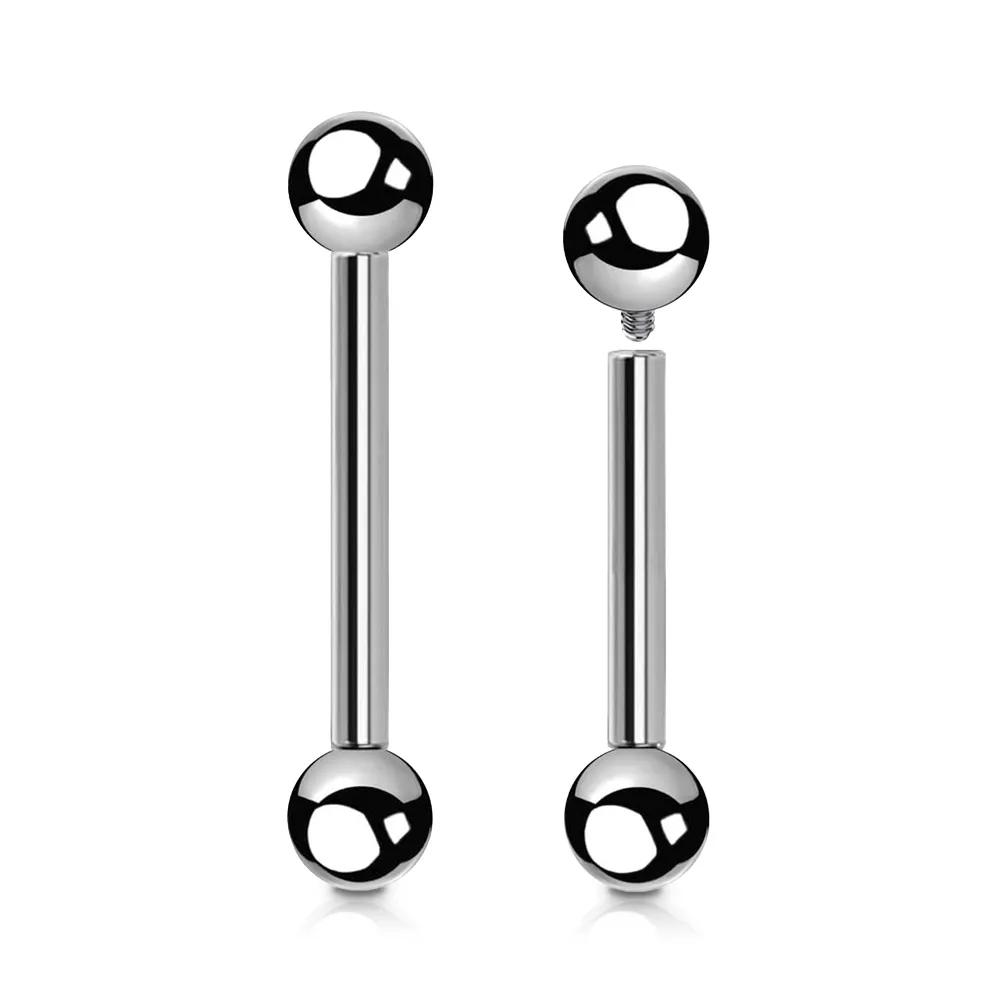 Internally threaded barbell example
Sterilized Titanium Straight Barbell
High Polish titanium straight barbell with internal threads and 3 mm balls.
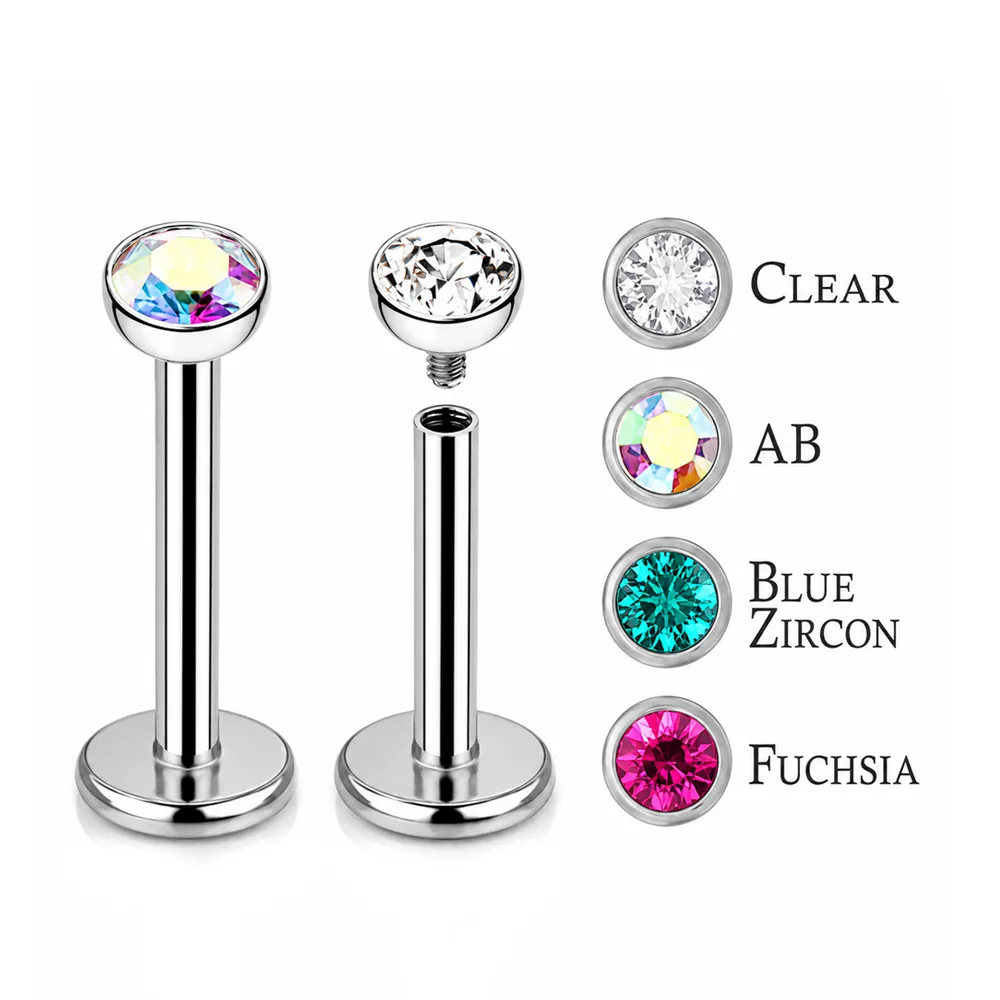 Internally threaded labret example
Sterilized Titanium CZ Ball Top Internally Threaded Labret
Sterilized titanium labret with a CZ top and an internal screw connection.
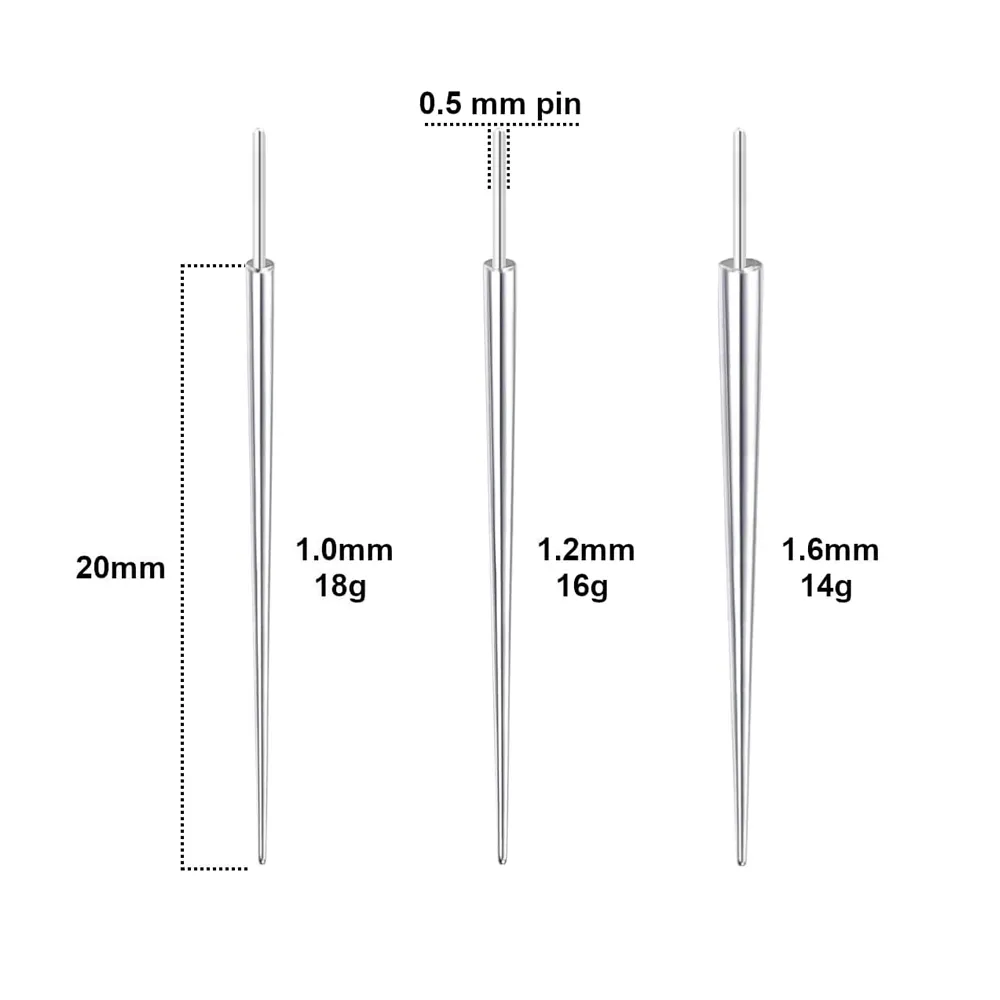 Professional threadless insertion tool
Sterilized Insertion Pin for Threadless Body Jewelry
Sterilized 20 mm single-use steel insertion tool for qualified piercers, not a wearable piece.
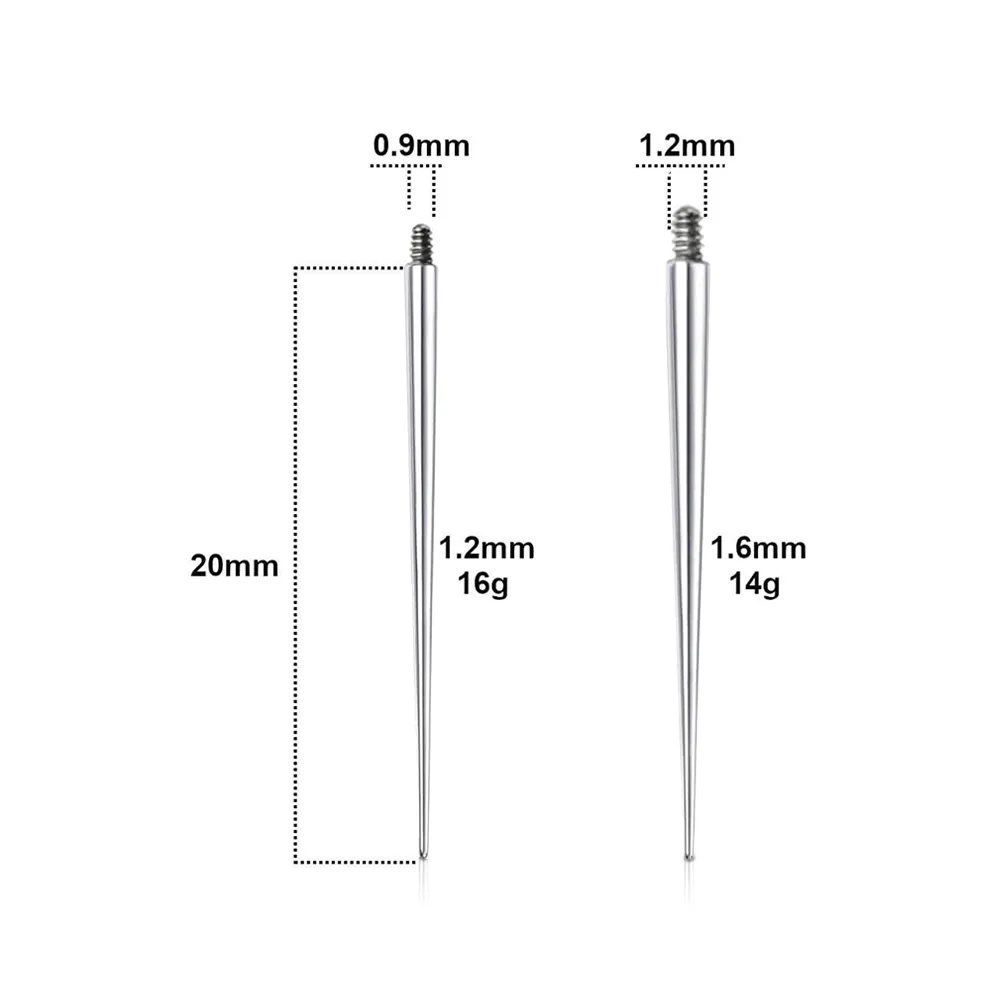 Professional internally threaded insertion tool
Sterilized Insertion Pin for Internally Threaded Body Jewelry
Sterilized 20 mm steel pin with listed 1.2 mm and 1.6 mm variants for qualified piercers.
Shop Sterilized Piercing Jewelry Shop Labrets
For shape comparisons beyond labret connections, see our nose jewelry types guide and our captive bead, segment ring and clicker comparison.
BEFORE YOU PURCHASE OR CHANGE
What should you check before buying a new piercing end or post?
Check the connection type, fit and healing stage before choosing the decorative look. APP emphasizes anatomy-specific sizing, while NeoMetal illustrates system-specific compatibility.
- Closure: Is this a tension-fit threadless end or an internally threaded screw end?
- Post: Does the new piece fit the existing system and manufacturer requirements?
- Gauge and length: Are they appropriate for the piercing rather than chosen only for appearance?
- Surface and material: Is the jewelry smooth and appropriately certified for the intended stage?
- Security: Will the end seat fully without a gap or repeated loosening?
- Healing: Is the piercing still healing, meaning the change belongs with a qualified piercer?
- Tool: Is an insertion pin necessary, and has a professional chosen the compatible instrument?
SVT Shop serves piercing artists and clients in El Paso, TX, with Next Day Delivery available in El Paso.
FAQ
12 questions about threadless and internally threaded piercing jewelry
APP provides piercing-jewelry and healing guidance; NeoMetal explains its manufacturer's threadless pin mechanism.
1. What is threadless piercing jewelry?
Threadless jewelry uses a bent decorative pin held by friction in a smooth post, according to NeoMetal. It has no screw threads.
2. Is threadless better than internally threaded jewelry?
APP accepts both for initial piercings. Threadless uses pin tension; internally threaded ends screw into a smooth post. Choose by fit and quality.
3. Are threadless earrings secure?
NeoMetal says more pin bend increases retention. Ask your piercer to inspect an end that repeatedly loosens.
4. How do I remove a threadless flat-back earring or nose stud?
For a fully healed piercing, NeoMetal advises pulling the end from the post, adding a slight twist if tight. Never force it.
5. Why will my threadless end not come off?
The pin's retention tension may be high. If gentle removal fails, see a piercer, especially during healing.
6. Can I change threadless jewelry in a new piercing?
APP advises a qualified piercer for any downsizing or jewelry change while the piercing is healing.
7. What is a piercing insertion pin or taper?
APP calls tapers professional instruments; NeoMetal says a taper pin guides a compatible threadless post into place.
8. Why are externally threaded posts not recommended for new piercings?
APP warns exposed threads can scrape the channel. Smooth internally threaded and threadless posts are preferred for new piercings.
9. How do you tighten a threadless end?
NeoMetal describes bending its own labret pin before pressing it fully into the shaft. Let your piercer adjust recurring looseness.
10. Do you need a tool to remove threadless jewelry?
NeoMetal describes pulling a press-fit end apart. A piercer uses appropriate tools when a change or reinsertion is difficult.
11. Are all threadless ends interchangeable?
NeoMetal says its own ends fit its 18, 16, 14 and 12 gauge posts. Check other manufacturers' compatibility separately.
12. How often should I check piercing jewelry tightness?
APP recommends regular checks of both systems and daily checks of threaded ends, using clean hands.
RESEARCH
Sources Consulted
APP sets out the closure and initial-jewelry standards, aftercare and healed-piercing guidance. NeoMetal explains the construction, tension and manufacturer-specific pin-bending method used in its threadless jewelry.
- Association of Professional Piercers (APP): Jewelry for Initial Piercings
- APP: Procedure Manual — Threading, Connections and Tapers
- APP: Suggested Aftercare for Body Piercings
- APP: Jewelry for Healed Piercings
- APP: Stretching and Professional Insertion Tapers
- NeoMetal: Guide to Threadless Jewelry
- NeoMetal: Threadless Pin Bending Guide