


 Powered by Comercia.io
PRODUCT BASICS
What Is Tattoo Numbing Cream?
Tattoo numbing cream is a topical product designed to reduce sensation at the skin's surface. Different formulas use different active ingredients, strengths, and application methods, so the term "numbing cream" does not describe one standardized product.
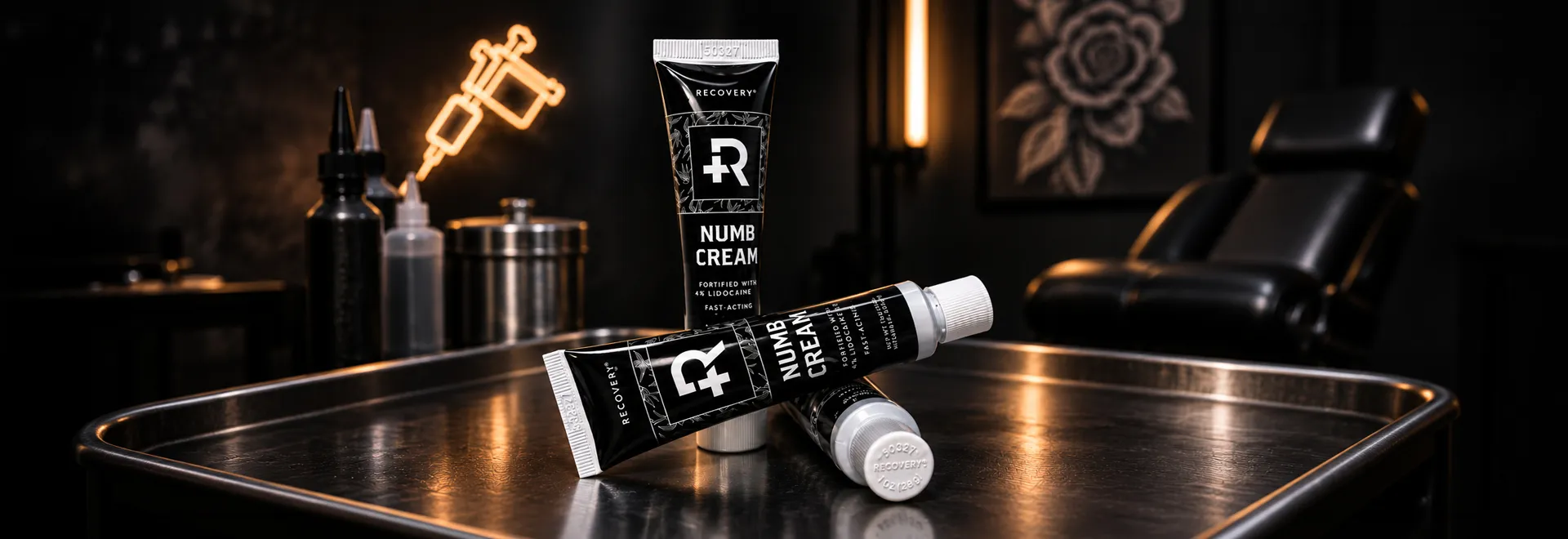
Recovery Numb Cream 1 oz contains 4% lidocaine, according to its published Drug Facts label. Lidocaine is a topical anesthetic. Recovery markets this cream for clients seeking reduced sensitivity around tattoo, piercing, and permanent makeup appointments, but that marketing description should be distinguished from the product's official labeled indications.
1 oz / 30 g tube, intended for external application.
The concentration listed in Recovery Numb's Drug Facts.
A manufacturer-described feature, not a promise about every client's skin.
What makes Recovery Numb different?
Recovery describes its cream as non-greasy, easy to massage into the skin, and free of epinephrine. The manufacturer associates the epinephrine-free formula with reduced concern about changes in skin texture during tattoo work. That is a manufacturer claim; it should not be interpreted as proof that no artist or client will notice a difference in the skin.
Recovery also advertises relatively fast onset and relief lasting up to six hours. The wording "up to" matters: it is a marketing statement about a potential upper duration, not a guaranteed session length, a fixed personal result, or an instruction to keep the product on the skin for six hours.
The official Drug Facts for Recovery Numb list temporary relief of pain and itching associated with minor skin conditions; tattoo pain is not listed as an approved OTC indication. Read the label, and ask a medical professional about use in connection with a tattoo procedure if you are uncertain.
TIMING GUIDE
How Long Before a Tattoo Should You Apply It?
The most useful answer comes from the specific product's published instructions, not from a general social-media rule. Recovery's application protocol says to apply its cream approximately 15–20 minutes before the procedure and states that peak action begins at about that point.
Online discussions frequently mention waiting 45, 60, or even 90 minutes with various products. Those anecdotes may involve different formulas, preparation methods, and client experiences. They should not replace Recovery's instructions or the Drug Facts printed on your tube.
Tell your artist the exact product name, ingredient strength, and that you are considering using it.
Recovery's published protocol describes the pre-procedure application window on intact skin.
Remove remaining product and allow the artist to complete the normal antiseptic preparation and stencil workflow.
Count backward from needle time, not just arrival time
Tattoo appointments often include design review, sizing, placement, stencil adjustments, and workstation preparation. An application scheduled for "20 minutes before the appointment" may not be 20 minutes before actual tattooing. Coordinate the sequence with the artist rather than guessing at home.
For a large design, an artist may decide that numbing is unnecessary, unsuitable, or worth discussing for one specific area. More skin coverage should never automatically mean using more cream or leaving it on longer.
MANUFACTURER INSTRUCTIONS
How to Use Recovery Numb Cream: Step by Step
The steps below summarize Recovery's published Recovery Numb Application Protocol and its product information. They describe the manufacturer workflow; they do not substitute for the actual package label, medical advice, or your tattoo artist's approval.
-
Get approval before the session.
Give the artist the product name and ask whether topical numbing fits their process. Discuss stencil timing and whether the artist prefers to handle the application.
-
Read the label and check the application site.
Use only as permitted by the product's Drug Facts. The Recovery protocol says to avoid open wounds, exposed tissue, and sensitive internal areas. Do not treat a freshly tattooed surface as intact skin.
-
Use the manufacturer's amount guidance cautiously.
The protocol illustrates approximately a US quarter-dollar-sized amount for a 4-by-4-inch area. It also contains separate gram-based guidance that is not straightforward to reconcile, so do not improvise a larger dose or scale this example across a broad tattoo site. The same protocol lists 10 grams as its recommended maximum per application session; treat that as a ceiling, not a target. Ask the manufacturer or a clinician if the amount is unclear.
-
Distribute with a gloved hand.
Recovery describes spreading the cream evenly and massaging the intended area in circular motions for approximately 30–60 seconds. This is the manufacturer's technique description, not an instruction to rub irritated or damaged skin.
-
Follow the stated pre-procedure window.
The protocol describes peak action starting around 15–20 minutes. Do not substitute a longer time based on another brand's online instructions.
-
Remove the remaining cream.
Recovery directs users to remove residue with a sanitary damp cloth before the procedure. The artist then completes normal antiseptic skin preparation according to studio protocol.
-
Let the artist control the tattoo workflow.
Stencil placement, skin evaluation, and the start of tattooing belong to the professional conducting the session. Do not apply additional product to newly broken skin without medical guidance.
The sequence matters: cream application, residue removal, antiseptic prep, stencil placement, and tattooing are separate stages. Plan them with your artist so numbing product does not interfere with stencil transfer or the prepared working surface.
What about reapplication, plastic wrap, or warming the skin?
Recovery's published protocol discusses reapplication for longer procedures and mentions occlusive coverings and warm compresses as techniques that can increase absorption. Those statements require caution: the FDA advises consumers not to wrap skin treated with OTC topical pain-relief products and warns about application to broken or irritated skin, excessive amounts, and prolonged exposure. Recovery's own protocol also says to avoid open wounds.
For that reason, this guide does not recommend plastic wrapping, heating, self-directed extra doses, or reapplication onto skin already being tattooed. A clinician should answer questions about any plan that goes beyond the Drug Facts label, especially during a procedure that breaks the skin.
STUDIO REALITY
How Numbing Cream Fits Into an Artist's Workflow
Artists do not evaluate numbing products on ingredient strength alone. They also care about how the skin feels, how the stencil transfers, whether the client can remain comfortably positioned, and whether the product complicates preparation.
Stencil compatibility
Residue and repeated wiping can disrupt stencil preparation. The artist should determine when the stencil goes on and whether the skin is ready.
Skin feel
Recovery says its epinephrine-free formula is designed not to alter skin texture. Artists discussing numbing products generally report mixed experiences, so inspection still matters.
Session length
A manufacturer-stated maximum duration cannot guarantee relief throughout a long lining, shading, or color session. Breaks and realistic scheduling remain important.
Artist preference
Some artists welcome a product they know; others prefer not to work on numbed skin. A client's purchase should never override that professional decision.
Does numbing cream affect how a tattoo turns out?
There is no reliable basis for promising that every numbing cream either improves or damages the final tattoo. In professional discussions, some artists report changes in texture, surface moisture, or color-packing feel with particular products, while others say their sessions proceed normally. These observations are anecdotal and do not prove that Recovery Numb has the same effects.
The better question is practical: Has your artist worked with this formula, and are they comfortable using it for this tattoo? That conversation is more useful than assuming a positive result from the words "epinephrine-free" or "fast acting" alone.
PRODUCT TYPES
Numbing Cream vs. Numbing Spray vs. Skin Prep
These products are often mentioned together, but their jobs can be different. A cream such as Recovery Numb is a topical anesthetic formula. Numbing sprays vary widely and need their own label review. An antiseptic skin preparation product is intended for cleansing and preparation, not for numbing.
Recovery Antiseptic Skin Prep 30 oz, for example, is a separate product marketed by Recovery for skin preparation. The manufacturer lists 3% chloroxylenol in its formula. It is not interchangeable with Recovery Numb Cream, and it should not be described as providing anesthetic relief.
For studios, the operational distinction is simple: select each product for its stated purpose, check the relevant label, and avoid mixing up skin preparation with topical anesthesia. Clients should not substitute an unverified spray or cream just because a forum says it worked for someone else.
AT-A-GLANCE COMPARISON
Which Product Fits Which Job?
| OPTION | PRIMARY ROLE | WHAT TO VERIFY | PRACTICAL LIMITATION |
|---|---|---|---|
| Recovery Numb Cream 1 oz | 4% lidocaine topical cream; manufacturer markets it for pre-procedure numbing. | Drug Facts, manufacturer protocol, intact skin, artist approval. | Relief and duration are not guaranteed; tattoo pain is not a listed OTC label indication. |
| Numbing sprays | Product-dependent topical anesthetic format. | Exact active ingredient, concentration, labeled uses, directions, and skin restrictions. | One spray's instructions cannot be applied to another; use during tattooing may raise additional risks. |
| Recovery Antiseptic Skin Prep 30 oz | Antiseptic preparation; manufacturer lists 3% chloroxylenol. | Product directions and the studio's professional skin-prep protocol. | Not a numbing cream or a substitute for a topical anesthetic. |
| No numbing product | A standard option for sessions where numbing is unwanted or inappropriate. | Artist's guidance, planned tattoo duration, breaks, and comfort needs. | Does not offer topical anesthetic effects. |
Comparison is about intended workflow, not a clinical performance ranking.
REAL-WORLD CONVERSATIONS
What Tattoo Artists and Forums Say
Artist communities and tattoo-client forums provide useful context about expectations, but they are not clinical studies or controlled product tests. The discussions below concern numbing products in general; they should not be mistaken for verified reviews or performance measurements of Recovery Numb specifically.
Some artists notice differences in the working surface
In a professional tattoo-artist discussion, participants described mixed experiences with numbing creams and sprays. Some mentioned changes in skin feel, stencil behavior, or how color seemed to go in; others reported better client comfort. These are individual observations involving assorted products, not universal outcomes.
Read the artist discussionAsking first is the recurring recommendation
In a conversation about whether to use numbing cream for an inner-arm tattoo, replies repeatedly recommended contacting the artist before application. Some contributors said their artist accepts certain products; others noted that a studio may refuse a session if numbing cream was used without approval.
Read the client discussionClient expectations vary considerably
One tattoo client shared a detailed account of using numbing cream over multiple appointments, emphasizing that reduced sensation is not the same as a painless tattoo. Other discussions describe relief that fades sooner than expected. These accounts reinforce the importance of not planning an entire session around a promised number of hours.
Read the user experienceThe clearest pattern is communication, not a winning brand or a universal application time. Share the product and its directions with the artist, expect individual variation, and do not use another person's Reddit timing as your own instructions.
CHOOSING YOUR APPROACH
Recommendations for First-Timers and Experienced Clients
Start with the artist's plan
Ask about the expected session length, placement, breaks, and whether numbing is appropriate. Do not buy and apply a cream secretly because you are nervous about your first appointment. Your artist may prefer a normal session without topical anesthesia.
Discuss the specific challenge
If a previous session was difficult in one area, describe exactly what happened and ask about options for the next appointment. A targeted conversation about placement, pacing, and product suitability is better than assuming a stronger cream is the answer.
Evaluate the full prep sequence
Review the client's proposed product, Drug Facts, manufacturer instructions, site condition, stencil workflow, and studio policy. Do not translate marketing duration into a guarantee to the client or treat numbing as a replacement for breaks and communication.
For all three groups, the most useful buying criteria are transparent active ingredients, readable directions, appropriate packaging, a manufacturer you can verify, and acceptance by the professional performing the tattoo. A dramatic percentage or "pain-free" slogan is not a substitute for that information.
AVOID THESE PROBLEMS
Common Tattoo Numbing Cream Mistakes
- Using the wrong timing. Applying generic 60–90 minute advice to Recovery Numb instead of checking its 15–20 minute manufacturer protocol.
- Arriving without telling the artist. Discovering at stencil time that the studio does not allow an unapproved cream.
- Confusing appointment time with tattoo start time. Forgetting that consultation, stencil work, and adjustments may happen first.
- Leaving residue on the skin. Skipping the manufacturer's instruction to remove remaining cream before normal antiseptic preparation.
- Assuming "up to six hours" is guaranteed. Planning an entire long session around the most optimistic advertised duration.
- Adding more cream to get stronger results. Treating a topical anesthetic like a cosmetic lotion, applying across large areas, or increasing exposure time without guidance.
- Wrapping or heating the application. Following internet techniques despite FDA warnings about increased absorption from covering treated skin and the manufacturer's own caution about warming.
- Applying to fresh tattoo work. Overlooking instructions to avoid open wounds and the additional risks of use on broken skin.
- Confusing antiseptic prep with numbing. Treating Recovery Antiseptic Skin Prep as though it performs the same function as a lidocaine cream.
- Believing any formula guarantees unchanged skin texture. Ignoring artist feedback and the variability described in professional discussions.
LABEL FIRST
Important Label and Safety Notes
Recovery Numb's official Drug Facts identify the product as a 4% lidocaine topical anesthetic for temporary relief of pain and itching from listed minor skin conditions. The label says it is for external use only and warns against use near the eyes or in large quantities, especially on raw or blistered surfaces.
The FDA has separately warned about topical pain-relief products marketed for cosmetic procedures, including tattooing. Its consumer recommendations include avoiding OTC topical pain-relief products containing more than 4% lidocaine, avoiding heavy application over large or damaged areas, and not covering treated skin with plastic wrap or dressings.
Consult a doctor or pharmacist before use if you have questions about your health, other medications, the product's ingredients, or a tattoo-related application that is not covered by the Drug Facts. Stop use and seek medical advice if an allergic reaction or increasing irritation occurs. Follow the package label if it differs from any online description.
Keep the product out of children's reach and store it according to the label; the published Drug Facts specify room temperature of 68–77°F (20–25°C). The manufacturer's application protocol, its marketing copy, and the official Drug Facts are different documents: where directions seem unclear or inconsistent, the physical package label and professional medical guidance should take precedence.
BEFORE YOU BUY
Tattoo Numbing Cream Buying Checklist
A good buying decision begins with the tattoo plan, not a claim about how many hours a tube will work. Use this quick checklist before choosing Recovery Numb or comparing other products.
- My tattoo artist knows the exact product and approves the plan.
- I have checked the active ingredient and concentration on the actual package.
- I know the manufacturer's instructions are specific to this formula.
- I understand the difference between a marketed duration and an individual outcome.
- I have a clear plan for residue removal, professional antiseptic prep, and stencil placement.
- I will not use excessive amounts, wrap the treated skin, or apply to broken skin.
- I know which questions belong with my artist and which require a doctor or pharmacist.
- I am choosing a product for its documented purpose, not simply the strongest marketing claim.
Keep the manufacturer's product information and Drug Facts accessible, distinguish numbing products from cleansing products, and have a consistent client communication process before an appointment begins.
SHOP WITH A CLEAR PLAN
Explore Recovery Numb and Skin Prep at SVT Shop
SVT Shop helps tattoo artists, apprentices, and studios find practical supplies for their workflow. Based in El Paso, Texas, SVT Shop offers next-day delivery options in El Paso. Delivery eligibility and order details should be confirmed at checkout.
Recovery Numb Cream 1 oz
Explore the 4% lidocaine topical cream discussed in this guide. Review its product information and the actual package Drug Facts before use.
VIEW NUMB CREAMRecovery Antiseptic Skin Prep 30 oz
A separate product for skin-preparation workflows, not topical numbing. Check its directions and your studio's standard procedure.
VIEW SKIN PREPComparing formats? Browse Numbing Creams & Sprays at SVT Shop.
BUYER QUESTIONS ANSWERED
Frequently Asked Questions
How long before a tattoo do you put on Recovery Numb Cream?
Recovery's published application protocol states approximately 15–20 minutes before the procedure and describes peak action beginning in that window. This is the manufacturer's stated timing, not a guarantee or a rule for other creams. Confirm the plan with your artist and check the actual Drug Facts label.
Is Recovery Numb Cream 1 oz a 4% lidocaine product?
Yes. The official Recovery Numb Drug Facts list lidocaine 4% as the active ingredient. The 1 oz tube contains 30 g of cream; the tube size is not a recommended single-application amount.
Can I apply numbing cream before leaving home?
Do not decide that without consulting your tattoo artist. Arrival time and actual tattoo start time may differ, and the artist may prefer to supervise skin preparation. Also consult a clinician if the intended tattoo-related use is not addressed by the package's labeled directions.
Should numbing cream be covered with plastic wrap?
No plastic-wrap method is recommended in this guide. The FDA warns that covering skin treated with OTC topical pain-relief products can increase absorption and the risk of serious side effects, even though some older manufacturer materials and forum posts discuss occlusion.
Will Recovery Numb make a tattoo completely painless?
Do not expect a guaranteed result. Recovery advertises reduced sensitivity and relief lasting up to six hours, but individual response, tattoo location, and session conditions vary. Its marketed duration is not a promise that a client will feel no pain.
Does numbing cream change skin texture or affect tattooing?
Recovery says its epinephrine-free formula is designed not to change skin texture. In artist forums, experiences with assorted numbing products are mixed. Discuss the specific formula with your artist rather than assuming every cream behaves alike.
Can I reapply Recovery Numb after tattooing has started?
Do not apply it to newly tattooed or otherwise broken skin on your own. Although Recovery's older application protocol mentions reapplication for procedures lasting over 60 minutes, the Drug Facts warn against large quantities on raw areas, and the FDA cautions about absorption through damaged skin. Ask a medical professional rather than treating that protocol note as permission to reapply.
Does Recovery Numb need to be wiped off?
Yes. The published application protocol instructs users to remove remaining cream with a sanitary wet cloth before the procedure, followed by the normal antiseptic preparation. Your artist should coordinate that step with stencil placement.
Is Recovery Antiseptic Skin Prep the same as Recovery Numb?
No. Recovery Numb is a topical anesthetic cream containing 4% lidocaine. Recovery Antiseptic Skin Prep is marketed for antiseptic cleansing and preparation, with 3% chloroxylenol listed by the manufacturer. The products serve different roles.
Which is better for a first tattoo: a numbing cream or spray?
Neither format is automatically better. Choose only after your artist approves the plan and you have reviewed the exact product's ingredient strength, directions, and labeled uses. If there is no appropriate product for your situation, proceeding without numbing is also an option.
What should I do if the cream causes irritation?
Stop using the product and follow the package warnings. Recovery's Drug Facts direct users to consult a doctor if an allergic reaction or increasing redness, swelling, irritation, or pain occurs. Ask a medical professional about any concerning symptoms.
RESEARCH & VERIFICATION
Sources Consulted
Manufacturer statements, official label information, regulatory guidance, and anecdotal artist discussions were reviewed separately. Sources are provided so readers can examine the original context.
- Recovery Aftercare — Numb Cream 1 ozManufacturer description, formula details, and advertised performance.
- Recovery — Numb Cream Application Protocol (PDF)Published timing, application sequence, and protocol cautions.
- DailyMed — Recovery Numb Lidocaine 4% Drug FactsOfficial labeled ingredients, uses, warnings, directions, and storage.
- U.S. FDA — Warning About Certain Topical Pain-Relief ProductsConsumer guidance related to cosmetic procedures and lidocaine absorption.
- Recovery Aftercare — Antiseptic Skin Prep 30 ozManufacturer details for the separate skin-preparation product.
- Reddit r/TattooArtists — Numbing Creams, Gels, and SpraysProfessional anecdotes about workflow, skin feel, and client experiences.
- Reddit r/tattooadvice — Thoughts of Numbing CreamCommunity emphasis on asking the tattoo artist first.
- Reddit r/tattoo — Properly Using Numbing CreamOne client's experience and expectations; anecdotal, not clinical evidence.
Editorial note: Last updated November 12, 2026. Manufacturer claims are identified as such; community comments are anecdotal. This article provides product education, not individual medical advice or a guarantee of numbing, tattoo outcomes, or health results. Consult your tattoo artist and, when appropriate, your doctor or pharmacist.